Multiple myeloma
Active Ingredient: Ixazomib
Indication for Ixazomib
Population group:
only
adults (18 years old or older)
Therapeutic intent: Curative procedure
Ixazomib in combination with lenalidomide and dexamethasone is indicated for the treatment of adult patients with multiple myeloma who have received at least one prior therapy.
For this indication, competent medicine agencies globally authorize below treatments:
4 mg once a week on days 1, 8, and 15 of a 28-day treatment cycle
For:
Dosage regimens
Oral, 4 milligrams ixazomib, once every 7 days, 3 doses in total, over the duration of 28 days. This step is repeated 1 to 24 times.
Detailed description
The recommended starting dose of ixazomib is 4 mg administered orally once a week on Days 1, 8, and 15 of a 28-day treatment cycle.
The recommended starting dose of lenalidomide is 25 mg administered daily on Days 1 to 21 of a 28-day treatment cycle.
The recommended starting dose of dexamethasone is 40 mg administered on Days 1, 8, 15, and 22 of a 28-day treatment cycle.
Dosing schedule. Ixazomib taken with lenalidomide and dexamethasone:
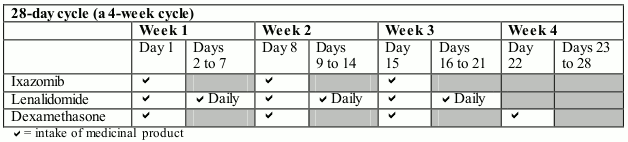
For additional information regarding lenalidomide and dexamethasone, refer to the Summary of Product Characteristics (SmPC) for these medicinal products.
Prior to initiating a new cycle of therapy:
- Absolute neutrophil count should be ≥1,000/mm³
- Platelet count should be ≥75,000/mm³
- Non-haematologic toxicities should, at the physician's discretion, generally be recovered to patient's baseline condition or ≤ Grade 1
Treatment should be continued until disease progression or unacceptable toxicity. Treatment with ixazomib in combination with lenalidomide and dexamethasone for longer than 24 cycles should be based on an individual benefit risk assessment, as the data on the tolerability and toxicity beyond 24 cycles are limited.
Delayed or missed doses
In the event that an ixazomib dose is delayed or missed, the dose should be taken only if the next scheduled dose is ≥72 hours away. A missed dose should not be taken within 72 hours of the next scheduled dose. A double dose should not be taken to make up for a missed dose.
If a patient vomits after taking a dose, the patient should not repeat the dose but should resume dosing at the time of the next scheduled dose.
Dose modifications
The ixazomib dose reduction steps are presented in Table 1 and the dose modification guidelines are provided in Table 2.
Table 1. Ixazomib dose reduction steps:
| Recommended starting dose* | First reduction to | Second reduction to | Discontinue |
| 4 mg | 3 mg | 2.3 mg |
* Recommended reduced dose of 3 mg in the presence of moderate or severe hepatic impairment, severe renal impairment or end-stage renal disease (ESRD) requiring dialysis.
An alternating dose modification approach is recommended for ixazomib and lenalidomide for overlapping toxicities of thrombocytopenia, neutropenia and rash. For these toxicities, the first dose modification step is to withhold/reduce lenalidomide. Refer to the lenalidomide SmPC, section 4.2 for the dose reduction steps for these toxicities.
Table 2. Dose modifications guidelines for ixazomib in combination with lenalidomide and dexamethasone:
| Haematological toxicities | Recommended actions |
| Thrombocytopenia (platelet count) | |
| Platelet count <30 000/mm³ | • Withhold ixazomib and lenalidomide until platelet count ≥30 000/mm³. • Following recovery, resume lenalidomide at the next lower dose according to its SmPC and resume ixazomib at its most recent dose. • If platelet count falls to <30 000/mm³ again, withhold ixazomib and lenalidomide until platelet count ≥30 000/mm³. • Following recovery, resume ixazomib at the next lower dose and resume lenalidomide at its most recent dose.* |
| Neutropenia (absolute neutrophil count) | |
| Absolute neutrophil count <500/mm³ | • Withhold ixazomib and lenalidomide until absolute neutrophil count is ≥500/mm³. Consider adding G-CSF as per clinical guidelines. • Following recovery, resume lenalidomide at the next lower dose according to its prescribing information and resume ixazomib at its most recent dose. • If absolute neutrophil count falls to <500/mm³ again, withhold ixazomib and lenalidomide until absolute neutrophil count is ≥500/mm³. • Following recovery, resume ixazomib at the next lower dose and resume lenalidomide at its most recent dose.* |
| Non-haematological toxicities | Recommended actions |
| Rash | |
| Grade† 2 or 3 | • Withhold lenalidomide until rash recovers to ≤ Grade 1. • Following recovery, resume lenalidomide at the next lower dose according to its SmPC. • If Grade 2 or 3 rash occurs again, withhold ixazomib and lenalidomide until rash recovers to ≤ Grade 1. • Following recovery, resume ixazomib at the next lower dose and resume lenalidomide at its most recent dose.* |
| Grade 4 | Discontinue treatment regimen. |
| Peripheral neuropathy | |
| Grade 1 peripheral neuropathy with pain or Grade 2 peripheral neuropathy | • Withhold ixazomib until peripheral neuropathy recovers to ≤ Grade 1 without pain or patient's baseline. • Following recovery, resume ixazomib at its most recent dose. |
| Grade 2 peripheral neuropathy with pain or Grade 3 peripheral neuropathy | • Withhold ixazomib. Toxicities should, at the physician's discretion, generally recover to patient's baseline condition or ≤ Grade 1 prior to resuming ixazomib. • Following recovery, resume ixazomib at the next lower dose. |
| Grade 4 peripheral neuropathy | Discontinue treatment regimen. |
| Other non-haematological toxicities | |
| Other Grade 3 or 4 non-haematological toxicities | • Withhold ixazomib. Toxicities should, at the physician's discretion, generally recover to patient's baseline condition or at most Grade 1 prior to resuming ixazomib. • If attributable to ixazomib, resume ixazomib at the next lower dose following recovery. |
* For additional occurrences, alternate dose modification of lenalidomide and ixazomib
† Grading based on National Cancer Institute Common Terminology Criteria (CTCAE) Version 4.03
Concomitant medicinal products
Antiviral prophylaxis should be considered in patients being treated with ixazomib to decrease the risk of herpes zoster reactivation. Patients included in studies with ixazomib who received antiviral prophylaxis had a lower incidence of herpes zoster infection compared to patients who did not receive prophylaxis.
Thromboprophylaxis is recommended in patients being treated with ixazomib in combination with lenalidomide and dexamethasone, and should be based on an assessment of the patient's underlying risks and clinical status.
For other concomitant medicinal products that may be required, refer to the current lenalidomide and dexamethasone SmPC.
Elderly
No dose adjustment of ixazomib is required for patients over 65 years of age.
Discontinuations in patients >75 years of age were reported in 13 patients (28%) in the ixazomib regimen and 10 patients (16%) in the placebo regimen. Cardiac arrhythmias in patients >75 years of age were observed in 10 patients (21%) in the ixazomib regimen and 9 patients (15%) in the placebo regimen.
Dosage considerations
Ixazomib should be taken at approximately the same time on days 1, 8, and 15 of each treatment cycle at least 1 hour before or at least 2 hours after food.
Liability Disclaimer : RxReasoner has utilized reasonable care in providing content and services that are accurate, complete and up to date. However, RxReasoner does not accept any responsibility or liability about it. The content and services of RxReasoner are for informational purposes only and they are not intended to be a substitute for the knowledge, expertise, skill, and judgment of physicians, pharmacists, nurses, or other healthcare professionals involved in patient care. RxReasoner offers no medical advice. Users are responsible for the use of the provided content. A shown indication or treatment should not be construed to indicate that the medication is safe, appropriate, or effective in any given patient or under any particular circumstances. The absence of an indication or treatment should not roule out the existence of other appropriate medications. Always seek the advice of a physician or other qualified health provider with any questions you may have regarding a medical condition or medicament. RxReasoner is not liable for any damages allegedly sustained arising out of the use of its content and services.