ADZYNMA Powder and solvent for solution for injection Ref.[116244] Active ingredients: Apadamtase alfa
Source: European Medicines Agency (EU) Revision Year: 2026 Publisher: Takeda Manufacturing Austria AG, Industriestrasse 67, 1221 Vienna, Austria, medinfoEMEA@takeda.com
4.1. Therapeutic indications
ADZYNMA is an enzyme replacement therapy (ERT) indicated for the treatment of ADAMTS13 deficiency in children and adult patients with congenital thrombotic thrombocytopenic purpura (cTTP).
ADZYNMA can be used for all age groups.
4.2. Posology and method of administration
ADZYNMA treatment should be initiated under the supervision of a physician experienced in the management of patients with haematological disorders.
Posology
Prophylactic enzyme replacement therapy:
- 40 IU/kg of body weight once every other week.
- The prophylaxis dosing frequency may be adjusted to 40 IU/kg of body weight once weekly based on clinical response (see sections 5.1 and 5.2).
On-demand enzyme replacement therapy for acute TTP episodes:
In case of acute thrombotic thrombocytopenic purpura (TTP) episode, the recommended dose of ADZYNMA to treat acute TTP episodes is as follows:
- 40 IU/kg of body weight on day 1.
- 20 IU/kg of body weight on day 2.
- 15 IU/kg of body weight starting day 3 once daily until two days after the acute event is resolved (see section 5.1).
Special populations
Elderly
There are limited data on the use of ADZYNMA in patients over 65 years of age. Based on the results from population pharmacokinetics analysis, no dose adjustment is required for elderly patients (see section 5.2).
Renal impairment
As rADAMTS13 is a recombinant protein with a high molecular weight, it is not excreted renally and no dose adjustment is needed for patients with renal impairment (see section 5.2).
Hepatic impairment
As rADAMTS13 is a recombinant protein with high molecular weight, it is cleared via catabolism (rather than hepatic metabolism), and no dose adjustment is needed for patients with hepatic impairment (see section 5.2).
Paediatric population
The recommended body-weight based dosing regimen in paediatric patients is the same as in adults. Based on the results from population pharmacokinetics analysis, it might be more likely for infants <10 kg body weight to require adjustment to dosing frequency from every other week to once weekly dosing (see section 5.2).
Method of administration
For intravenous use after reconstitution only.
ADZYNMA 500 IU and ADZYNMA 1 500 IU powder and solvent for solution for injection is administered at a rate of 2 to 4 mL per minute.
Home or self-administration
Home or self-administration under the supervision of a healthcare professional may be considered for patients who are tolerating their injections well. The decision to have a patient move to home or 4 self-administration should be made after evaluation and recommendation by the treating physician. Appropriate training should be given by the treating physician and/or nurse to the patient and/or caregiver prior to initiation of home or self‑administration. Dose and administration rate should remain constant while at home, and not be changed without consulting the treating physician. If the patient experiences early signs of hypersensitivity during the home administration, the administration process should be stopped immediately, and appropriate treatment should be initiated (see section 4.4). Subsequent injections need to occur in a clinical setting. Treatment should be closely followed by the treating physician.
For instructions on reconstitution of the medicinal product before administration, see section 6.6.
4.9. Overdose
In clinical studies, single doses up to 160 IU/kg were used and their safety profile was generally consistent with results from clinical study results in cTTP patients.
In case of overdose, based on the pharmacological action of rADAMTS13, there is the potential for increased risk of bleeding (see section 5.1).
6.3. Shelf life
Unopened vial:
3 years.
After reconstitution:
Chemical and physical in-use stability has been demonstrated for 6 hours at 25°C.
From a microbiological point of view, unless the method of opening/reconstituting/dilution precludes the risks of microbial contamination, the product should be used immediately. If not used immediately, in-use storage times and conditions are the responsibility of the user.
6.4. Special precautions for storage
Powder:
Store in a refrigerator (2°C – 8°C).
Do not freeze.
Store in the original package in order to protect from light.
ADZYNMA may be stored at room temperature up to 30°C for a period of up to 6 months in lyophilized form, but not exceeding the expiry date.
Do not return ADZYNMA to refrigerated storage after storage at room temperature.
Record on the carton the date ADZYNMA is removed from refrigeration.
After reconstitution:
For storage conditions after reconstitution of the medicinal product, see section 6.3.
6.5. Nature and contents of container
ADZYNMA 500 IU powder and solvent for solution for injection:
Each pack contains:
- powder in a vial (type I glass), with a butyl rubber stopper
- 5 mL of solvent in a vial (type I glass), with a butyl rubber stopper
- one reconstitution device (BAXJECT II Hi-Flow)
- one disposable 10 mL syringe
- one 25-gauge infusion set
- two alcohol swabs
ADZYNMA 1 500 IU powder and solvent for solution for injection:
Each pack contains:
- powder in a vial (type I glass), with a butyl rubber stopper
- 5 mL of solvent in a vial (type I glass), with a butyl rubber stopper
- one reconstitution device (BAXJECT II Hi-Flow)
- one disposable 20 mL syringe
- one 25-gauge infusion set
- two alcohol swabs
6.6. Special precautions for disposal and other handling
ADZYNMA is to be administered intravenously after reconstitution of the powder with the provided water for injections.
General instructions:
- Calculate administration dose and volume based on the patient's body weight.
- Use aseptic technique throughout the procedure.
- Check expiry date of the product prior to use.
- Do not use ADZYNMA if the expiry date has passed.
- If the patient needs more than one vial of ADZYNMA per injection, reconstitute each vial according to the instructions stated under 'Reconstitution'. Please note that the BAXJECT II Hi-Flow device is intended for use with a single vial of ADZYNMA and water for injections only, therefore reconstituting and withdrawing a second vial into the syringe requires a second BAXJECT II Hi-Flow device.
- Parenteral medicinal products should be inspected visually for particulate matter and discoloration prior to administration, whenever solution and container permit. The reconstituted ADZYNMA solution should be clear and colourless in appearance.
- Do not administer if particulate matter or discoloration is observed.
- Administer ADZYNMA within 3 hours after reconstitution when stored at room temperature.
- Do not administer ADZYNMA in the same tubing or container at the same time with other medicinal products for infusion.
Reconstitution:
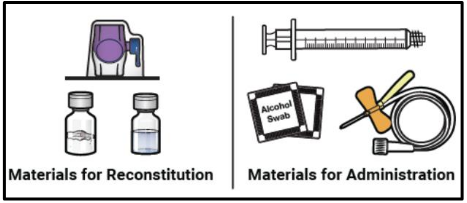
1. Prepare a clean flat surface and gather all the materials you will need for the reconstitution and administration (Figure A).
Figure A:
2. Allow the vials of ADZYNMA and diluent to reach room temperature before use.
3. Wash and dry your hands thoroughly.
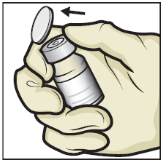
4. Remove plastic caps from the ADZYNMA and diluent vials and place the vials on a flat surface (Figure B).
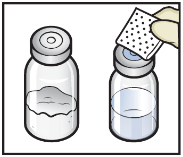
5. Wipe the rubber stoppers with an alcohol swab and allow them to dry prior to use (Figure C).
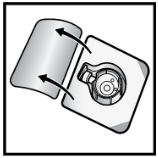
6. Open the BAXJECT II Hi-Flow device package by peeling away the lid, without touching the inside (Figure D).
- Do not remove the BAXJECT II Hi-Flow device from the package.
- Do not touch the clear plastic spike.
Figure D:
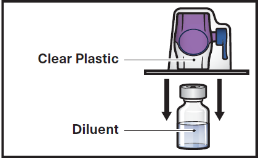
7. Turn the package with the BAXJECT II Hi-Flow device upside down and place it over the top of the diluent vial. Press straight down until the clear plastic spike pierces through the diluent vial stopper (Figure E).
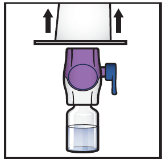
8. Grip the BAXJECT II Hi-Flow device package at its edge and pull the package off the device (Figure F).
- Do not remove the blue cap from the BAXJECT II Hi-Flow device.
- Do not touch the exposed purple plastic spike.
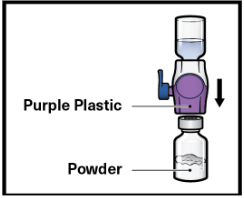
9. Turn the system over so that the diluent vial is now on top. Press the BAXJECT II Hi-Flow device straight down until the purple plastic spike pierces through the ADZYNMA powder vial stopper (Figure G). The vacuum will draw the diluent into the ADZYNMA powder vial.
- You may notice some bubbles or foam – this is normal and should soon disappear. Figure G
Figure G:
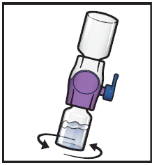
10. Swirl the connected vials gently and continuously until the powder is completely dissolved (Figure H).
- Do not shake the vial.
Figure H:
11. Visually inspect the reconstituted solution for particulate matter before administration.
- Do not use the product if particulate matter or discoloration is observed.
12. If the dose requires more than one vial of ADZYNMA, reconstitute each vial using the above steps.
- Use a different BAXJECT II Hi-Flow device to reconstitute each vial of ADZYNMA and diluent.
Administration instructions:
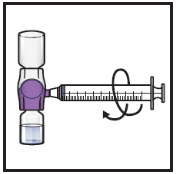
13. Take off the blue cap from the BAXJECT II Hi-Flow device (Figure I). Attach a Luer-lock syringe (Figure J).
- Do not inject air into the system.
Figure I:
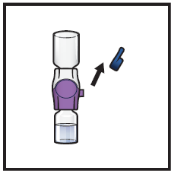
Figure J:
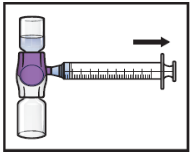
14. Turn the system upside down (ADZYNMA vial is now on top). Draw the reconstituted solution into the syringe by pulling the plunger back slowly (Figure K).
Figure K:
15. If a patient is to receive more than one vial of ADZYNMA, the contents of multiple vials can be drawn into the same syringe. Repeat this process for all reconstituted vials of ADZYNMA until the total volume to be administered is reached.
16. Disconnect the syringe and attach a suitable injection needle or an infusion set.
17. Point the needle up and remove any air bubbles by gently tapping the syringe with your finger and slowly and carefully pushing air out of the syringe and needle.
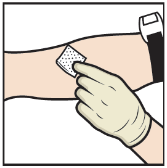
18. Apply a tourniquet and clean the chosen injection site with an alcohol swab (Figure L).
Figure L:
19. Insert the needle into the vein and remove the tourniquet.
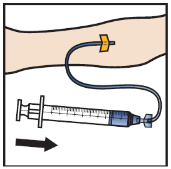
20. Infuse the reconstituted ADZYNMA slowly, at a rate of 2 to 4 mL per minute (Figure M).
- A syringe pump may be used to control the rate of administration.
Figure M:
21. Take the needle out of the vein and put pressure on the injection site for several minutes.
- Do not recap the needle.
22. Place the needle, syringe, and empty vials in a puncture-resistant sharps container.
- Do not dispose of syringes and needles in the household waste.
Any unused medicinal product or waste material should be disposed of in accordance with local requirements.
© All content on this website, including data entry, data processing, decision support tools, "RxReasoner" logo and graphics, is the intellectual property of RxReasoner and is protected by copyright laws. Unauthorized reproduction or distribution of any part of this content without explicit written permission from RxReasoner is strictly prohibited. Any third-party content used on this site is acknowledged and utilized under fair use principles.