EKTERLY Film-coated tablet Ref.[115832] Active ingredients: Sebetralstat
Source: European Medicines Agency (EU) Revision Year: 2025 Publisher: KalVista Pharmaceuticals (Ireland) Ltd., Magennis Place, Block C, Dublin 2, D02 FK76, Ireland
5.1. Pharmacodynamic properties
Pharmacotherapeutic group: Other haematological agents, drugs used in hereditary angioedema
ATC code: B06AC08
Mechanism of action
Sebetralstat is a competitive, reversible inhibitor of plasma kallikrein (PKa). By inhibiting PKa, sebetralstat blocks the cleavage of high molecular weight kininogen (HK) and the subsequent generation of bradykinin (BK), thereby halting HAE attack progression which is associated with increased vascular permeability and oedema formation. Sebetralstat also suppresses the activation of positive feedback mechanism of the kallikrein-kinin system (KKS), thereby reducing factor XIIa (FXIIa) and additional PKa production.
Clinical efficacy and safety
KONFIDENT trial
The efficacy of Ekterly for the treatment of HAE attacks in adult and adolescent patients aged 12 years and older was studied in the KONFIDENT trial, a randomised, double-blind, placebo-controlled, three-way cross-over design.
A total of 110 patients treated 264 attacks. The median age of the patients was 39.5 years and ranged from 13 to 74 years. This notably included 13 [11.8%] adolescents and only 4 [3.6%] elderly patients. Patients with HAE type 1 (101 patients [91.8%]) and type 2 (9 patients [8.2%]) were represented in the trial. Patients entered the trial either taking conventional on-demand treatment (86 [78.2%]) or long-term prophylactic treatment (24 [21.8%]). The baseline characteristics of the treated attacks included all attack severities (113 [42.8%] mild, 102 [38.6%] moderate, 38 [14.4%] severe and 7 [2.7%] very severe) and all anatomic locations (142 [53.8%] subcutaneous, 120 [45.5%] mucosal (of which 8 [3%] were laryngeal)).
The median time to treatment (IQR) was 41 (6 to 140) minutes.
Of the 264 treated attacks, 87 were treated with 300 mg sebetralstat, 93 were treated with 600 mg sebetralstat, and 84 were treated with placebo. Following treatment of each attack, after at least 3 hours, an additional dose could be taken as determined by the patient if needed based on symptoms.
The primary efficacy endpoint was the time to beginning of symptom relief, defined as at least "a little better" (two time points in a row) within 12 hours of the first sebetralstat administration, as assessed using Patient Reported Global Impression of Change (PGI-C). The PGI-C required patients to assess their attack symptoms using a seven-point scale ("much worse" to "much better"). To achieve the primary endpoint, a patient had to report a positive and sustained response of at least "a little better" two timepoints in a row on the PGI-C within 12 hours.
There was a statistically significant faster time to the beginning of symptom relief for 300 mg sebetralstat (Bonferroni adjusted p<0.0001) and 600 mg sebetralstat (Bonferroni adjusted p<0.0013) compared to placebo (Figure 1).
Figure 1. KONFIDENT trial – Kaplan-Meier plot for time to beginning of symptom relief within 12 hours of dosing:
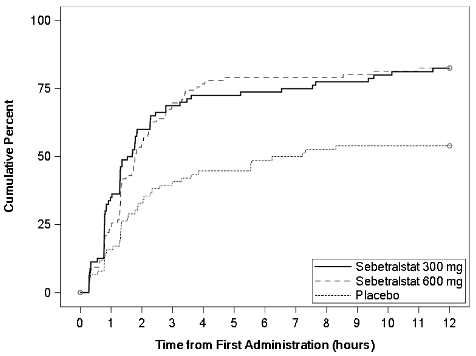
The proportions of patients who took a second dose within 12 hours were 29.9% and 37.6% for 300 mg sebetralstat and 600 mg sebetralstat respectively, which was lower than placebo, 48.8%. The proportion of patients who achieved the primary endpoint without a second administration or before a second administration of 300 mg sebetralstat or 600 mg sebetralstat was 93.9% and 95.8%, respectively.
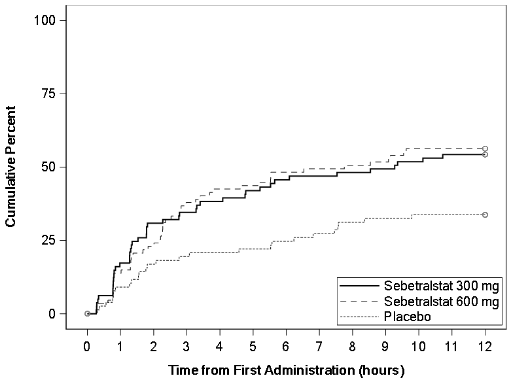
The first key secondary endpoint was the time to first incidence of decrease in severity from baseline (two time points in a row) within 12 hours of the first sebetralstat administration on the Patient Global Impression of Severity (PGI-S). The PGI-S required patients to assess their attack symptoms using a five-point scale ("none" to "very severe"). To achieve the first key secondary endpoint, a patient had to report a positive and sustained reduction of at least one step on the PGI-S within 12 hours.
There was a statistically significant faster time to reduction in severity for 300 mg sebetralstat (Bonferroni adjusted p=0.0036) and 600 mg sebetralstat (Bonferroni adjusted p=0.0032) compared to placebo (Figure 2).
Figure 2. KONFIDENT trial - Kaplan-Meier plot for time to reduction in severity within 12 hours of dosing:
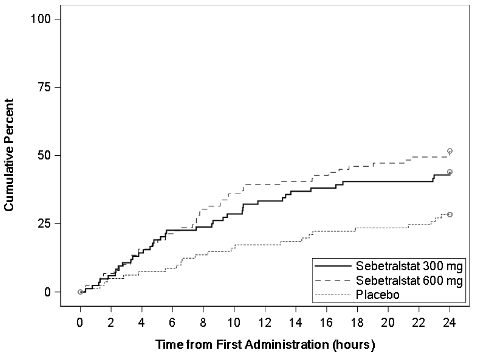
The second key secondary endpoint was time to complete attack resolution defined on the PGI-S within 24 hours of dosing. To achieve the second key secondary endpoint, a patient had to report "none" on PGI-S within 24 hours.
There was a statistically significant faster time to complete attack resolution for 300 mg sebetralstat (Bonferroni adjusted p=0.0022) and 600 mg sebetralstat (Bonferroni adjusted p<0.0001) compared to placebo (Figure 3).
Figure 3. KONFIDENT trial - Kaplan-Meier plot for time to complete attack resolution within 24 hours of dosing:
Assessment of primary and key secondary efficacy endpoint results in the KONFIDENT trial in all predefined subgroups, including use of on-demand treatment only or long-term prophylactic treatment were consistent with the results in the overall population.
KONFIDENT-S trial
In the open-label KONFIDENT-S trial, patients treated multiple attacks with 600 mg sebetralstat for up to 2 years. A total of 134 patients (including 23 adolescents) have treated 1706 attacks. The median number of attacks treated by patients was 8 and ranged from 1-61 attacks. The median number of attacks treated ranged from 0 to 2 attacks per month. The median time from onset of attack to treatment was 10 minutes. For adolescent patients the median time from onset of attack to treatment was 4 minutes. The efficacy results were consistent with the results of the KONFIDENT trial. Efficacy was maintained with repeated treatments.
Laryngeal HAE attacks
A total of 36 laryngeal attacks have been treated in clinical trials. In the KONFIDENT trial, 4 laryngeal HAE attacks were treated (2 with 300 mg sebetralstat and 2 with 600 mg sebetralstat). In the open label KONFIDENT-S trial, 32 laryngeal attacks were treated with 600 mg sebetralstat. The results were similar to patients with non-laryngeal attacks with respect to time to onset of symptom relief. No events of difficulty swallowing Ekterly tablets were reported.
Normal C1-INH HAE population
There are no data available on the use of Ekterly in HAE patients with nC1-INH (see sections 4.2 and 4.4).
Cardiac Electrophysiology
In the clinical trial dedicated to the assessment of cardiac electrophysiology, a potential of sebetralstat to extend the QT interval was detected but only at high concentrations that are not expected to be reached with the recommended dose. The largest mean increase in QTc interval was 10.4 ms (upper confidence interval = 15.3 ms) after administration of Ekterly (5 times the maximum recommended dose) in healthy subjects. The increase in the QTc interval was concentration dependent (see section 4.4).
Paediatric population
The European Medicines Agency has deferred the obligation to submit the results of studies with Ekterly in one or more subsets of the paediatric population in the treatment of hereditary angioedema (see section 4.2 for information on paediatric use).
5.2. Pharmacokinetic properties
Absorption
After a dose of 300 mg, sebetralstat was rapidly absorbed with peak plasma concentrations occurring at approximately 1 hour.
Food effect
In an evaluation of food effect, no difference in the AUC of sebetralstat was observed following a dose of 600 mg with a high-fat meal. There was an approximately 29% reduction in Cmax, and median Tmax was delayed by 2 hours. Ekterly was administered without regard to food in clinical safety and efficacy trials, and can be taken with or without food.
Distribution
Plasma protein binding in humans is approximately 77%. After a dose of 600 mg radiolabelled sebetralstat, the blood to plasma ratio of radioactivity was approximately 0.65. The geometric mean apparent volume of distribution (Vz/F) was 208 L after a dose of 300 mg.
Elimination
After a dose of 300 mg, the geometric mean elimination half-life of sebetralstat was 3.7 hours. The geometric mean apparent clearance (CL/F) was 38.5 L/h.
Metabolism
Sebetralstat is primarily metabolised by CYP3A4 in vitro. Sebetralstat is an in vitro substrate of P-glycoprotein and BCRP. After a dose of 600 mg radiolabelled sebetralstat, sebetralstat represented 64.1% of the total plasma radioactivity AUC0-24, with 11 metabolites, each accounting for between 0.39% and 7.1% of the total radioactivity AUC0-24. The most prevalent plasma metabolite is not pharmacologically active.
Sebetralstat is an in vitro inhibitor of CYPs 3A4 and 2C9, and of the transporters OAT3, OCT2, MATE1, MATE2-K, OATP1B1 and OATP1B3.
Sebetralstat is an in vitro inducer of CYP3A4. Given its intermittent use and its rapid absorption and elimination, the risk of CYP3A4 induction is considered not to be clinically significant.
Excretion
After a dose of 600 mg radiolabelled sebetralstat to healthy male subjects, approximately 32% of radioactivity was excreted in urine and 63% was excreted in faeces. Approximately 8.7% and 12.5% of the dose was recovered in the urine and faeces, respectively, as unchanged sebetralstat. Sebetralstat is mainly eliminated by hepatic metabolism via the faeces.
Linearity/non-linearity
Across a dose range of 5 mg to 600 mg, the Cmax of sebetralstat was proportional to dose; the AUC was greater than dose proportional, likely due to emergence of a longer terminal elimination phase at higher doses.
Special populations
Hepatic impairment
The pharmacokinetics of 600 mg sebetralstat were studied in patients with mild and moderate hepatic impairment (Child-Pugh Class A or B). In patients with mild hepatic impairment Cmax was increased by 7% and AUC by 16% compared to patients with normal hepatic function. In patients with moderate hepatic impairment, Cmax was increased by 63% and AUC was increased by 100%. In patients with moderate hepatic impairment who are taking a strong CYP3A4 inhibitor a single dose of 300 mg is recommended when treating an HAE attack (see sections 4.2 and 4.5).
Renal impairment
Sebetralstat is not primarily renally eliminated and is not administered as a chronic treatment. Sebetralstat pharmacokinetics have not been studied in patients with renal impairment (see section 4.2).
Elderly
KONFIDENT did not include sufficient numbers of patients 65 years of age and older to determine whether they respond differently from younger adult patients (see section 4.2).
Pharmacokinetic/pharmacodynamic relationship(s)
Concentration-dependent inhibition of plasma kallikrein, measured as a reduction from baseline of specific enzyme activity, was demonstrated to be rapid, with near complete (≥95%) suppression of plasma kallikrein as early as 15 minutes after dosing with 300 mg Ekterly in patients with HAE.
5.3. Preclinical safety data
Non-clinical data reveal no special hazard for humans based on conventional studies of safety pharmacology, repeated dose toxicity, genotoxicity and carcinogenic potential.
Carcinogenicity of sebetralstat was evaluated in a 26-week study in rasH2-Tg transgenic mice and a 104-week study in rats. There were no increases in malignant tumours and no evidence of carcinogenicity in either species at any dose level. Exposure at the highest doses (on an unbound plasma AUC basis) were 0.2 and 0.4 times the maximum recommended human dose (MRHD) in male and female mice respectively, and 5.7 times MRHD in rats.
In a fertility study conducted in rats, there was no effect on mating or fertility at any dose level while an increase in preimplantation loss was observed at the high dose level of 600 mg/kg/day (7.7 times human exposure at the MRHD based on unbound AUC levels). Embryofetal development studies were conducted in rats and rabbits. In rats, sebetralstat and/or its metabolites was shown to cross the placenta; malformations (cleft palate, ventricular septal defect) and embryofetal lethality were reported at 600 mg/kg/day (12 times human exposure at the MRHD based on unbound AUC levels); the no observed adverse effect level for embryofetal development was 300 mg/kg/day (3.0-times human exposure at the MRHD based on unbound AUC levels). In rabbits, no malformations or embryo-fetal lethality were observed at doses up to 300 mg/kg/day (6.8-times human exposure at the MRHD based on unbound AUC levels); potential developmental effects associated with PKa inhibition may not have been fully captured in rabbits due to interspecies difference in pharmacological activity of sebetralstat. There were no adverse developmental effects in a rat pre- and-post natal development study at doses up to 450 mg/kg/day.
Administration of a single dose of radiolabelled sebetralstat to lactating rats resulted in similar concentrations of total radioactivity in milk and plasma, with the maximum concentration observed at 1 hour post dose. By 24 hours post dose mean levels of radioactivity in both milk and plasma were close to background.
Environmental risk assessment studies have shown that sebetralstat has the potential to accumulate and may persist in some aquatic sediment systems.
© All content on this website, including data entry, data processing, decision support tools, "RxReasoner" logo and graphics, is the intellectual property of RxReasoner and is protected by copyright laws. Unauthorized reproduction or distribution of any part of this content without explicit written permission from RxReasoner is strictly prohibited. Any third-party content used on this site is acknowledged and utilized under fair use principles.