EKTERLY Film-coated tablet Ref.[115734] Active ingredients: Sebetralstat
Source: FDA, National Drug Code (US) Revision Year: 2025
12.1. Mechanism of Action
Sebetralstat is a competitive, reversible inhibitor of plasma kallikrein. Plasma kallikrein is a serine protease that cleaves high molecular weight kininogen (HK) releasing bradykinin which increases vascular permeability through activation of bradykinin receptors causing edema. Sebetralstat inhibits the cleavage of HK and reduces production of bradykinin, thereby treating the clinical symptoms of an acute, episodic attack of HAE. Sebetralstat also inhibits the positive feedback mechanism of the kallikrein kinin system by plasma kallikrein, thereby reducing factor XIIa and additional plasma kallikrein generation.
12.2. Pharmacodynamics
Concentration-dependent inhibition of plasma kallikrein, measured as a reduction from baseline of specific enzyme activity, was observed in exploratory assays. Following administration of a single oral dose of 600 mg sebetralstat to healthy subjects, greater than 90% mean inhibition of plasma kallikrein activity was observed beginning at 30 minutes after dosing and maintained through about 6 hours post-dose.
Cardiac Electrophysiology
The largest mean increase in QTc interval was 10.4 msec (upper confidence interval = 15.3 msec) after administration of sebetralstat (2.5 times the maximum recommended dose) in healthy subjects. The increase in the QTc interval was concentration dependent.
12.3. Pharmacokinetics
Following a single oral dose of 600 mg sebetralstat in subjects with HAE, the geometric mean (CV%) Cmax is 6,080 ng/mL (40%) and AUC0-inf is 17,600 ng•h/mL (36%). Following administration of a second oral dose of 600 mg sebetralstat 3 hours after the first dose, Cmax increases 10% and AUC0-inf increases 90% when compared to those observed following a single dose.
No clinically relevant differences in sebetralstat pharmacokinetics were observed between healthy subjects and patients with HAE.
Absorption
After a single oral dose of 600 mg sebetralstat, the median time to peak plasma concentration is approximately 1 hour.
Effect of Food
No clinically relevant differences in sebetralstat pharmacokinetics were observed following administration of a high-fat meal (900-1,000 calories in total – 500-600, 250 and 150 calories from fat, carbohydrate and protein respectively).
Distribution
The estimated typical apparent volume of distribution (Vz/F) for sebetralstat is 70.1 L (95% CI: 64.8, 75.4). Sebetralstat plasma protein binding is 77% in vitro.
Elimination
Following administration of a single oral dose of 600 mg sebetralstat, the mean (SD) elimination half-life of sebetralstat ranged from 5.3 (2.3) to 8.9 (5.1) hours. The estimated typical apparent clearance (CL/F) is 30.7 L/h (95% CI: 29.1, 32.2).
Metabolism
Sebetralstat is primarily metabolized by CYP3A4 and to a lesser extent by CYP2C8.
Excretion
Following administration of a single oral dose of 600 mg radiolabeled sebetralstat to healthy male subjects, approximately 63% of the dose was recovered in feces (12.5% as unchanged sebetralstat) and 32% in urine (8.7% as unchanged sebetralstat).
Specific Populations
No clinically relevant differences in the pharmacokinetics of sebetralstat were observed based on body weight (45-135 kg), age (19-68 years), sex, race (71% White, 17% Black, 11% Asian), and mild renal impairment (eGFR 60-89 mL/min/1.73 m²). The effect of moderate and severe renal impairment (eGFR <60 mL/min/1.73 m²) on sebetralstat pharmacokinetics is unknown.
Patients with Hepatic Impairment
The pharmacokinetics of sebetralstat were evaluated in subjects with mild (Child-Pugh Class A) and moderate (Child-Pugh Class B) hepatic impairment following administration of a single 600 mg dose. In subjects with mild hepatic impairment Cmax was increased by 7% and AUC increased by 16% compared to subjects with normal hepatic function. In subjects with moderate hepatic impairment Cmax was increased by 63% and AUC was increased by 100% compared to subjects with normal hepatic function. The effect of severe hepatic impairment (Child-Pugh Class C) on sebetralstat pharmacokinetics is unknown [see Use in Specific Populations (8.6)].
Drug Interaction Studies
Clinical Studies and Model-Informed Approaches
Strong CYP3A4 Inhibitors: Sebetralstat Cmax increased 2.4-fold and AUC0-inf increased 5.2-fold following concomitant administration with itraconazole (a strong CYP3A4 inhibitor) 200 mg once daily for 6 days [see Drug Interactions (7.1)].
Moderate CYP3A4 Inhibitors: Sebetralstat Cmax increased 1.8-fold and AUC0-inf increased 2-fold following concomitant administration with verapamil (a moderate CYP3A4 inhibitor) 240 mg once daily for 6 days [see Drug Interactions (7.1)].
Strong CYP3A4 Inducers: Sebetralstat Cmax decreased by 66% and AUC0-inf decreased by 83% following concomitant administration with phenytoin (a strong CYP3A4 inducer) 100 mg three times daily for 15 days [see Drug Interactions (7.1)].
Moderate CYP3A4 Inducers: Sebetralstat Cmax decreased by 63% and AUC0-inf decreased by 79% following concomitant administration with efavirenz (a moderate CYP3A4 inducer) 600 mg once daily for 14 days [see Drug Interactions (7.1)].
Acid-Reducing Agents: Sebetralstat Cmax is estimated to decrease by up to 56% and AUC0-inf is estimated to decrease by up to 30% at pH 6 relative to pH 0.5.
Other Drugs: No clinically significant differences in sebetralstat pharmacokinetics were observed when administered concomitantly with quinidine (P-gp inhibitor), eltrombopag (BCRP inhibitor), cimetidine (evaluated as a weak CYP3A4 inhibitor), or modafinil (weak CYP3A4 inducer).
In vitro Studies
CYP450 Enzymes: Sebetralstat is a substrate of CYP3A4 and CYP2C8, and is not a substrate of CYP1A2, CYP2A6, CYP2B6, CYP2C9, CYP2C19, CYP2D6, or CYP2E1. Sebetralstat is an inhibitor of CYP2C9 and CYP3A4. Sebetralstat did not inhibit CYP1A2, CYP2B6, CYP2C8, CYP2C19, or CYP2D6.
Transporter Systems: Sebetralstat is a substrate of P-gp and BCRP, and is not a substrate of OATP1B1, OATP1B3, OAT1, OAT3, OCT2, or MATE1. Sebetralstat is an inhibitor of BCRP, OATP1B1, OATP1B3, OAT3, OCT2, MATE1, MATE2-K, and BSEP. Sebetralstat did not inhibit P-gp or OAT1.
13.1. Carcinogenesis, Mutagenesis, Impairment of Fertility
Carcinogenesis
A 6-month carcinogenicity study in rasH2-Tg transgenic mice was conducted to assess the carcinogenic potential of sebetralstat. Sebetralstat demonstrated no tumorigenic potential in a study with male and female mice that received oral doses up to 200 mg/kg/day and 300 mg/kg/day, respectively.
Mutagenesis
Sebetralstat was not mutagenic or clastogenic in the following assays: in vitro bacterial reverse mutation (Ames) test, in vitro chromosomal aberration assay in human peripheral blood lymphocytes, and in vivo rat micronucleus assay.
Impairment of Fertility
Fertility and reproductive performance were unaffected in male or female rats that received sebetralstat by the oral route at dose levels up to 600 mg/kg/day (approximately 38 times the MRHD in adults on an AUC basis).
14. Clinical Studies
The efficacy of EKTERLY for the treatment of acute attacks of hereditary angioedema (HAE) in adult and pediatric patients aged 12 years and older was evaluated in a double-blind, randomized, placebo-controlled, multicenter crossover clinical trial (KONFIDENT [NCT05259917]). KONFIDENT employed a 3-way, complete crossover design comparing EKTERLY 600 mg and EKTERLY 300 mg to placebo. If needed (as determined by the patient) a second dose could be administered after 3 hours. Patients were required to treat an eligible HAE attack prior to crossover to the next treatment period. Severe laryngeal attacks were not treated in KONFIDENT. The duration of trial participation was approximately 25 weeks. Although evaluated in KONFIDENT, EKTERLY 300 mg is not a recommended dose for treatment of acute HAE attacks.
The demographics and baseline characteristics of patients in KONFIDENT are provided in Table 4.
Table 4. Demographics and Baseline Characteristics of Patients in KONFIDENT Trial:
| KONFIDENT (N=110) | |
|---|---|
| Female, n (%) | 66 (60) |
| Mean age, years (SD) | 38 (15) |
| 12 to <18 years, n (%) | 13 (12) |
| ≥18 years, n (%) | 97 (88) |
| Race, n (%) | |
| Asian | 10 (9) |
| Black or African American | 1 (1) |
| White | 92 (84) |
| Other | 1 (1) |
| Not reported | 6 (5) |
| Hispanic or Latino, n (%) | 7 (6) |
| HAE Type I, n (%) | 101 (92) |
| Background HAE prophylaxis, n (%) | 24 (22) |
A total of 110 patients were randomized and experienced at least one HAE attack. Of the 264 treated HAE attacks, 142 (54%) had peripheral symptoms only, 85 (32%) had abdominal symptoms only, 27 (10%) had abdominal and peripheral symptoms, 8 (3%) had mild to moderate laryngeal symptoms, and 2 (1%) had missing attack location.
The primary endpoint for KONFIDENT was the 'time to beginning of symptom relief' defined as at least "a little better" at two consecutive time points within 12 hours of first dose administration, assessed using a seven-point scale Patient Reported Global Impression of Change (PGI-C) ranging from "much worse" to "much better".
As shown in Figure 1, there was a statistically significant faster time to the beginning of symptom relief for EKTERLY 600 mg compared to placebo. A total of 71 out of 93 (76%) patients administered EKTERLY 600 mg and 41 out of 84 (49%) patients administered placebo achieved the primary endpoint. The median time to beginning of symptom relief within 12 hours of first dose was 2.0 hours (95% CI: 1.5, 2.8) in patients administered EKTERLY 600 mg.
Figure 1. Kaplan-Meier for Time to Beginning of Symptom Relief Within 12 Hours of First Dose Administration with EKTERLY in KONFIDENT:
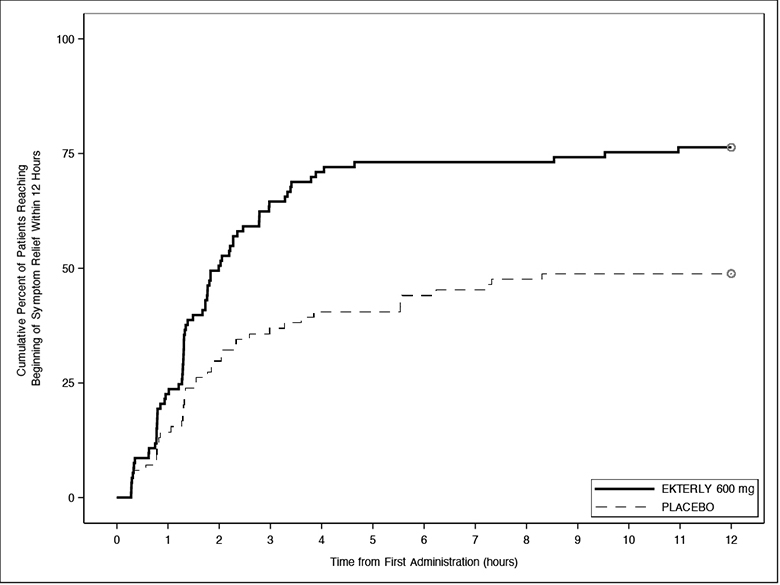
Note: In the EKTERLY 600 mg group, 38% of patients administered a second dose within 12 hours.
Less than 50% of placebo patients reached beginning of symptom relief within 12 hours; therefore, the median time could not be estimated.
Patients who did not achieve the endpoint, received alternate on-demand therapy, or lacked at least 2 consecutive post-baseline assessments were right-censored at 12 hours.
Secondary Endpoints
The first key secondary endpoint was the 'time to first incidence of reduction in severity' at two consecutive time points within 12 hours of first dose administration, assessed using a five-point scale Patient Global Impression of Severity (PGI-S) ranging from "none" to "severe".
The 'time to first incidence of reduction in severity' (Figure 2) was statistically significantly faster for EKTERLY 600 mg compared to placebo. A total of 49 out of 93 (53%) patients administered EKTERLY 600 mg and 26 out of 84 (31%) patients administered placebo achieved reduction in severity within 12 hours. The median time to achieve this endpoint was 9.1 hours (95% CI: 3.8, not reached) in patients administered EKTERLY 600 mg.
Figure 2. Kaplan-Meier for Time to First Incidence of Reduction in Severity Within 12 Hours of First Dose Administration with EKTERLY in KONFIDENT:
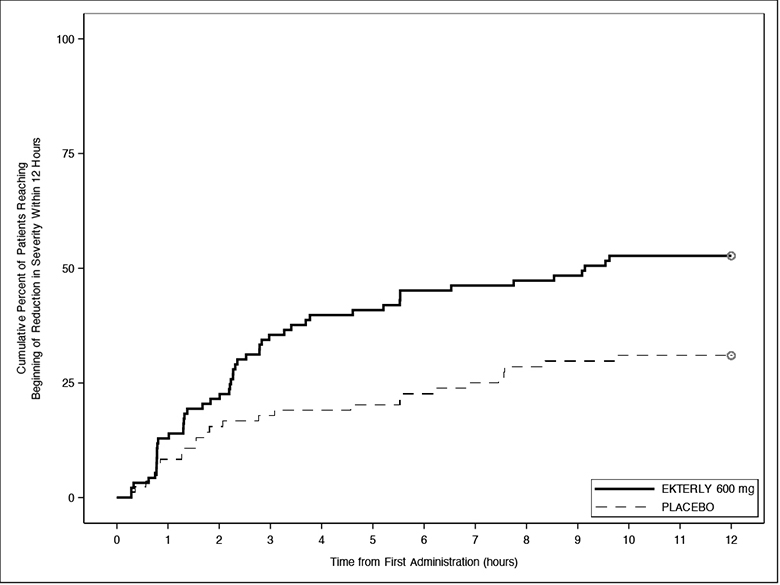
Note: In the EKTERLY 600 mg group, 38% of patients administered a second dose within 12 hours.
Less than 50% of placebo patients reached beginning of reduction in severity within 12 hours; therefore, the median time could not be estimated.
Patients who did not achieve the endpoint, received alternate on-demand therapy, or lacked at least 2 consecutive post-baseline assessments were right-censored at 12 hours.
The second key secondary endpoint was 'time to attack resolution' defined as PGI-S of "none" within 24 hours of first dose administration.
The 'time to attack resolution' (Figure 3) was statistically significantly faster for EKTERLY 600 mg compared to placebo. A total of 46 out of 93 (49%) patients administered EKTERLY 600 mg and 23 out of 84 (27%) patients administered placebo achieved attack resolution within 24 hours.
Figure 3. Kaplan-Meier for Time to Attack Resolution Within 24 Hours of First Dose Administration with EKTERLY in KONFIDENT:
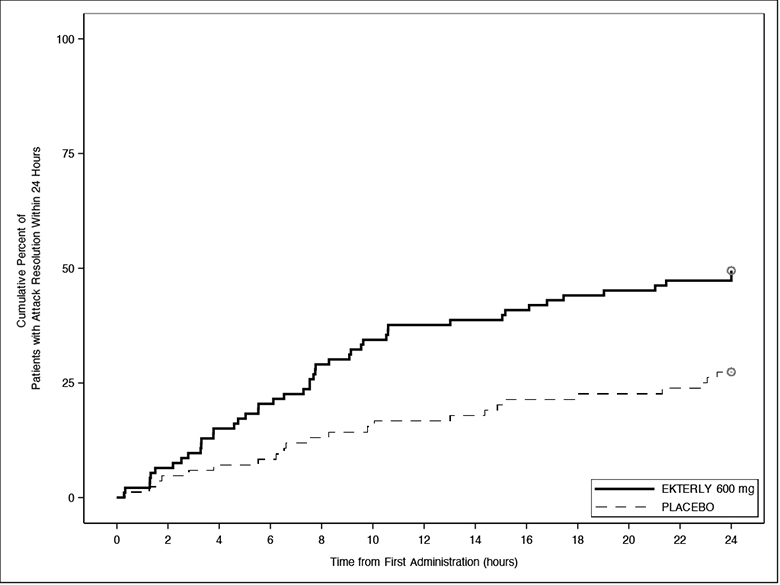
Note: In the EKTERLY 600 mg group, 39% of patients administered a second dose within 24 hours.
Less than 50% of EKTERLY 600 mg and placebo patients had attack resolution within 24 hours; therefore, the median time could not be estimated.
Patients who did not achieve the endpoint, received alternate on-demand therapy, or lacked post-baseline assessments were right-censored at 24 hours.
Other Endpoints
The time to beginning of at least "better" at two consecutive time points on the PGI-C within 12 hours of the first dose administration was assessed. A total of 54 out of 93 (58%) patients administered EKTERLY 600 mg and 21 out of 84 (25%) patients administered placebo achieved this endpoint. The median time was 4.6 hours (95% CI: 3.3, 9.5) in patients administered EKTERLY 600 mg.
© All content on this website, including data entry, data processing, decision support tools, "RxReasoner" logo and graphics, is the intellectual property of RxReasoner and is protected by copyright laws. Unauthorized reproduction or distribution of any part of this content without explicit written permission from RxReasoner is strictly prohibited. Any third-party content used on this site is acknowledged and utilized under fair use principles.