ETCAMAH Film-coated tablet Ref.[116758] Active ingredients: Camizestrant
Source: European Medicines Agency (EU) Revision Year: 2026 Publisher: AstraZeneca AB, SE-151 85 Södertälje, Sweden
5.1. Pharmacodynamic properties
Pharmacotherapeutic group: Endocrine therapy, Anti-estrogens
ATC code: L02BA05
Mechanism of action
Camizestrant is an oral selective oestrogen receptor degrader (SERD) and oestrogen receptor (ER) antagonist.
Camizestrant binds to the ligand binding domain of ERα, antagonising the activity of ERα encoded by both wild-type ESR1 and mutated ESR1, and inducing proteasome-dependent degradation of ERα, without agonising ERα.
Cardiac electrophysiology
Exposure response analysis of potential QTcI prolongation of daily 75 mg to 300 mg of camizestrant monotherapy was assessed in 30 patients. The predicted drug related mean QTcI prolongation was 2.99 msec (95% CI: (-0.75, 6.73)) at the mean steady state Cmax with an upper bound of 6.09 msec (90% CI) following 75 mg camizestrant daily. At the recommended 75 mg dose of camizestrant, a mean increase in QTcI >10 msec was not observed.
Clinical efficacy
ER-positive, HER2-negative locally advanced or metastatic breast cancer
SERENA-6
SERENA-6 was a randomised, double-blind, circulating tumour DNA (ctDNA)-guided study to assess the efficacy and safety of switching to Etcamah plus a CDK4/6 inhibitor (palbociclib, ribociclib or abemaciclib) versus continuing AI (letrozole or anastrozole) plus a CDK4/6 inhibitor in adult pre/peri/post-menopausal females and males with ER-positive/HER2-negative, locally advanced or metastatic breast cancer with detectable ESR1-mutation assessed by ctDNA testing without disease progression during first-line treatment with AI plus a CDK4/6 inhibitor. All patients were required to be currently on treatment and have received ≥6 months of AI plus a CDK4/6 inhibitor treatment as the initial endocrine based treatment with no evidence of disease progression as per investigator assessment. Patients could have received one prior line of chemotherapy before the start of AI plus a CDK4/6 inhibitor treatment. Patients with ECOG >1, presence of widespread symptomatic metastatic visceral disease, early progressors on CDK4/6 inhibitor; severe and uncontrolled cardiac comorbidity, severe hepatic impairment and/or QTc prolongation (defined as >480 msec for combination with palbociclib or abemaciclib; or ≥450 msec for combination with ribociclib were excluded. ESR1- mutation status was prospectively determined through testing of plasma-derived circulating tumour DNA (ctDNA) using Guardant 360 CDx assay. Mutations in ESR1 that cause the indicated amino acids changes were eligible for inclusion E380Q, V422del, S463P, L536H, L536P, L563R, Y537C, Y537D, Y537N, Y537S, D538G. Based on results from the Guardant 360 assay, the most common ESR1 alterations were variants at amino acids D538G, Y537S, and Y537N detected in 44.6%, 38.9% and 18.5% of patients with an eligible ESR1-mutation, respectively.
A total of 315 patients were randomised 1:1 to receive either Etcamah (n=157, 75 mg once daily) plus a CDK4/6 inhibitor and a placebo of AI or continue AI plus a CDK4/6 inhibitor and placebo of Etcamah (n=158). The total percentage of randomised patients on palbociclib were 75.6%, ribociclib were 14.9%, and abemaciclib were 9.5%. The choice of CDK4/6 inhibitor and its dose remained the same at the time of randomisation for both arms. Randomisation was stratified by disease site (visceral disease versus non-visceral disease), ESR1m detection (first test versus subsequent ctDNA tests), time from initiation of AI plus CDK4/6 inhibitor to randomisation (<18 months versus ≥18 months), and type of CDK4/6 inhibitor (palbociclib versus ribociclib versus abemaciclib). Pre/perimenopausal female patients and male patients taking concomitant LHRH agonist continued to receive it after randomisation. Treatment with Etcamah continued until disease progression or unacceptable toxicity occurred.
The primary endpoint was progression free survival (PFS) as assessed by investigator per Response Evaluation Criteria in Solid Tumors (RECIST) v1.1. The key secondary endpoints were time from randomisation to second progression or death (PFS2) and overall survival (OS).
Demographic and baseline characteristics were well balanced between arms. Of the 315 patients, the median age was 61.0 years (range 29.0 to 89.0 years and 36.8% were over 65 years of age); female (99.0%); male (1.0%); White (63.2%), Asian (23.2%), Black (1.9%), and other races (1.0%). Eastern Cooperative Oncology Group (ECOG) performance status 0 (65.1%) or 1 (33.0%); 79.4% were post-menopausal female and 20.6% were pre-/peri-menopausal female or male.
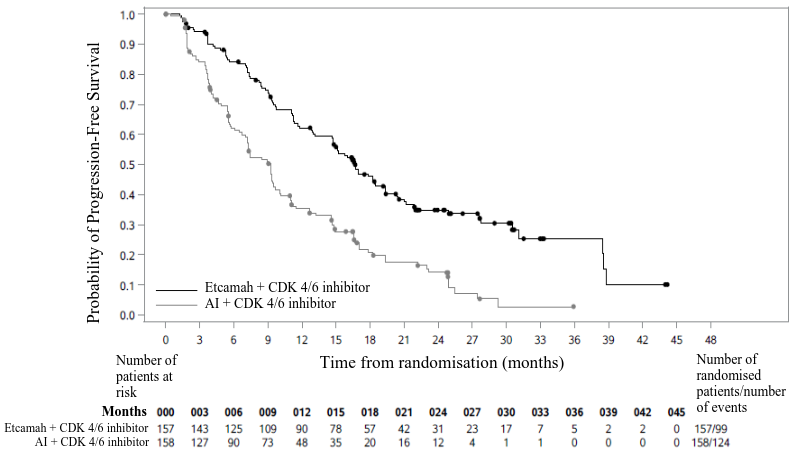
Efficacy results are summarized in Table 3 and Figure 1.
Table 3. Efficacy Results in SERENA-6 (DCO3: 02 Jan 2026):
| Etcamah plus a CDK4/6 inhibitor (n=157) | AI plus a CDK4/6 inhibitor (n=158) | |
| Progression free survival (PFS) by Investigator assessment | ||
| Number of eventsa (%) | 99 (63.1) | 124 (78.5) |
| Median monthsb (95% CI) | 16.76 (14.72, 19.35) | 9.23 (7.23, 9.66) |
| Hazard ratioc (95% CI) | 0.45 (0.34, 0.59) | |
| p-valued | <0.00001 | |
| Overall survival (OS) (30% maturity) | ||
| Number of events (%) | 46 (29.3) | 49 (31.0) |
| Median monthsb (95% CI) | 41.20 (35.48, NC) | 40.21 (36.50, 43.27) |
| Hazard ratioc | 0.87 (0.57, 1.30) | |
a Includes progression events that occur within 2 visits of last evaluable assessment.
b The calculation is based on the Kaplan-Meier method.
c A hazard ratio <1 favours Etcamah plus CDK4/6 inhibitor treatment arm.
d p value <0.00001 achieved at DCO1 (28 Nov 2024).
Figure 1. Kaplan-Meier plot of progression-free survival by investigator assessment in SERENA-6:
Paediatric population
The European Medicines Agency has waived the obligation to submit the results of studies with Etcamah in all subsets of the paediatric population in breast cancer (see section 4.2 for information on paediatric use).
5.2. Pharmacokinetic properties
Camizestrant pharmacokinetic parameters have been characterized in healthy patients and breast cancer patients. Based on population pharmacokinetic (popPK) analysis, the pharmacokinetics of camizestrant at the 75 mg dose are characterized by an apparent plasma clearance of 69.1 L/h, apparent volume of distribution (Vss/F) at steady state of 26.97 L/kg and a terminal half-life of approximately 23 hours. The camizestrant 75 mg dose oral bioavailability is 43% and steady state is reached by Day 5 following once daily dosing.
Absorption
Following oral administration, camizestrant is absorbed with median peak plasma concentrations achieved between approximately 2 to 4 hours after dosing.
Effect of food
Similar exposures were observed following administration with a high fat meal or fasted overnight supporting camizestrant being taken with or without food. Following a high fat meal, the fed to fasted Cmax and AUC geometric mean ratios (90% CI) were 106.2% (90% CI: 94.3%, 119.7%) and 109.8% (90% CI: 104.4%, 115.5%), respectively.
Distribution
Based on popPK analysis, camizestrant is distributed in the tissues with an apparent peripheral volume of distribution of 8.69 L/kg. The apparent volume of distribution of camizestrant at steady state is 26.97 L/kg.
Plasma protein binding of camizestrant is 75.3% (24.7% free). There is no evidence of concentration dependent plasma protein binding. The blood to plasma ratio was 0.99.
Biotransformation
Metabolism results from in vitro hepatocytes studies suggest that camizestrant undergoes multiple oxidation reactions in addition to direct N-glucuronidation and is primarily metabolised by CYP3A4/5 and UGT1A4. Human metabolites of camizestrant were detected and quantified in pharmacokinetic samples from healthy female volunteers receiving a single oral dose of 75 mg [14C]-camizestrant (0.67 MBq). The major drug-related circulating materials were the N-glucuronide conjugate of camizestrant, the N-glucuronide of the acid metabolite and camizestrant which accounted for 20.1%, 11.2%, and 13.6% of the circulating radioactivity in plasma. The other eight minor metabolites in plasma, each of which had a relative abundance lower than 10% of the total drug-related materials in plasma, were either oxidative metabolites or glucuronides of oxidative metabolites. No active metabolites have been identified.
In vitro: Camizestrant does not inhibit CYP1A2, CYP2A6, CYP2C8, CYP2C9, CYP2C19 or CYP2E1 and is a weak (IC50 >100 μM) inhibitor of UGT1A1 and UGT2B7. Camizestrant does not cause time-dependent inhibition of CYP1A2, CYP2D6 and CYP3A4/5. Camizestrant has low potential to cause induction of CYP1A2, CYP2B6, and CYP3A4/5. For the drug transporters, camizestrant does not inhibit OATP1B3, OCT2, OAT1, OAT3, MATE1, and MATE2K and is not a substrate of BCRP, OATP1B1 or OATP1B3.
Elimination
Following single oral administration of 75 mg [14C]-camizestrant, mean of 82% of the radioactivity administered was recovered in urine and faeces. Mean total radioactivity (65.1%) was recovered in faeces indicating faecal excretion was the main route of elimination following oral dosing; with 16.8% of the total radioactivity being recovered from the urine.
Linearity/non-linearity
Camizestrant AUC and Cmax showed greater than dose-proportional increase over the dose range of 25 to 450 mg.
Special populations
Effect of age, gender, race and weight
Based on popPK analyses (n=756), no clinically significant relationships were identified between model predicted steady-state exposure, area under the curve at steady state (AUCss) and the following covariates: baseline median age 61 years (29 to 89 years) and racial groups. PopPK analysis showed baseline median body weight was 69.9 kg (34.2 to 150 kg) and it affected apparent volume of distribution (V2/F), but this was not clinically relevant; it did not significantly impact apparent total body clearance (CL/F) or AUCss. No dose adjustments for camizestrant are required based on age, gender, race, or body weight.
Renal impairment
The popPK analysis used continuous creatinine clearance. Baseline creatinine clearance (CrCL) was calculated using the Cockcroft-Gault equation to evaluate the effect of renal function on camizestrant PK; the median CrCL was 86.2 mL/min (range 22.8-303 mL/min). The analysis showed no clinically meaningful impact of mild and moderate renal impairment at baseline on camizestrant PK, indicating that no dose adjustment is necessary for patients with mild to moderate renal impairment.
There were limited patients with severe renal impairment and no patients on dialysis or with CrCL <15 mL/min were included in the clinical studies of camizestrant. Therefore, an appropriate dose of camizestrant has not been established for severe renal impairment patients and patients on dialysis (see section 4.2).
Hepatic impairment
Based on a pharmacokinetic study in patients following a single 75 mg dose, camizestrant exposure geometric mean Cmax and AUC0-INF in patients with moderate (Child-Pugh B) hepatic impairment was 2.4-fold and 2.7-fold, respectively, compared to patients with normal hepatic function. Camizestrant exposure geometric mean Cmax and AUC0-INF in patients with severe (Child-Pugh C) hepatic impairment was 3.1-fold and 3.8-fold, respectively, compared to patients with normal hepatic function.
The exposure to camizestrant is higher than dose-proportional and increases with time until steady state. The increase in exposure to camizestrant from single dose to steady state is not known in subjects with hepatic impairment (Child-Pugh). PopPK modelling did not indicate mild hepatic impairment (NCI) as a significant covariate for camizestrant exposure. As precautionary measures, camizestrant should be avoided in subjects with moderate and severe hepatic impairment. Patients with mild hepatic impairment are allowed to take camizestrant.
5.3. Preclinical safety data
Non-clinical/repeat-dose toxicity
In repeat-dose toxicity studies in mice, rats and dogs, the reproductive tract was identified as a target organ with histopathological findings occurring at exposures significantly below (female) or at 2-fold (male) human exposure at Maximum Recommended Human Dose (MRHD). There were related findings in the adrenals (rats and mice) and pituitary (mice) glands. Findings were hormone-driven, based on the pharmacological action of camizestrant and therefore not relevant for post-menopausal women or pre- or peri menopausal women or men administered an LHRH agonist. Findings in the male reproductive tract of clinical relevance are described in the fertility section.
Macrophage aggregation (lung, spleen, thymus and mesenteric lymph nodes) and vacuolation (biliary epithelium of the liver) were noted in the rat and/or mouse. This was confirmed as phospholipidosis in the lung of rat, was reversible following 1-month dosing but was considered adverse in female rats in the 6-month study at a total plasma exposure (AUC) of approximately 60-fold human exposure at MRHD.
In mechanistic studies, camizestrant caused rod bipolar cell dysfunction in the retina of rats at clinically relevant exposures (approximately 5-fold human exposure at MRHD). The retina effects in rats were reversible and are consistent with the transient visual effects observed in humans.
Cardiovascular effects were observed across species (i.e. dogs and rats) and supported by mechanistic studies. Heart rate reduction, related to decreased sinoatrial node pacemaker current activity via HCN4 ion channels, was observed in animals and confirmed clinically (see section 4.4). In dogs and rats, additional delayed-onset cardiovascular functional effects included dose- and time-dependent decreases in diastolic blood pressure, QA interval and PR interval, with increases in pulse pressure, QT/QTc intervals and left ventricular parameters (dP/dt+ and dP/dt-). When assessed in dogs, QTc prolongation persisted for at least 3 days up to 4 weeks. The QTc prolongation was of unknown mechanism, independent of heart rate and unrelated to hERG inhibition and observed at maximum unbound plasma concentrations ≥ 4-fold those at human MRHD. Additional atrial premature complexes (APCs) were observed in one telemetry and one toxicology dog at maximum free plasma levels 12-fold and 33-fold human MRHD, respectively. Cardiomyopathy was observed in female rats following dosing for 6 months at total plasma exposures ≥ 11-fold the human AUC exposure at human MRHD.
In dogs, combination dosing of camizestrant with atropine resulted in a significant increase in plasma and brain exposure of atropine considered to be due to inhibition of atropine metabolism and, therefore, likely dog specific.
Mutagenicity and carcinogenicity
Camizestrant was negative in the in vitro Ames and micronucleus assays, and the in vivo micronucleus study. Findings in the ovaries in chronic repeat-dose studies included hyperplasia at total plasma exposures (AUC) ≥2-fold (rat granulosa cell) and 52-fold (dog sex cord stromal) relative to human exposure at MRHD and benign granulosa cell tumours at total plasma exposures (AUC) of approximately 60-fold (rats) and 3.5-fold (dogs) relative to human exposure at MRHD. An interstitial (Leydig) cell adenoma was observed in the testis of a single dog at 13-fold human exposure at MRHD. Findings are considered hormone-driven, based on the pharmacological action of camizestrant and therefore not relevant for post-menopausal women or in pre- or peri menopausal women or men administered an LHRH agonist.
Reproductive toxicity
Embryofoetal/developmental toxicity
Administration of camizestrant in a modified embryofoetal development study in rats resulted in a complete lack of implantation in females when dosing at 0.1 mg/kg/day commenced prior to implantation. When administration was restricted to the phase of organogenesis, camizestrant had no effect on embryofoetal survival or development, but when dosed from implantation through parturition and into lactation, camizestrant resulted in increased length of gestation, dystocia, impaired offspring survival and growth. Maternal exposures in this study were far below human exposure at MRHD.
Fertility
In a fertility study in female rats, camizestrant negatively affected oestrous cycles, mating behaviour, fertility and early embryonic survival which fully reversed following 1 month off dose. Effects were observed at maternal exposures below human exposure at MRHD.
In male rats and dogs, atrophy of the prostate gland, seminal vesicle and seminiferous tubules, tubular dilation of testis and changes in the epididymis (decreased sperm in rats and cell debris in dog) were evident from the lowest dose in chronic studies at exposures ≥2-fold (rat) or ≥3.5-fold (dog) human exposure at MRHD and were considered of clinical relevance. In male rats following 9 weeks of dosing there were lower spermatid/sperm counts, a higher percentage of sperm abnormalities, lower sperm motility, and lower mating and pregnancy rates indicating an effect on male fertility. Effects were observed at a total plasma exposure (AUC) ≥2-fold that observed at a clinical dose of 75 mg, but a no-effect level was not established. In that study, implantation loss and a decrease in number of live foetuses was observed in non-dosed females paired with dosed males suggesting male-mediated reproductive toxicity at a total plasma exposure (AUC) 27-fold the human exposure at MRHD. Reversibility of male fertility findings was not assessed.
© All content on this website, including data entry, data processing, decision support tools, "RxReasoner" logo and graphics, is the intellectual property of RxReasoner and is protected by copyright laws. Unauthorized reproduction or distribution of any part of this content without explicit written permission from RxReasoner is strictly prohibited. Any third-party content used on this site is acknowledged and utilized under fair use principles.