ISEMBYLD Solution for injection Ref.[116934] Active ingredients: Apitegromab
Source: FDA, National Drug Code (US) Revision Year: 2026
12.1. Mechanism of Action
ISEMBYLD is a fully human monoclonal IgG4 antibody that binds to promyostatin and latent myostatin and inhibits the activation of myostatin, blocking myostatin signaling.
12.2. Pharmacodynamics
In Study 1, the increase in serum total latent myostatin levels are comparable across ISEMBYLD 10 mg/kg and 20 mg/kg (twice the recommended dosage) doses in patients with SMA 2 to 12 years of age, and the 20 mg/kg dose in patients with SMA 13 years of age and older.
12.3. Pharmacokinetics
The PK of apitegromab-mstn were characterized in healthy adult subjects and in patients with SMA using population pharmacokinetic modeling.
Pharmacokinetics of apitegromab-mstn were linear and dose-proportional in the range of 10 mg/kg to 20 mg/kg (twice the recommended dosage) in patients with SMA.
Following administration of ISEMBYLD once every 4 weeks in patients with SMA, approximately 2-fold accumulation of apitegromab-mstn exposures were observed, and exposures reached steady state by approximately 16-20 weeks.
Distribution
The apitegromab-mstn mean (coefficient of variation % [CV%]) steady state volume of distribution in patients with SMA (2 to 21 years of age) was estimated to be 2.16 L (48%).
Elimination
Apitegromab-mstn is expected to be degraded into small peptides and amino acids via catabolism in the same manner as endogenous IgGs.
The mean value (CV%) of clearance of apitegromab-mstn in patients with SMA (2 to 21 years of age) was estimated to be 0.055 L/day (50%). The mean value (CV%) of the terminal elimination half-life of apitegromab-mstn was estimated to be 31.2 days (32%).
Specific Populations
Pediatric Patients
The PK of apitegromab-mstn was characterized in pediatric patients 2 years of age and older using a population pharmacokinetic model. Following weight-based dosing of ISEMBYLD 10 mg/kg, model-predicted steady state exposures (Cmax, Ctrough and AUC) of apitegromab-mstn was comparable between patients 2 to 12 years of age and 13 to 21 years of age.
Male and Female Patients and Racial or Ethnic Groups
Based on the population PK analysis, sex, race, and ethnicity had no effect on apitegromab-mstn PK in patients with SMA.
Patients with Renal or Hepatic Impairment
No clinical studies were conducted to evaluate the PK of apitegromab-mstn in patients with renal or hepatic impairment. Apitegromab-mstn is degraded by proteolytic enzymes and is not expected to undergo renal elimination or metabolism by hepatic enzymes.
Drug Interaction Studies
An effect of apitegromab-mstn on the PK of co-administered medications is not expected. Based on the population PK analysis, SMN-modulating therapies (nusinersen and risdiplam) had no effect on apitegromab-mstn PK in patients with SMA.
13.1. Carcinogenesis, Mutagenesis, Impairment of Fertility
Carcinogenesis
Carcinogenicity studies have not been conducted with apitegromab-mstn.
Mutagenesis
Genetic toxicology studies have not been conducted with apitegromab-mstn.
Impairment of Fertility
Once-weekly intravenous injection of apitegromab-mstn (0, 30, 100, or 300 mg/kg) to rats prior to and during mating and continuing in females to gestation day 6 resulted in decreased sperm concentrations, estrous cycle disruption, decreased male and/or female mating and fertility indices, and increased postimplantation loss at all doses. A no-effect dose for adverse effects on fertility and early embryonic development was not identified. The lowest dose tested (30 mg/kg) was associated with apitegromab-mstn exposures (AUC) lower than that in humans at the MRHD.
13.2. Animal Toxicology and/or Pharmacology
Adverse effects on bone were observed in toxicology studies conducted in rats. In a study in which apitegromab-mstn (0, 10, 30, 100, or 300 mg/kg) was administered weekly by intravenous injection for 12 weeks, fissure at the femoral head physis was observed at all doses at the end of the dosing and recovery periods. The fissure was associated with partial or complete absence of the epiphysis and with degenerative (resorption) and reactive (fibrosis, woven bone, hyperplastic osteoclasts) changes at the femoral neck and proximal metaphysis. Qualitative findings of partial or complete missing femoral head epiphysis were observed in computed tomography images of apitegromab-mstn-exposed animals. Weekly intravenous administration of apitegromab-mstn (0, 30, 100, or 300 mg/kg) to rats for 26 weeks resulted in a dose-related increase in the incidence and severity of adverse changes in the femoral head/neck (femoral head loss, thinning, fracture, fragmentation of the femoral neck) observed by in vivo radiography at the end of the dosing and recovery periods.
A no-effect dose for bone effects was not identified. The lowest effect doses for adverse effects on bone in 12- and 26-week studies in rats (10 and 30 mg/kg, respectively) were associated with apitegromab-mstn exposures (AUC) lower than that in humans at the MRHD.
14. Clinical Studies
The efficacy of ISEMBYLD for the treatment of spinal muscular atrophy (SMA) in patients 2 years of age and older was demonstrated in a randomized, double-blind, placebo-controlled, multicenter clinical trial (Study 1; NCT05156320).
Study 1 enrolled a total of 188 patients with a diagnosis of 5q SMA who were 2 to 21 years of age. Patients were randomized in a 1:1:1 ratio to receive ISEMBYLD 20 mg/kg (twice the recommended dosage), ISEMBYLD 10 mg/kg (the recommended dosage), or placebo, respectively, via intravenous infusion once every 4 weeks for approximately 1 year. All patients enrolled in this trial were receiving an approved SMN2-targeted treatment (either nusinersen or risdiplam). All patients were nonambulatory at baseline.
In Study 1, the main efficacy population consisted of patients who were 2 to 12 years of age (n=156). Of the patients 2 to 12 years of age, 53 patients received at least one dose of ISEMBYLD 10 mg/kg (the recommended dosage) and 50 patients received placebo. Of these patients, the mean age was 8 years, 47% were female, 74% were White, 8% were of Hispanic or Latino ethnicity, 4% were Asian, and 2% were Black or African-American. Baseline disease characteristics including age of disease onset, disease duration, and Hammersmith Functional Motor Scale Expanded (HFMSE) scores were balanced between patients treated with ISEMBYLD and placebo. Ninety-nine percent of patients completed the study.
The primary efficacy endpoint was the mean change from baseline at 1 year in HFMSE, which evaluates motor function in patients with SMA. HFMSE is comprised of 33 scored activities that give objective information on motor ability and clinical progression, such as the ability to sit unassisted, stand, or walk. The item scores are summed for a total score, with a maximum of 66. A higher total score reflects better motor function.
ISEMBYLD at the recommended dosage of 10 mg/kg every 4 weeks demonstrated a nominally statistically significant treatment effect at 1 year on the HFMSE compared to placebo in patients with SMA 2 to 12 years of age (2.2 LS mean change versus placebo, p-value 0.01) (Table 2 and Figure 1). A greater proportion of patients treated with ISEMBYLD 10 mg/kg achieved 3 points or greater improvement on HFMSE at 1 year compared to placebo.
Efficacy assessments in patients with SMA 13 to 21 years of age receiving 20 mg/kg (twice the recommended dosage) of ISEMBYLD showed a trend consistent with the patients 2 to 12 years of age who received the 10 mg/kg dose. Further, the observed treatment effect of ISEMBYLD was similar across predefined subgroups.
Table 2. Summary of Efficacy in Patients with SMA at 1 Year of Treatment (Study 1):
| Endpoint | ISEMBYLD1 10 mg/kg (N=53) | Placebo1 (N=50) |
| Primary Endpoint: | ||
| Change from baseline in HFMSE total score at 1 year | 1.0 | -1.2 |
| Difference from placebo, LS mean difference (95% CI) p-value2,3 | 2.2 (0.49, 3.95) 0.0121 | |
| Key Secondary Endpoints: | ||
| Proportion of patients with a change from baseline in HFMSE total score of 3 or more at 1 year4 | 34.2% | 13.5% |
| Odds ratio for overall response (95% CI) p-value2,4 | 3.8 (1.33, 10.90) 0.0125 | |
1 All patients on SMN2-targeted treatment and 2 to 12 years of age.
2 nominal p-value
3 The MMRM analysis included the fixed effects of treatment group, visit, treatment group-by-visit interaction, baseline HFMSE total score, baseline HFMSE total score-by-visit interaction, and type of SMN Therapy (i.e., nusinersen or risdiplam).
4 The Logistic regression model included covariates of Baseline HFMSE total score, and type of SMN Therapy (i.e., nusinersen or risdiplam).
Analysis is based on imputed data when there are missing HFMSE total scores.
Abbreviations: CI, confidence interval; HFMSE, Hammersmith Functional Motor Scale Expanded; LS, least squares; MMRM, Mixed Model Repeated Measure; N, number of subjects; SMA, spinal muscular atrophy; SMN, survival motor neuron.
Figure 1. Mean Change from Baseline in HFMSE Total Score in Patients Aged 2 to 12 Years with SMA Through Year 1 (Study 1):
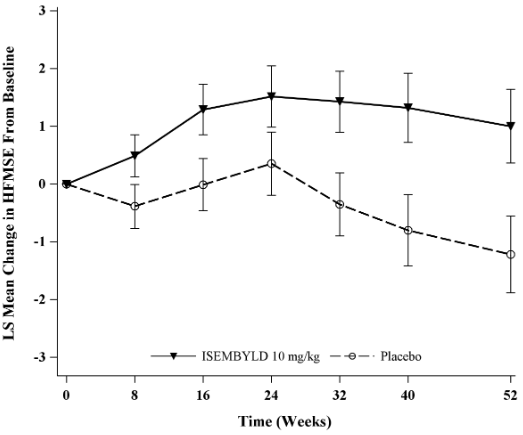
All patients on SMN2-targeted treatment.
Abbreviations: HFMSE, Hammersmith Functional Motor Scale Expanded; LS, Least Squares; SE, Standard Error; SMA, spinal muscular atrophy.
Note: Error bars represent +/- SE around the mean.
© All content on this website, including data entry, data processing, decision support tools, "RxReasoner" logo and graphics, is the intellectual property of RxReasoner and is protected by copyright laws. Unauthorized reproduction or distribution of any part of this content without explicit written permission from RxReasoner is strictly prohibited. Any third-party content used on this site is acknowledged and utilized under fair use principles.