ITVISMA Solution for injection Ref.[116806] Active ingredients: Onasemnogene abeparvovec
Source: European Medicines Agency (EU) Revision Year: 2026 Publisher: Novartis Europharm Limited, Vista Building, Elm Park, Merrion Road, Dublin 4, Ireland
5.1. Pharmacodynamic properties
Pharmacotherapeutic group: Other drugs for disorders of the musculo-skeletal system
ATC code: M09AX09
Mechanism of action
Onasemnogene abeparvovec is a gene therapy designed to introduce a functional copy of the survival motor neuron gene (SMN1) in the transduced cells to address the monogenic root cause of spinal muscular atrophy (SMA). By providing an alternative source of SMN protein expression in motor neurons, it is expected to promote the survival and function of transduced motor neurons.
Onasemnogene abeparvovec is a non-replicating recombinant AAV vector that utilises AAV9 capsid to deliver a stable, fully functional human SMN transgene. The SMN1 gene present in onasemnogene abeparvovec is designed to reside as episomal DNA in the nucleus of transduced cells and is stably expressed in post-mitotic cells. The transgene is introduced to target cells as a self-complementary double-stranded molecule. Expression of the transgene is driven by a constitutive promoter (cytomegalovirus enhanced chicken-β-actin-hybrid), which results in continuous and sustained SMN expression. Proof of the mechanism of action mainly derives from non-clinical studies.
Clinical efficacy and safety
COAV101B12301 (STEER) phase III study in patients with SMA
This is a 52-week, randomised, double-blind, sham-controlled, multicentre study.
Efficacy was assessed in 126 patients with SMA aged 2 to <18 years who were treatment-naïve and able to sit but never able to walk independently. Patients were randomised 3:2 and received Itvisma (1.2 × 10¹⁴ vg) by lumbar intrathecal injection (n=75) or sham procedure (n=51). Randomisation was stratified by age and pre-treatment Hammersmith Functional Motor Scale – Expanded (HFMSE) score at screening. Patients with elevated (reference to ˃1:50) baseline serum anti-AAV9 antibody titre were excluded.
The primary endpoint was the change from baseline in HFMSE total score at the end of follow-up, defined as the average of the week 48 and week 52 assessment, in the overall study population (2 to <18 years age group) with Itvisma compared to sham. A secondary endpoint was the proportion of patients with at least a 3-point improvement from baseline in HFMSE total score at the end of follow-up. The HFMSE evaluates motor function in patients with SMA who have limited ambulation, comprising 33 graded items assessing movements ranging from sitting to using the stairs. Each item is scored from 0 to 2, with a maximum total score of 66. Higher scores indicate better motor function. Another secondary endpoint was the change from baseline in Revised Upper Limb Module (RULM) at the end of follow-up. The RULM is a SMA-specific assessment used to assess upper limb (proximal and distal) motor function. The RULM contains 19 graded items (18 scored from 0 to 2 and 1 scored from 0 to 1), and there is a maximum achievable score of 37, with higher scores indicating greater motor function.
The median age at screening was 4.54 years (range: 2.0 to 16.5 years) and the median reported age of onset of clinical signs and symptoms of SMA was 11 months (range: 6 to 33 months). Patients' highest motor milestone ever achieved included sitting, standing with or without support, or walking with support. At baseline, the mean HFMSE score was 17.97 and 18.17 in the Itvisma-treated group and sham-control group, respectively. The mean baseline RULM score was 16.52 in the Itvisma-treated group and 17.42 in the sham-control group. The baseline demographic characteristics were balanced between the Itvisma and sham arms.
The primary endpoint analysis showed a statistically significant and clinically meaningful improvement in HFMSE scores from baseline at the end of follow-up in the Itvisma-treated group compared to the sham-control group (Table 3 and Figure 1).
Table 3. Primary endpoint in study COAV101B12301:
| Endpoint | Itvisma-treated patients (N=75) | Sham-control patients (N=51) |
| Mean HFMSE total score at baseline (SD) | 17.97 (10.110) | 18.17 (9.756) |
| Mean HFMSE total score at the end of follow-up1 (SD) | 20.49 (11.356) | 19.05 (10.132) |
| Change from baseline in total HFMSE score2 at the end of follow-up in the overall study population (2 to <18 years age group)1,2,3,4 | 2.39 (0.439) | 0.51 (0.532) |
| Difference from sham Estimate (95% CI) | 1.88 (0.51 – 3.25) | |
SD = Standard deviation
1 The end of follow-up was defined as the average of the week 48 and week 52 assessment.
2 Assessed using the Full Analysis Set (FAS) population, which included all participants who were dosed with Itvisma or who underwent sham procedure.
3 Least squares (LS) mean (standard error of the mean [SEM]).
4 The Mixed Model Repeated Measure (MMRM) analysis with fixed effects included treatment, scheduled visit, treatment by visit interaction, the strata, and the baseline HFMSE total score as covariate.
Figure 1. Change from baseline in HFMSE for patients aged 2 to ˂18 years in study COAV101B12301:
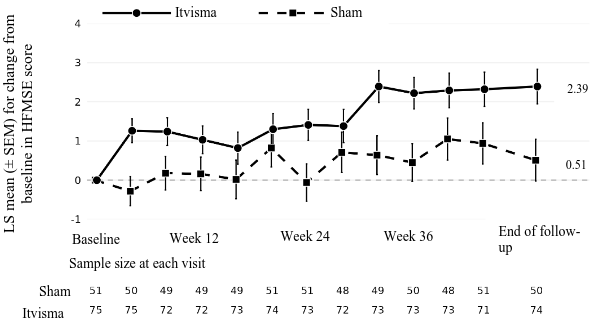
Note: Data represent LS mean ± SEM; intermediate time points are descriptive only and not controlled for multiplicity.
The change from baseline in RULM at the end of follow-up was assessed in the Itvisma-treated and sham-control groups. The least squares (LS) mean increase in RULM total score from baseline to the end of follow-up was 2.44 points in the Itvisma-treated group, and 0.92 points in the sham-control group. The treatment difference of 1.52 points in favour of the Itvisma-treated group did not meet statistical significance (95% CI: 0.34, 2.71) under an alpha level of 0.0025 per the pre-planned multiple testing strategy.
The percentage of patients with at least a 3-point improvement in total HFMSE score from baseline to the end of follow-up was numerically higher in the Itvisma-treated group (39.2%) than the sham-control group (26.0%), although the difference did not meet statistical significance (odds ratio (OR): 2.03; 95% CI: 0.9, 4.57).
Sixty-seven of the 75 patients from COAV101B12301 who received Itvisma continued to be followed for an additional 3 months after the end of follow-up. Over the combined follow-up period of up to 15 months following Itvisma administration, mean HFMSE scores continued to increase, demonstrating improved and sustained motor function.
COAV101B12302 (STRENGTH) phase III study in SMA patients previously treated with other SMA-modifying therapies
This is a phase III, open-label, single-arm, multicentre study of intrathecal administration of Itvisma (1.2 × 10¹⁴ vg) in 27 patients with SMA aged 2 to <18 years (median age at screening: 7.0 years; range: 2.3 to 17.6 years) who discontinued previous SMA treatment (nusinersen n=21, risdiplam n=4, nusinersen and risdiplam [not concurrently] n=2). Prior to treatment with Itvisma, patients had previously received nusinersen for a mean duration of 4.3 years (range: 1.86 to 6.18 years), and risdiplam for a mean duration of 3.0 years (range: 0.39 to 6.28 years). All patients were able to sit but never able to walk independently. Patients' baseline motor function included sitting, standing with or without support and/or walking with support. Patients with elevated (reference to ˃1:50) baseline serum anti-AAV9 antibody titre were excluded.
At week 52, patients showed overall stabilisation in motor function as measured by HFMSE (n=21), with a mean (SD) change from baseline of 0.17 (2.88), and RULM (n=21), with a mean (SD) change from baseline of 0.29 (2.85). After adjusting for baseline age stratum, the adjusted mean (LS mean) change from baseline to week 52 in HFMSE and RULM total score was 1.05 and 0.59, respectively. The majority of patients demonstrated maintenance of baseline motor milestones or higher motor milestones at week 52.
COAV101A12102 (STRONG) phase I/II study in patients with SMA
This is a phase I/II, open-label study in which Itvisma (1.2 × 10¹⁴ vg) was administered as a single intrathecal injection in 25 patients from 6 months to <5 years of age at the time of dosing. All patients were treatment-naive and able to sit but never able to stand or walk independently at baseline. Patients with elevated (reference to ˃1:50) baseline serum anti-AAV9 antibody titre were excluded. Patients were stratified in two groups based on age at dosing (6 months to <2 years of age (N=13); 2 to <5 years of age (N=12)). The median age at dosing was 17.7 months (range: 7 to 23 months) in the 6 months to <2 years age group, and 33.7 months (range: 26 to 55 months) in the 2 to <5 years age group. The median age of onset of clinical signs and symptoms of SMA was 8.0 months and 8.5 months in the 6 months to <2 years group and 2 to <5 years group, respectively.
The primary efficacy endpoint for patients 2 to <5 years of age was the change from baseline in HFMSE at 12 months following Itvisma injection. The mean HFMSE score (SD) was 14.8 (9.98) at baseline and 21.3 (11.94) at month 12. The primary analysis in this age group showed LS mean change (95% CI) in HFMSE from baseline to month 12 of 6.0 (3.7, 8.3) points.
The primary efficacy endpoint for patients 6 months to <2 years of age was the ability to stand alone for at least 3 seconds (Bayley Scales of Infant and Toddler Development (Bayley-III) – Gross Motor (GM) Subtest Item #40), at any post-baseline visit up to 12 months following Itvisma injection. The primary endpoint was not met; 1 of the 13 patients demonstrated this milestone at month 12.
Exploratory analyses in patients 6 months to <2 years of age show improvements from baseline in gross and fine motor skills, as measured by the Bayley-III Gross and Fine Motor Subtests. All 13 patients showed improvement from baseline up to month 12 in gross and/or fine motor subtest total scores, with a mean change (SD) from baseline of 6.7 (6.46) and 12.7 (3.71), respectively. Furthermore, in a subset of patients who reached 2 years of age during the study and had at least seven months post-baseline HFMSE data (n=6), all patients showed increases in HFMSE score ranging from 1 to 14 points (mean ± SD change: 6.7 ± 4.72) from initial assessment of HFMSE to the end of month 7. Efficacy has not been established in the 6 months to ˂2 years age-group.
Twelve of the 25 patients from COAV101A12102 were enrolled in a long-term study for up to 7.2 years. As of 30 June 2025, the majority of patients maintained or further improved their motor function. Nine of the 12 patients received concomitant nusinersen or risdiplam treatment at some point during the long-term study. The reason for concomitant nusinersen or risdiplam is unknown and a conclusion on the treatment effect in those patients cannot be made.
5.2. Pharmacokinetic properties
Onasemnogene abeparvovec vector shedding studies, which assess the amount of vector DNA eliminated from the body through saliva, urine, faeces and nasal secretions, were performed following intrathecal administration.
Vector DNA was detectable in shedding samples following intrathecal injection of onasemnogene abeparvovec. Shedding (excretion) of onasemnogene abeparvovec was primarily via faeces. The majority of the vector DNA (˃90%) is excreted within 2 weeks after dose administration. Peak shedding in faeces was estimated to be between 0.005% to 0.03% of total dose. The maximal shedding concentration in faeces was ~70-fold lower following intrathecal administration of 1.2 × 10¹⁴ vg in COAV101B12301 compared with intravenous administration of 1.1 × 10¹⁴ vg/kg (studies AVXS-101-CL-302 and AVXS-101-CL-303).
In subjects aged 6 months to ˂2 years, the CSF volume increases between 1.0- to 1.6-fold. Based on this, onasemnogene abeparvovec exposure in the CSF in paediatric patients aged 6 months to ˂2 years may be up to 1.6-fold higher compared to patients aged ≥2 years.
5.3. Preclinical safety data
Biodistribution
Following intrathecal administration in non-human primates, the vector was widely distributed with subsequent expression of transgene mRNA. The highest vector DNA concentration was detected in the liver, followed by the dorsal root ganglia (DRG) and spinal cord, with the lowest concentration in the gonads. The highest concentration of transgene mRNA tended to occur in the heart, liver and muscle.
In mice dosed with onasemnogene abeparvovec via intravenous or intracerebroventricular administration at PND1 (post-natal day 1), the viral vector was not detected in germline cells of males and females at week 3, 8 or 24 post-dosing. In juvenile non-human primates treated with a scAAV9 viral vector, which is utilised in onasemnogene abeparvovec but here carrying green fluorescent protein (GFP) or mCherry as transgene, this was shown to transduce oocytes of cycling females 13-17 months of age, but not the seminiferous tubules or germ cells in sexually mature males, following intrathecal, intracisterna magna and intravenous administration.
In non-human primates, high pre-existing serum anti-AAV9 antibody titres (corresponding to human titre values of up to approximately 1:25 000) were not shown to affect scAAV9 vector (utilised in onasemnogene abeparvovec) DNA distribution in the spinal cord following intrathecal administration.
General toxicity
In a 12-month toxicity study conducted in juvenile non-human primates, intrathecal administration of a single dose of onasemnogene abeparvovec at doses of 1.20 × 10¹³, 3.0 × 10¹³, or 6.0 × 10¹³ vg/animal, resulted at 6 weeks post-dosing in acute, minimal to moderate mononuclear cell inflammation and neuronal degeneration in the dorsal root ganglia (DRG) and trigeminal ganglia (TG), as well as axonal degeneration and/or gliosis in the spinal cord. At 12 months, these non-progressive findings resulted in partial to full resolution. These findings in non-human primates had no correlative clinical observations, therefore the clinical relevance in humans is unknown. Liver findings in juvenile non-human primates, including elevated transaminase levels and single-cell necrosis of hepatocytes, demonstrated complete reversibility at 12 months. A NOAEL (no observed adverse effect level) could not be identified because of the inflammation and degeneration in the CNS/DRG/TG already at the lowest dose.
Genotoxicity and carcinogenicity
Genotoxicity and carcinogenicity studies have not been conducted with onasemnogene abeparvovec.
Reproductive and developmental toxicity
In fertility and early embryonic development (FEED) studies conducted in mice, no adverse effects on male or female fertility were observed with onasemnogene abeparvovec at doses of 1.1 × 10¹³ or 1.1 × 10¹⁴ vg/kg administered intravenously.
In an embryofoetal development (EFD) study in mice, pregnant animals received an intravenous dose of either 1.1 × 10¹³ vg/kg or 1.1 × 10¹⁴ vg/kg of onasemnogene abeparvovec on GD6 (gestational day 6). There was no evidence of maternal toxicity, embryofoetal toxicity, teratogenicity or reduced viability. There was no onasemnogene abeparvovec DNA detected in any foetal tissue at GD18, despite the presence of vector DNA in the placenta, ovaries and uterus.
The NOAEL for the EFD study and FEED studies is 1.1 × 10¹⁴ vg/kg, corresponding to at least 7 times the recommended clinical intrathecal dose based on body weight.
© All content on this website, including data entry, data processing, decision support tools, "RxReasoner" logo and graphics, is the intellectual property of RxReasoner and is protected by copyright laws. Unauthorized reproduction or distribution of any part of this content without explicit written permission from RxReasoner is strictly prohibited. Any third-party content used on this site is acknowledged and utilized under fair use principles.