LIPFENDRA Film-coated tablet Ref.[116750] Active ingredients: Enlicitide
Source: FDA, National Drug Code (US) Revision Year: 2026
12.1. Mechanism of Action
Enlicitide is a macrocyclic peptide that binds to PCSK9. PCSK9 binds to the low-density lipoprotein receptors (LDLR) on the surface of hepatocytes to promote LDLR degradation within the liver. By inhibiting the binding of PCSK9 to LDLR, enlicitide increases the number of LDLRs available to clear LDL-C, thereby lowering LDL-C levels.
12.2. Pharmacodynamics
Administration of single doses of enlicitide ≥10 mg results in a maximum reduction in plasma levels of free PCSK9 >90% at Tmax for enlicitide (0.5–1 hour postdose). Exposure–response analysis across enlicitide daily doses ranging from 0.5 times to 1.5 times the recommended dose demonstrated that the 20 mg dose achieved near-maximal reductions in plasma LDL-C in participants with hypercholesterolemia.
Cardiac Electrophysiology
At four times that of the clinical Cmax at the maximum recommended enlicitide dose, clinically significant QTc interval prolongation was not observed.
12.3. Pharmacokinetics
The geometric means (% coefficient of variation) of steady-state enlicitide AUC and Cmax following once daily enlicitide 20 mg were 308 nM•h (28%) and 15.5 nM (29%), respectively, in participants with hypercholesterolemia. Enlicitide plasma exposures were less than dose-proportional between 0.25 times and 15 times the recommended dosage of 20 mg. Steady-state is achieved by approximately 7 days with an accumulation ratio of 1.42.
Absorption
Each LIPFENDRA tablet contains sodium caprate, which facilitates the oral absorption of enlicitide. The oral bioavailability of enlicitide is approximately 1%. When LIPFENDRA is orally administered on an empty stomach in the morning with a meal given at least 30 minutes after the enlicitide dose, enlicitide is rapidly absorbed with a Tmax of approximately 0.5–1 hour.
Effect of Food
LIPFENDRA administration on an empty stomach in the morning, at least 30 minutes before a meal, does not affect the exposure of enlicitide. LIPFENDRA administration 30 minutes after a meal reduces steady-state AUC and Cmax by 48% and 50%, respectively, and delays Tmax.
Effect of Beverages
The administration of LIPFENDRA with black coffee or plain tea does not result in a clinically meaningful change in enlicitide exposure.
Distribution
The apparent steady-state volume of distribution of enlicitide is 2,384 L. Enlicitide exhibits concentration dependent plasma protein binding, ranging from 93% bound at 2 nM to 32% bound at 1 μM. Enlicitide blood to plasma ratio is approximately 0.6.
Elimination
The steady-state apparent clearance in participants with hypercholesterolemia is approximately 41 L/h at the 20 mg once daily dose. Enlicitide clearance increases with increasing concentration, resulting in non- linear pharmacokinetics (PK). Enlicitide has an effective half-life of approximately 14 hours and a terminal half-life of approximately 244 hours.
Metabolism
Enlicitide is minimally metabolized. No major metabolites of enlicitide have been identified.
Excretion
Enlicitide is primarily eliminated via glomerular filtration following IV administration, with approximately 73% and 8% of the dose excreted in urine and feces, respectively.
Specific Populations
Age, Sex, and Race/Ethnicity
There is no clinically meaningful effect of age (18 to 88 years), body weight (40 to 174 kg), sex, race (American Indian or Alaskan Native, Asian, Black or African American, White, or multi-racial), or ethnicity (Hispanic or Latino) on the PK of enlicitide.
Patients with Renal Impairment
Patients with mild (eGFR 60 to 89 mL/min), moderate (eGFR 30 to 59 mL/min), and severe renal impairment (eGFR less than 30 mL/min) are expected to have 5%, 11%, and 26% higher enlicitide steady-state exposure compared to patients with normal renal function. These increases in exposure are not clinically meaningful.
Compared to participants with normal renal function, single dose enlicitide exposure (AUC0-inf) was 17% and 75% higher in participants with end-stage renal disease (ESRD) on hemodialysis when enlicitide was administered before hemodialysis and after hemodialysis, respectively. These increases in exposure are not clinically meaningful.
Patients with Hepatic Impairment
The PK of enlicitide is not impacted by moderate hepatic impairment (Child-Pugh Class B). The PK of enlicitide in participants with severe hepatic impairment (Child-Pugh Class C) was not evaluated.
Drug Interaction Studies
No clinically meaningful drug interactions have been observed with LIPFENDRA. LIPFENDRA (formulated with the permeation enhancer, sodium caprate) did not affect the exposure of lithium, levothyroxine, digoxin, warfarin, atorvastatin, alendronate, lisinopril, or oral semaglutide tablets. Oral semaglutide tablets (formulated with salcaprozate sodium to facilitate absorption) or atorvastatin did not affect the exposure of enlicitide. Based on in vitro studies, LIPFENDRA has very low drug interaction potential via cytochrome P450 enzymes or drug transporters at the therapeutic dose.
13.1. Carcinogenesis, Mutagenesis, Impairment of Fertility
Carcinogenesis
In a 26-week study in RasH2Tg mice, enlicitide was administered daily both by subcutaneous and oral routes at subcutaneous/oral dosages of 2.5/1, 10/2 or 30/4 mg/kg/day. Enlicitide was not carcinogenic in rasH2 transgenic mice up to the highest dose tested, corresponding to 59-fold the human exposure at the RHD, based on AUC.
Based on a comprehensive assessment of the available toxicology data and the PCSK9-specific target, enlicitide is not expected to be carcinogenic in humans.
Mutagenesis
Enlicitide was not mutagenic or genotoxic in a standard battery of genotoxicity tests that included a microbial mutagenicity assay, an in vitro chromosome aberration assay and an in vivo micronucleus assay in rats.
Impairment of Fertility
In fertility and early embryonic-development studies, male or female rats were administered enlicitide subcutaneously at doses of 1, 5, or 10 mg/kg/day for 14 days (female) or 15 days (male) prior to cohabitation, during cohabitation, until the day prior to scheduled sacrifice (male) or through GD 7 (female). There were no adverse effects on fertility, mating performance or early embryonic development up to the highest dose tested, corresponding to 45-fold the human exposure at the RHD, based on AUC
14. Clinical Studies
Primary Hypercholesterolemia in Adults
Trial 1 (CORALreef Lipids, NCT05952856) was a multicenter, double-blind, randomized, placebo-controlled trial in which 2,904 patients with hypercholesterolemia (including those with and without HeFH) and a history of a major atherosclerotic cardiovascular disease (ASCVD) event or increased risk for development of a first major ASCVD event were randomized in a 2:1 ratio to receive LIPFENDRA 20 mg orally once daily (n=1,935) or placebo (n=969) for 52 weeks. Patients required additional LDL-C reduction despite stable lipid-lowering treatment with moderate- or high-intensity statins (unless statin intolerance was documented) with or without other lipid-modifying therapy. Patients taking other PCSK9 inhibitors were excluded.
The mean age at baseline was 63 years (range: 19 to 89 years), 47% were 65 years or older, 39% were female, 54% were White, 26% were Asian, 11% were multi-racial, 9% were Black or African American, and <1% were American Indian or Alaska Native; 28% were of Hispanic or Latino ethnicity. At baseline, 50% had diabetes mellitus (49% type 2 diabetes), 58% had a history of an ASCVD event, and 42% were at increased risk for an ASCVD event. At baseline, 97% were receiving statin therapy (54%, 41%, and 1% were receiving high-, moderate-, or low-intensity statin therapy, respectively). The mean baseline LDL-C was 96 mg/dL.
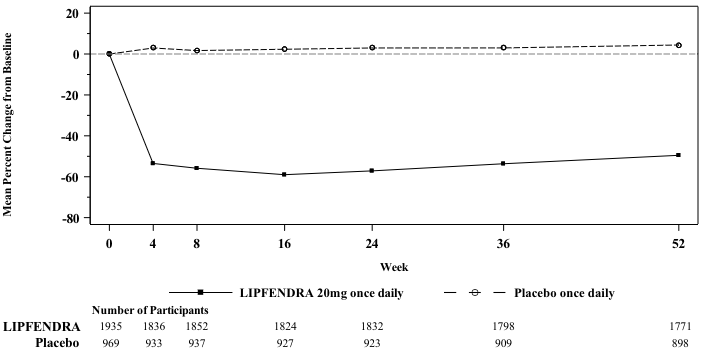
The primary efficacy outcome measure in Trial 1 was the percent change from baseline to Week 24 in LDL- C. The difference between the LIPFENDRA and placebo groups in mean percent change in LDL-C from baseline to Week 24 was -56% (95% CI: -61%, -51%; p<0.001). For additional results, see Table 1 and Figure 1.
Table 1. Percent Change in Lipid Parameters from Baseline to Week 24 in Trial 1 (Patients with Hypercholesterolemia and History of ASCVD Events or Increased Risk for First ASCVD Event):
| Treatment Group | LDL-C | Non-HDL-C | ApoB |
| LIPFENDRA (n=1,935) | -57 | -54 | -50 |
| Placebo (n=969) | 3 | 3 | 3 |
| Difference from placebo (95% CI) | -56 (-61, -51) | -53 (-55, -51) | -50 (-52, -49) |
ApoB = apolipoprotein B; CI = confidence interval; Non-HDL-C = non-high-density lipoprotein cholesterol; LDL-C = low-density lipoprotein cholesterol
Summary statistics shown for LIPFENDRA and placebo rows are raw values based on observed data and do not account for missing data.
The percent change from baseline for LDL-C at 24 weeks was -60% for LIPFENDRA and +3% for placebo, respectively, when LDL-C values 0 were set to missing according to revised data handling rules (post-hoc). The difference between the LIPFENDRA and placebo groups in percent change in LDL-C from baseline to Week 24 was -60% (95% CI: -62%, -57%).
Treatment-specific results are the mean percent changes from baseline at Week 24. The differences from placebo are estimated differences based on an analysis of covariance model with treatment and the stratification factors (renal function and geographic region) as fixed effects and baseline as a covariate. Missing data at Week 24 were handled via multiple imputation using a control-based imputation method.
Figure 1. Observed Mean Percent Change in LDL-C from Baseline Over 52 Weeks in Trial 1 (Patients with Hypercholesterolemia and History of ASCVD or Increased Risk for First ASCVD Event):
Heterozygous Familial Hypercholesterolemia in Adults
Trial 2 (CORALreef HeFH, NCT05952869) was a multicenter, double-blind, randomized, placebo-controlled trial in which 303 patients with HeFH were randomized 2:1 to receive either LIPFENDRA 20 mg orally once daily (n=202) or placebo (n=101) for 52 weeks. Patients required additional LDL-C reduction despite stable, lipid-lowering treatment with moderate- or high-intensity statins, with or without other lipid-modifying therapy. The diagnosis of HeFH was made by clinical criteria or genotyping
The mean age at baseline was 52 years (range: 20 to 84 years), 20% were 65 years or older, 51% were female, 70% were White, 17% were Asian, 11% were multi-racial, and 3% were Black or African American; 21% were of Hispanic or Latino ethnicity. At baseline, 12% had type 2 diabetes mellitus, all patients were receiving statin therapy and 82% were receiving high-intensity statin therapy; 64% of patients were treated with cholesterol-absorption inhibitors (e.g., ezetimibe). The mean baseline LDL-C was 119 mg/dL.
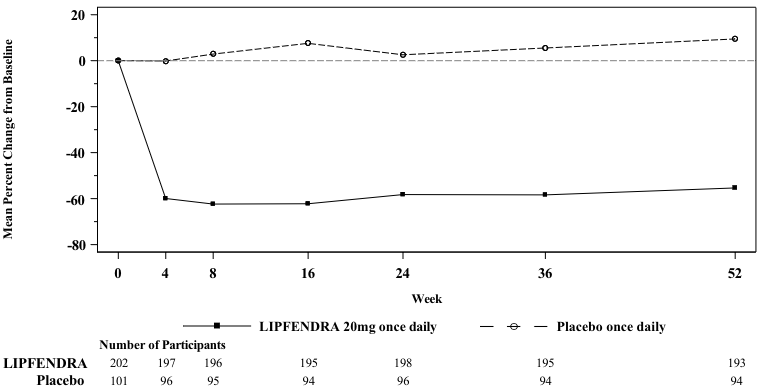
The primary efficacy outcome measure in Trial 2 was the percent change from baseline to Week 24 in LDL-C. The difference between the LIPFENDRA and placebo groups in mean percent change in LDL-C from baseline to Week 24 was -59% (95% CI: -66%, -53%; p<0.001). For additional results, see Table 2 and Figure 2.
Table 2. Percent Change in Lipid Parameters from Baseline to Week 24 in Trial 2 (Patients with HeFH on Statin Therapy):
| Treatment Group | LDL-C | Non-HDL-C | ApoB |
| LIPFENDRA (n=202) | -58 | -52 | -48 |
| Placebo (n=101) | 3 | 2 | 2 |
| Difference from placebo (95% CI) | -59 (-66, -53) | -53 (-59, -47) | -49 (-54, -44) |
ApoB = apolipoprotein B; CI = confidence interval; non-HDL-C = non-high-density lipoprotein cholesterol; LDL-C = low-density lipoprotein cholesterol
Summary statistics shown for LIPFENDRA and placebo rows are raw values based on observed data and do not account for missing data.
Treatment-specific results are the mean percent changes from baseline at Week 24. The differences from placebo are estimated differences based on an analysis of covariance model with treatment as a fixed effect and baseline as a covariate.
Missing data at Week 24 were handled via multiple imputation using a control-based imputation method.
Figure 2. Observed Mean Percent Change in LDL-C from Baseline Over 52 Weeks in Trial 2 (Patients with HeFH on Statin Therapy):
© All content on this website, including data entry, data processing, decision support tools, "RxReasoner" logo and graphics, is the intellectual property of RxReasoner and is protected by copyright laws. Unauthorized reproduction or distribution of any part of this content without explicit written permission from RxReasoner is strictly prohibited. Any third-party content used on this site is acknowledged and utilized under fair use principles.