LYNAVOY Film-coated tablet Ref.[117086] Active ingredients: Linerixibat
Source: European Medicines Agency (EU) Revision Year: 2026 Publisher: GlaxoSmithKline Trading Services Limited, 12 Riverwalk, Citywest Business Campus, Dublin 24, Ireland, D24 YK11
5.1. Pharmacodynamic properties
Pharmacotherapeutic group: Bile and liver therapy, other drugs for bile therapy
ATC code: A05AX08
Mechanism of action
Linerixibat is a locally acting, minimally absorbed reversible inhibitor of the ileal bile acid transporter (IBAT). It decreases the reabsorption of bile acids in the ileum leading to increased faecal elimination. Linerixibat improves pruritus in PBC patients which is assumed to be due to a decrease in mediators of pruritus including serum bile acids, lysophosphatidic acid (LPA) [via measurement of autotaxin as a surrogate] and interleukin 31 (IL-31).
Pharmacodynamic effects
Linerixibat reduces total serum bile acids in healthy volunteers and patients with cholestatic pruritus in PBC. In healthy volunteers, serum bile acids were reduced within 1 day of treatment with linerixibat compared to placebo treatment.
Clinical efficacy
The efficacy and safety of linerixibat in the treatment of cholestatic pruritus in patients with PBC were evaluated in a randomised, double-blind, placebo-controlled, multicentre, global Phase 3 study, GLISTEN. Patients (N=238) were randomised to Lynavoy 40 mg twice daily (N=119) or placebo (N=119) for 24 weeks. Seventeen patients who participated remotely (fully decentralised site) were not included in the efficacy analyses (Lynavoy N=111, placebo N=110). One patient randomised to placebo withdrew before initiating treatment.
Eligible patients had a confirmed diagnosis of PBC and moderate or severe pruritus (assessed by the Worst Itch Numerical Rating Scale [Worst Itch NRS] in the 4 weeks prior to randomisation. Patients who were on stable UDCA, fibrates, bile acid binding resins or other antipruritic therapy at baseline were eligible to enrol and to continue their PBC and/or pruritus treatment regimen unchanged throughout the duration of the study. Exclusion criteria included hepatic decompensation, chronic viral hepatitis, symptomatic cholelithiasis, active cholecystitis, primary sclerosing cholangitis, alcoholic liver disease, current malignancies, active inflammatory ileal disease, bariatric surgery with ileal bypass, skin disorders with itch, clinically significant diarrhoea, severe renal impairment (estimated glomerular filtration rate [eGFR] <30 mL/min/1.73 m²) and treatment with obeticholic acid (OCA).
The mean age of patients was 55.5 years (range 30 to 80), 95% were female, 56% were Caucasian. The mean (range) ALP at baseline was 234 IU/L (46.5-1102): 24% of subjects were ≤1 times the upper limit of normal (x ULN), 28% were >1 x ULN and <1.67 x ULN, and 48% were ≥1.67 x ULN. Mean (SD) baseline itch severity was 7.4 (1.5) based on Worst Itch NRS with 41% categorized as having moderate itch and 59% as having severe itch. At baseline 97% of patients were receiving UDCA. A total of 43% of patients randomised to linerixibat and 48% randomised to placebo were receiving concomitant fibrates, selective serotonin reuptake inhibitors, bile acid binding resins, gabapentin, antihistamines, opiate antagonists, rifampicin and/or pregabalin which could impact itch.
Worst Itch NRS Scores
In GLISTEN, linerixibat demonstrated a significant improvement from baseline in pruritus compared with placebo over 24 weeks of treatment (primary endpoint) as shown in Table 2.
Table 2. Change from baseline in worst itch NRS scorea over 24 weeks:
| Lynavoy (n=111) | Placebo (n=109) | |
| Baseline Monthly Itch Score, Mean (SD)b | 7.35 (1.62) | 7.36 (1.44) |
| Analysis of Change from Baseline in Monthly Itch Score over 24 Weeksc | ||
| Change from Baseline LS Mean (95% CI) | -2.76 (-3.13, -2.38) | -2.07 (-2.46, -1.69) |
| LS Mean Difference vs. Placebo (95% CI) | -0.68 (-1.14, -0.23) p=0.003 | |
SD = standard deviation; LS = least squares; CI = confidence interval
a Worst Itch NRS: 0 = no itching to 10 = worst imaginable itching.
b Baseline determined from all placebo patients, n=110
c Based on a least squares mean from a mixed-effect model for repeated measures (MMRM) for change from baseline in Monthly Itch Score over the 24-week period with terms for treatment, visit, treatment by visit interaction, baseline itch, baseline itch by visit interaction, and use of baseline concomitant itch medication.
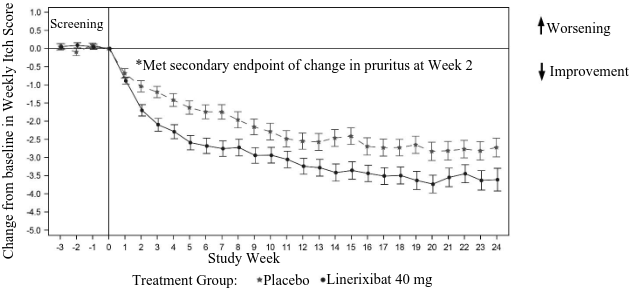
Change from baseline in weekly itch scores through Week 24 are shown in Figure 1. There was significant improvement in pruritus by Week 2 based on the Worst Itch NRS (Weekly Itch Score) for the linerixibat treatment group compared with placebo (LS mean difference -0.69 [95% CI: -1.06, -0.31], p<0.001).
Figure 1. Mean treatment group change from baseline in worst itch NRS score through Week 24:
Itch responders
A higher proportion of patients randomised to linerixibat compared with placebo achieved a clinically meaningful itch response at Week 24 when defined as an improvement of ≥2-, ≥3-, or ≥4-points from baseline in the Worst Itch NRS Score (Table 3).
Table 3. Analysis for difference in itch responder rates at Week 24:
| Treatment group | n | % Respondersa | Adjusted Difference vs Placebo (95% CI)a |
| Responder: reduction in Monthly Itch Score from Baseline ≥2 | |||
| Lynavoy 40 mg | 111 | 68% | 6% (-7 %, 20%) |
| Placebo | 110 | 62% | |
| Responder: reduction in Monthly Itch Score from Baseline ≥3 | |||
| Lynavoy 40 mg | 111 | 55% | 13% (0%b, 27%) |
| Placebo | 110 | 42% | |
| Responder: reduction in Monthly Itch Score from Baseline ≥4 | |||
| Lynavoy 40 mg | 111 | 40% | 13% (0%c, 26%) |
| Placebo | 110 | 27% | |
a Based on Cochran-Mantel-Haenszel (CMH) stratified analysis adjusting for baseline stratification factors (Baseline Itch Severity and concomitant cholestatic pruritus treatment regimen). Combined results from multiple imputation.
b The lower limit of the 95% CI represents a rounded value of -0.2%
c The lower limit of the 95% CI represents a rounded value of 0.4%
Pruritus-related sleep interference
Patients randomised to linerixibat had significantly improved pruritus-related sleep interference compared with placebo over 24 weeks of treatment (-2.70 linerixibat vs -2.16 placebo; LS mean difference -0.54 [95% CI: -1.02, -0.06], p=0.027).
Additional pruritus-related assessments
At baseline, patients randomised to both linerixibat and placebo reported similar levels of pruritus severity based on the Patient Global Impression of Severity (PGI-S) item (recall: past 7 days; score range: 1 [absent] to 5 [very severe]). Treatment with linerixibat resulted in more improvement in the PGI-S score when compared to placebo over 24 weeks (LS mean change from baseline -1.17 vs. -0.80; LS mean difference -0.37 [95% CI: -0.55, -0.18]). At Week 24, a larger proportion of the linerixibat group (66%) compared to placebo (48%) reported 'absent' or 'mild' itch.
Patients randomised to linerixibat reported more itch improvement over 24 weeks compared to placebo as measured by Patient Global Impression of Change (PGI-C) scores (range: 1 [very much improved] to 7 [very much worse]) (LS mean 1.97 vs. 2.51; LS mean difference -0.53 [95% CI: -0.81, -0.25]). At Week 24, a larger proportion of the linerixibat group (54%) compared to placebo (36%) reported itch severity to be 'very much improved', and a larger proportion of patients in the placebo group (26%) reported 'no change' compared to the linerixibat group (3%).
Maintenance of efficacy
In the open label, long term extension study (LLSAT), the majority of responders following 24 weeks of linerixibat treatment maintained their response at Week 52: 72.7% of those with ≥2-point response, 80.8% with a ≥3-point response and 81.8% with a ≥4-point response.
Paediatric population
The European Medicines Agency has waived the obligation to submit the results of studies with Lynavoy in all subsets of the paediatric population in the treatment of cholestatic pruritus with PBC (see section 4.2 for information on paediatric use).
5.2. Pharmacokinetic properties
Linerixibat inhibits the ileal bile acid transporter in the lumen of the small intestine; therefore, plasma levels of linerixibat are not relevant to its clinical efficacy. Following single and repeated oral administration of linerixibat, plasma concentrations were often below the limit of quantification (10 pg/mL).
Absorption
Linerixibat is minimally absorbed following oral administration. The absolute oral bioavailability of linerixibat is 0.05%. Following multiple doses of linerixibat 40 mg twice daily in PBC patients with cholestatic pruritus, plasma concentrations are often below the limit of detection (10 pg/mL) and highly variable.
Effect of food
The effect of food on linerixibat plasma concentrations is not clinically relevant. Due to the minimal absorption of linerixibat, pharmacokinetic parameters in the food effect study were highly variable. Peak systemic concentrations of linerixibat (Cmax) were lower when 40 mg linerixibat was administered orally under fed compared to fasted conditions (geometric least squares mean ratio 0.663, 90% CI 0.443 to 0.991). Despite the lack of clinically important pharmacokinetic effects with food, it is recommended to administer linerixibat approximately 30 minutes prior to food or beverage (other than water) to allow linerixibat to enter the gastrointestinal lumen prior to release of bile acids (see section 4.2).
Distribution
The in vitro plasma protein binding range of linerixibat was 71.0 to 76.4%.
Biotransformation
Following administration of oral radiolabelled linerixibat, no linerixibat metabolites have been detected in plasma. Three minor oxidative metabolites were detected in faeces, and each accounted for negligible radioactivity (less than 1%), demonstrating that linerixibat is minimally metabolised in humans.
Elimination
Following oral administration of radiolabelled linerixibat, approximately 97% of the dose was excreted in faeces; approximately 0.04% of the dose was excreted in urine. More than 99% of faecal radioactivity was determined to be unchanged and unabsorbed linerixibat.
Other special populations
No clinically meaningful differences in the pharmacokinetics of linerixibat were observed based on body weight, age, sex, or race/ethnicity.
Renal impairment
Linerixibat has not been studied in patients with severe renal impairment or end stage renal disease (ESRD) including those on haemodialysis. Renal impairment is not expected to impact linerixibat exposure, because linerixibat is minimally absorbed and has negligible recovery in urine (<0.04% of the oral dose).
Hepatic impairment
Hepatic metabolism is not a major component of the elimination of linerixibat. In a pharmacokinetic study in participants with moderate hepatic impairment (Child-Pugh B), the mean AUC(0-∞) and Cmax values were approximately 13 times and 9.4 times higher than matched healthy subjects. However, given that linerixibat is minimally absorbed, the systemic exposures in participants with moderate hepatic impairment following a 40 mg dose were still exceedingly low (Cmax 1 980 pg/mL) and were of a similar magnitude to exposures following a 40 mg dose in patients with PBC (Cmax 922 pg/mL). Linerixibat has not been studied in patients with severe hepatic impairment (Child-Pugh C).
Drug interactions
Bile acid binding resins
Colestyramine and colesevelam bind linerixibat in vitro (78-95% bound); therefore, these resins have the potential to inhibit the effect of linerixibat on its target, IBAT (see sections 4.2 and 4.5).
IBAT substrates
Ursodeoxycholic acid (UDCA):
In linerixibat clinical studies, concomitant administration of UDCA with linerixibat had no effect on UDCA plasma concentrations and no clinically relevant increases in ALP were observed (see section 4.5). The geometric mean ratio (90% CI) for dose-normalized UDCA AUC(0-24) was 0.99 (0.83, 1.19) when comparing co-administration of UDCA with linerixibat vs. with placebo. However, there was a significant decrease of the UDCA conjugates, glyco-UDCA and tauro-UDCA, of which the clinical relevance remains unclear (see section 4.5).
Effects of linerixibat on cytochrome P450 enzymes (CYPs) and transporters:
In in vitro studies, linerixibat did not inhibit CYPs 1A2, 2A6, 2B6, 2C8, 2C9, 2C19, 2D6, and 2E1, but was an inhibitor of CYP3A4. Due to the low fraction absorbed, an interaction based on CYP3A4 inhibition is not likely. Linerixibat did not induce CYPs 1A2, 2B6, and 3A4.
Linerixibat does not inhibit the transporters P-glycoprotein, breast cancer resistance protein (BCRP), organic anion transporters (OAT) 1 and 3, organic cation transporter (OCT) 2, and multi drug and toxin extrusion protein (MATE) 1 and 2-K. In vitro studies suggest that there is a potential for linerixibat to inhibit OATP1B1 and OATP1B3. However, due to the low fraction absorbed, an interaction is not likely.
5.3. Preclinical safety data
Non-clinical data reveal no special hazard for humans based on studies of safety pharmacology, repeat-dose toxicity, genotoxicity, carcinogenic potential, or toxicity to reproduction.
Linerixibat did not cause developmental toxicity in rat or rabbit studies at doses up to 11-times (for rats) and 4.5-times (for rabbits) the AUC at the maximal recommended human dose (MRHD). Linerixibat had no effect on male or female fertility or early embryonic development in rats or on offspring during gestation and lactation when administered to dams at exposures approximately 12-times the AUC at the MRHD. Linerixibat was present in the plasma of offspring (up to 15.3 ng/mL) via lactational exposure.
© All content on this website, including data entry, data processing, decision support tools, "RxReasoner" logo and graphics, is the intellectual property of RxReasoner and is protected by copyright laws. Unauthorized reproduction or distribution of any part of this content without explicit written permission from RxReasoner is strictly prohibited. Any third-party content used on this site is acknowledged and utilized under fair use principles.