NEXPOVIO Film-coated tablet Ref.[116825] Active ingredients: Selinexor
Source: European Medicines Agency (EU) Revision Year: 2026 Publisher: Stemline Therapeutics B.V., Basisweg 10, 1043 AP Amsterdam, Netherlands
5.1. Pharmacodynamic properties
Pharmacotherapeutic group: Antineoplastic agents, other antineoplastic agents
ATC code: L01XX66
Mechanism of action
Selinexor is a reversible covalent selective inhibitor of nuclear export (SINE) compound that specifically blocks exportin 1 (XPO1). XPO1 is the major mediator of the nuclear export of many cargo proteins including tumour suppressor proteins (TSPs), growth regulators and mRNAs of growth promoting (oncogenic) proteins. XPO1 inhibition by selinexor leads to marked accumulation of TSPs in the nucleus, cell cycle arrest, reductions in several oncoproteins such as c-Myc and cyclin D1, and apoptosis of cancer cells. The combination of selinexor and dexamethasone and/or bortezomib demonstrated synergistic cytotoxic effects in multiple myeloma in vitro and increased anti‐tumour activity in murine xenograft multiple myeloma models in vivo, including those resistant to proteasome inhibitors.
Cardiac electrophysiology
The effect of multiple doses of selinexor up to 175 mg twice weekly on the QTc interval was evaluated in patients with heavily pre-treated haematologic malignancies. Selinexor had no large effect (i.e. no greater than 20 ms) on QTc interval at the therapeutic dose level.
Clinical efficacy and safety
Selinexor in combination with bortezomib and dexamethasone (SVd) for the treatment of patients with multiple myeloma
The efficacy and safety of selinexor in combination with bortezomib and dexamethasone were evaluated in Study KCP-330-023 (BOSTON), a phase 3, global, randomised, open-label, active-controlled study, in patients with multiple myeloma who had received at least one prior therapy. BOSTON required patients to have measurable myeloma per International Myeloma Working Group (IMWG) criteria with documented evidence of progressive disease on or after their most recent treatment regimen, have previously received treatment with one to three prior different regimens for multiple myeloma. Patients who had previously received proteasome inhibitors (alone or as part of a combination treatment) were required to have had at least a partial response to the therapy and at least a 6-month interval since their last proteasome inhibitor therapy, with no history of discontinuation of bortezomib due to Grade 3 or higher toxicity. Patients had to have an ECOG performance score of ≤2, adequate hepatic, renal and haematopoietic function. Patients with systemic light-chain amyloidosis, active central nervous system myeloma, peripheral neuropathy of Grade 2 or higher, or painful neuropathy of Grade 2, plasma cell leukaemia, polyneuropathy, organomegaly, endocrinopathy, monoclonal gammopathy, or skin changes (POEMS) syndrome were excluded from trial participation.
The study compared treatment with once weekly selinexor 100 mg (administered orally on Day 1 of each week) in combination with twice weekly dexamethasone 20 mg (administered orally on Days 1 and 2 of each week) and once-weekly bortezomib 1.3 mg/m² (administered subcutaneous on Day 1 of weeks 1-4 with week 5 off) [SVd arm] to treatment with twice-weekly bortezomib 1.3 mg/m² (administered subcutaneous on Days 1, 4, 8, 11) with low-dose dexamethasone 20 mg (administered orally on Days 1, 2, 4, 5, 8, 9, 11, 12) of a standard 21-day cycle for the first 8 cycles, followed by once weekly subcutaneous bortezomib 1.3 mg/m² (administered subcutaneously on Day 1 of weeks 1-4 with week 5 off) with twice weekly low-dose dexamethasone 20 mg (administered orally on Days 1 and 2 of each week) for cycles ≥9 [Vd arm].
Treatment continued in both arms until disease progression, death or unacceptable toxicity. Upon confirmed progressive disease (PD), patients in the control arm (Vd) could cross over to receive selinexor based therapy in the form of weekly SVd (BOSTON regimen) or weekly Sd (selinexor 100 mg once weekly (Day 1 of each week) and low-dose dexamethasone 20 mg twice weekly (Days 1 and 2 of each week).
A total of 402 patients were randomised: 195 to SVd arm and 207 to Vd arm.
Baseline patient and disease characteristics are described in Table 6.
Table 6. Demographics and disease characteristics of patients with relapsed refractory multiple myeloma in BOSTON Study (n=402):
| Characteristic | SVd (n=195) | Vd (n=207) |
| Median from diagnosis to randomization, years (range) | 3.81 (0.4, 23.0) | 3.59 (0.4, 22.0) |
| Time since end of last prior therapy, median (range) | 48 weeks (1, 1088) | 42 weeks (2, 405) |
| Number of prior treatment regimens, mean (range) | 1.7 (1, 3) | 1.7 (1, 3) |
| Number of Prior Therapies (%) | ||
| 1 | 51% | 48% |
| 2 | 33% | 31% |
| 3 | 16% | 21% |
| Age, median (range) | 66 years (40, 87) | 67 years (38, 90) |
| Patients <65 years of age, n (%) | 86 (44) | 75 (36) |
| Patients 65-74 years of age, n (%) | 75 (39) | 85 (41) |
| Patients ≥75 years of age, n (%) | 34 (17) | 47 (23) |
| Males : Females, n (%) | 115 (59) : 80 (41) | 115 (56) : 92 (44) |
| Type of prior therapy, n (%) | ||
| Stem Cell transplantation | 76 (39) | 63 (30) |
| Lenalidomide in any combination | 77 (39) | 77 (37) |
| Pomalidomide in any combination | 11 (6) | 7 (3) |
| Bortezomib in any combination | 134 (69) | 145 (70) |
| Carfilzomib in any combination | 20 (10) | 21 (10) |
| Any proteasome inhibitor in any combination | 148 (76) | 159 (77) |
| Daratumumab in any combination | 11 (6) | 6 (3) |
| Revised International Staging System at baseline, n (%) | ||
| I | 56 (29) | 52 (25) |
| II | 117 (60) | 125 (60) |
| III | 12 (6) | 16 (8) |
| Unknown | 10 (5) | 14 (7) |
| High-risk cytogeneticsa, n (%) | 97 (50) | 95 (46) |
| ECOG performance status: 0 to 1, n (%) | 175 (90) | 191 (92) |
a Includes any of del (17p)/p53, t (14;16), t (4;14), 1q21.
The primary endpoint was progression free survival (PFS) according to the IMWG Uniform Response Criteria for Multiple Myeloma, as assessed by an Independent Review Committee (IRC).
Based on a pre-planned PFS interim analysis, where the boundary for PFS was crossed (median follow up of 15.1 months); BOSTON showed a statistically significant improvement in PFS in the SVd arm as compared to the Vd arm; hazard ratio (HR)=0.70 (95% CI: 0.53-0.93; p=0.0075), a median PFS of 13.9 months (95% CI: 11.7, not reached) and 9.5 months (95% CI: 8.1, 10.8) in the SVd and Vd arms respectively.
There was a statistically significant improvement in overall response rate (ORR): 76.4% in the SVd arm vs 62.3% in the Vd arm, p=0.0012. The ≥ very good partial response rate (≥VGPR rate includes stringent complete response [sCR], complete response [CR] and VGPR) was 44.6% in the SVd arm compared with 32.4% in the Vd arm.
The median time to response was 1.4 months in the SVd-treated patients and 1.6 months in the Vd treated patients. The median duration of response (DoR), among responding patients, was 20.3 months and 12.9 months in the SVd and Vd arms, respectively.
At the time of the pre-planned PFS interim analysis, 109 overall survival (OS) events had occurred; there were 47 and 62 deaths in the SVd and Vd arms respectively (HR=0.84 [95% CI: 0.57, 1.23]). Median OS was not reached for the SVd arm and was of 25 months for the Vd arm.
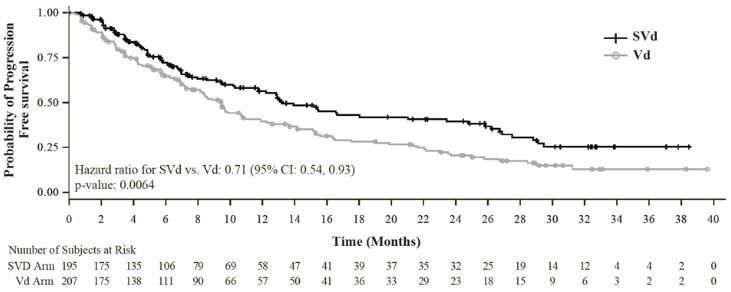
At an updated descriptive analysis with a median follow up of 22.1 months results were consistent with the primary analysis. Efficacy results are shown in Table 7 and Figure 1.
Table 7. Efficacy results assessed by independent review committee in BOSTON study (median follow-up 22.1 months):
| SVd (n=195) | Vd (n=207) | |
| Progression Free Survival (PFS)a Hazard Ratio (95% CI) | 0.71 (0.54, 0.93) | |
| Median PFS in months (95% CI) | 13.2 (11.7, 23.4) | 9.5 (8.1, 10.8) |
| Overall Response Rate (ORR)b, n (%) | 150 (76.9) | 131 (63.3) |
| 95% CI | (70.4, 82.6) | (56.3, 69.9) |
| sCR | 19 (10) | 13 (6) |
| CR | 14 (7) | 9 (4) |
| VGPR | 54 (28) | 45 (22) |
| PR | 63 (32) | 64 (31) |
| Time to Response, months (95% CI) | 1.4 (1.4, 1.5) | 1.6 (1.5, 2.1) |
| Median Duration of Response, months (95% CI)c | 17.3 (12.6, 26.3) | 12.9 (9.3, 15.8) |
| Overall survival (OS, median follow-up 28.7 months)a Number of events, n (%) | 68 (35) | 80 (39) |
| Median OS, months (95% CI) | 36.7 (30.2, Not Reached) | 32.8 (27.8, Not Reached) |
| Hazard Ratio (95% CI) | 0.88 (0.63, 1.22) | |
SVd=selinexor-bortezomib-dexamethasone, Vd=bortezomib-dexamethasone, sCR= stringent complete response, CR= complete response, VGPR= very good partial response, PR= partial response
* Efficacy results reported correspond to a descriptive analysis based on the 15 Feb 2021 data cut off.
a Hazard ratio is based on stratified Cox's proportional hazard regression modelling, p-value based on stratified log-rank test.
b Includes sCR + CR + VGPR + PR, p value based on Cochran-Mantel-Haenszel test.
c Includes responding patients who achieved a PR or better.
Figure 1. Kaplan-Meier Curve of PFS in BOSTON study (median follow-up 22.1 months):
Grade ≥2 peripheral neuropathy, a pre‐specified key secondary endpoint, was lower in the SVd arm (21%) compared to the Vd arm (34%); odds ratio 0.50 [95% CI: 0.32, 0.79, p=0.0013], due to the lower dose of bortezomib in the SVd arm.
Selinexor in combination with dexamethasone (Sd) for the treatment of patients with relapsed/refractory multiple myeloma
Study KPC-330-012 (STORM), a phase 2, multi-centre, single-arm, open-label, study, enrolled patients with relapsed and/or refractory multiple myeloma (RRMM). STORM Part 2 required patients to have measurable disease per IMWG criteria, have previously received three or more antimyeloma treatment regimens including an alkylating agent, glucocorticoids, bortezomib, carfilzomib, lenalidomide, pomalidomide, and an anti-CD38 monoclonal antibody; and whose myeloma was documented to be refractory to glucocorticoids, a proteasome inhibitor, an immunomodulatory agent, an anti-CD38 monoclonal antibody, and to the last line of therapy. Patients had to have an ECOG performance status score ≤2, adequate hepatic, renal and haematopoietic function. Systemic light chain amyloidosis, active central nervous system myeloma, peripheral neuropathy of Grade 3 or higher, or painful neuropathy of Grade 2 or higher were exclusion criteria.
Patients were treated with 80 mg selinexor in combination with 20 mg dexamethasone on Days 1 and 3 of every week. Treatment continued until disease progression, death or unacceptable toxicity.
Among patients enrolled in STORM Part 2 (n=123), eighty-three (83) patients had RRMM that was refractory to two proteasome inhibitors (bortezomib, carfilzomib), two immunomodulators (lenalidomide, pomalidomide) and an anti-CD38 monoclonal antibody (daratumumab). The median duration of selinexor treatment in these 83 patients was 9 weeks (range: 1 to 61 weeks). The median total dose of selinexor received was 880 mg (range 160 to 6,220 mg), with a median dose of 105 mg (range: 22 to 180 mg) received per week.
The data presented below is from the 83 patients whose disease was refractory to bortezomib (B), carfilzomib (C), lenalidomide (L), pomalidomide (P), and daratumumab (D) (penta-refractory).
Table 8 provides patients disease and prior treatment characteristics.
Table 8. Demographics and disease characteristics of patients with relapsed refractory multiple myeloma treated with twice weekly 80 mg selinexor and 20 mg dexamethasone (n=83):
| Characteristics | |
| Median from diagnosis to start of study treatment, years (range) | 7 years (1, 23) |
| Number of prior treatment regimens, median (range) | 8 (4, 18) |
| Age, median (range) | 65 years (40, 86) |
| Patients <65 years of age, n (%) | 40 (48) |
| Patients 65-74 years of age, n (%) | 31 (37) |
| Patients ≥75 years of age, n (%) | 12 (15) |
| Males : Females, n (%) | 51 M (61) : 32 F (39) |
| Refractory status to specific treatment combinations, n (%) | |
| Penta refractory (BCLPD) | 83 (100) |
| Daratumumab in any combination | 57 (69) |
| Daratumumab as single agent | 26 (31) |
| Previous stem cell transplant1, n (%) ≥2 transplants | 67 (81) 23 (28) |
| Previous CAR-T Cell Therapy, n (%) | 2 (2.4) |
| Revised Integrated Staging System at baseline, n (%) | |
| I | 10 (12) |
| II | 56 (68) |
| III | 17 (21) |
| High-risk cytogenetics, n (%) (includes any of del(17p)/p53, t(14; 16), t(4; 14), or 1q21) | 47 (57) |
| ECOG performance status: 0 to 1, n (%) | 74 (89) |
1 One patient had an allogeneic stem cell transplant.
The primary efficacy endpoint was overall response rate (ORR) as assessed by an Independent Review Committee based on the IMWG uniform response criteria for multiple myeloma. Responses were assessed monthly and as per IMWG guidelines. Table 9 provides an overview of the efficacy results.
Table 9. Efficacy results: assessed by Independent Review Committee (STORM, patients with relapsed refractory multiple myeloma treated with twice weekly 80 mg selinexor and 20 mg dexamethasone):
| Efficacy endpoint | NEXPOVIO 80 mg + dexamethasone 20 mg n=83 |
| Overall response rate (ORR), n (%) (includes sCR + VGPR + PR)1 | 21 (25.3) |
| 95% confidence interval | 16.4, 36 |
| sCR, MRD negative, n (%) | 1 (1.2) |
| CR, n (%) | 0 (0) |
| VGPR, n (%) | 4 (4.8) |
| PR, n (%) | 16 (19.3) |
| Minimal response (MR), n (%) | 10 (12.0) |
| Stable disease (SD), n (%) | 32 (38.6) |
| Progressive disease (PD)/not evaluable (NE), n (%) | 20 (24.1) |
| Median time to first response (weeks) (range: 1 to 10 weeks) | 3.9 |
| Median duration of response (DOR) months (95% confidence interval) | 3.8 (2.3, 10.8) |
1 sCR = stringent complete response, CR = complete response, VGPR = very good partial response, PR = partial response
Paediatric population
The European Medicines Agency (EMA) has waived the obligation to submit the results of studies with selinexor in all subsets of the paediatric population in the treatment of RRMM (see section 4.2 for information on paediatric use).
5.2. Pharmacokinetic properties
Absorption
Following oral administration of selinexor peak plasma concentration, Cmax is reached within 4 hours. Concomitant administration of a high fat meal (800-1,000 calories with approximately 50% of total caloric content of the meal from fat) did not have a clinically significant effect on the pharmacokinetics of selinexor.
Distribution
Selinexor is 95.0% bound to human plasma proteins. In a population pharmacokinetic (PK) analysis, the apparent volume of distribution (Vd/F) of selinexor was 133 L in cancer patients.
Biotransformation
Selinexor is metabolised by CYP3A4, multiple UDP-glucuronosyltransferases (UGTs) and glutathione S-transferases (GSTs).
Elimination
Following a single dose of 80 mg selinexor the mean half-life (t1/2) is 6 to 8 hours. In a population PK analysis, the apparent total clearance (CL/F) of selinexor was 18.6 L/h in cancer patients.
Specific populations
Age, sex and race
Age (18 to 94 years of age), sex, or race had no clinically significant effect on the pharmacokinetics of selinexor.
In the population PK dataset, age and race were not identified as a significant covariate, gender was identified as a significant covariate.
Renal impairment
The degree of renal impairment was determined by creatinine clearance as estimated by the Cockcroft- Gault equation. Results from population PK analyses of patients with normal (n=283, CLcr: ≥90 mL/min), mild (n=309, CLcr: 60 to 89 mL/min), moderate (n=185, CLcr: 30 to 59 mL/min) or severe (n=13, CLcr: 15 to 29 mL/min) renal dysfunction indicated that creatinine clearance had no impact on the PK of NEXPOVIO. Therefore, mild, moderate, or severe renal impairment is not expected to alter selinexor PK, and no adjustments in the dose of selinexor are required in patients with renal dysfunction.
Hepatic impairment
Population PK analysis indicated that mild hepatic impairment (bilirubin >1-1.5 x ULN or AST > ULN, but bilirubin ≤ ULN, n=119) had no clinically significant effect on the PK of selinexor. In a clinical study using NCI-ODWG criteria to classify the degree of hepatic impairment, no clinically relevant change in selinexor pharmacokinetics was seen in patients with moderate hepatic impairment (TB >1.5 to 3 x ULN and any AST, n=7).
In patients with severe hepatic impairment (TB >3 x ULN and any AST, n=6) up to a 32% higher dose normalized exposure was seen in comparison to patients with normal hepatic function. Hepatic impairment did not result in any clinically relevant changes in plasma protein binding of selinexor.
5.3. Preclinical safety data
Repeated-dose Toxicity
Findings in the repeat dose 13-week rat study were decrements in body weight gain and food consumption, and haematopoietic/lymphoid hypoplasia, and male/female reproductive organ effects. In the 13-week monkey study, the treatment-related effects observed included body weight loss, gastrointestinal effects, and lymphoid/haematologic depletion. Gastrointestinal toxicities, including anorexia, decrements in body weight gain and reduced food consumption were noted to be CNS-mediated. No safety margin for these toxicities could be established.
Genotoxicity
Selinexor was not mutagenic in a bacterial reverse mutation assay. Selinexor was not clastogenic in either the in vitro cytogenetic assay in human lymphocytes or in the in vivo rat micronucleus assay.
Carcinogenicity
Carcinogenicity studies have not been conducted with selinexor.
Toxicity to Reproduction and Development
Fertility studies in animals have not been conducted with selinexor. In repeat-dose oral toxicity studies, selinexor was administered for up to 13 weeks in rats and monkeys. Reduced sperm, spermatids, and germ cells in epididymides and testes were observed in rats, decreased ovarian follicles were also observed in rats, and single cell necrosis of testes was observed in monkeys. These findings were observed at systemic exposures approximately 0.11, 0.28, and 0.53 times, respectively, the exposure (AUClast) in humans at the recommended human dose of 80 mg. Developmental effects were seen with daily exposure in pregnant rats at systemic exposures below the exposure (AUClast) in humans at the recommended human dose of 80 mg.
Other Toxicities
A guinea pig sensitisation assay showed that selinexor at 25% induced a mild Grade II dermal contact hypersensitivity response at 24 and 48 hours.
© All content on this website, including data entry, data processing, decision support tools, "RxReasoner" logo and graphics, is the intellectual property of RxReasoner and is protected by copyright laws. Unauthorized reproduction or distribution of any part of this content without explicit written permission from RxReasoner is strictly prohibited. Any third-party content used on this site is acknowledged and utilized under fair use principles.