OMISIRGE Suspension for solution for infusion Ref.[116107] Active ingredients: Omidubicel
Source: FDA, National Drug Code (US) Revision Year: 2025
1. Indications and Usage
1.1 Hematologic Malignancies
OMISIRGE is indicated for the treatment of adults and pediatric patients 12 years and older with hematologic malignancies who are planned for umbilical cord blood transplantation following myeloablative conditioning to reduce the time to neutrophil recovery and the incidence of infections.
1.2 Severe Aplastic Anemia
OMISIRGE is indicated for the treatment of adults and pediatric patients 6 years of age and older with severe aplastic anemia (SAA) following reduced intensity conditioning.
2. Dosage and Administration
2.1 Dose
For intravenous use only.
The recommended dose of OMISIRGE is a one-time infusion delivered in two separate bags which consists of
- a Cultured Fraction (CF): a minimum of 8.0 × 10 8 total viable cells of which a minimum of 8.7% is CD34+ cells and a minimum of 9.2 × 10 7 CD34+ cells, and
- a Non-cultured Fraction (NF): a minimum of 4.0 × 10 8 total viable cells with a minimum of 2.4 × 10 7 CD3+ cells
The CF and NF are supplied cryopreserved. OMISIRGE requires thaw and dilution with two infusion solution (IS) bags (one IS bag for the CF, and one IS bag for the NF) prior to administration. Infusion of the NF bag should begin within 1 hour after completion of the CF infusion. For timing of dosing of each fraction, refer to section 2.2 under "Planning prior to OMISIRGE preparation".
2.2 Preparation and Administration
Administration of OMISIRGE should be under the supervision of a physician experienced in treatment of hematologic malignancies or SAA, as appropriate, in centers with expertise in hematopoietic stem cell transplants.
Preparation
Pretreatment:
- Confirm the Release For Infusion Certificate (RFI Certificate) is available for OMISIRGE before starting the conditioning regimen.
- Before infusion of OMISIRGE, administer as appropriate:
- For patients with hematologic malignancies, administer a myeloablative conditioning regimen according to institutional guidelines.
- For patients with SAA, administer a reduced intensity conditioning regimen according to institutional guidelines.
- Administer prophylactic and supportive therapies [including Granulocyte-Colony Stimulating Factor (G-CSF)] for prevention or treatment of transplant complications (GvHD, infections) according to institutional guidelines.
Confirm emergency medications are available prior to infusion and during the recovery period as per institutional guidelines.
Premedication for Patients with Hematologic Malignancies:
- Premedicate the patient approximately 30 to 60 minutes prior to OMISIRGE infusion.
- Premedicate with diphenhydramine 50 mg IV (or 0.5 mg/kg up to a maximum of 50 mg) or dexchlorpheniramine 10 mg IV, hydrocortisone 50 mg IV (or 0.5 mg/kg up to a maximum of 50 mg) and acetaminophen 650 mg PO (or 10 mg/kg up to a maximum of 650 mg).
- Avoid prophylactic use of methylprednisolone in conjunction with OMISIRGE.
- Ensure the patient is adequately hydrated.
Premedication for Patients with SAA:
- For patients receiving Anti-thymocyte globulin (ATG) – administer oral prednisone at 1 mg/kg/day (or IV methylprednisolone if clinically indicated) 1 day prior to the first dose of ATG and continue according to institutional guidelines.
- Administer diphenhydramine 25-50 mg PO or IV and acetaminophen 650 mg PO or weight-based dosing for pediatric patients as per institutional guidelines, approximately 30 minutes prior to OMISIRGE infusion.
- Ensure the patient is adequately hydrated.
Receipt of OMISIRGE:
Do not irradiate.
OMISIRGE is shipped directly to the transplant center in 2 shipping containers: [see How supplied/ Storage and Handling (16)]
- A liquid nitrogen dry vapor shipper containing the CF, the NF and a Chimerism Testing Sample(s) at ≤ - 150°C.
- A refrigerated shipping container containing the Infusion Solution for CF and the Infusion Solution for NF at 2-8°C.
- Confirm that the batch number and patient-specific identifiers on both shipping container labels match the intended patient and the information on the documents from the Gamida Cell Assist Hospital Portal.
- Confirm receipt of the Release for Shipping Certificate. Confirm patient-specific identifiers on the RFI Certificate and Certificates of Analysis (CoAs) match the patient's identity.
- Ensure that OMISIRGE was received in appropriate conditions and confirm that the temperature of the liquid nitrogen dry vapor shipper upon receipt was ≤ -150°C and the temperature of the refrigerated shipping container was 2-8°C.
- If either of the shippers have expired upon arrival, or if you cannot confirm the patient identity with the patient-specific identifiers on any of the labels, contact Gamida Cell at (844) 477-7478.
- You should receive a total of 4 bags [i.e., CF Drug Product (DP) bag, NF DP bag, IS bag for CF DP and IS bag for NF DP] and vial or segment(s) containing Chimerism Testing Sample(s) in the OMISIRGE shipment.
The liquid nitrogen dry vapor shipper contains two metal cassettes, one labeled for the CF containing the CF cryopreserved bag and one labeled for the NF containing the NF cryopreserved bag. The shipper also contains a Chimerism Testing Sample(s).
- Do NOT open the metal cassettes until time of thaw since the product's overwrap bag may inflate preventing cassette closure.
- Verify that the products are within their expiry date by checking the label located on the front of the metal cassettes and through the cassette windows. Do NOT open the cassettes to locate the expiration date.
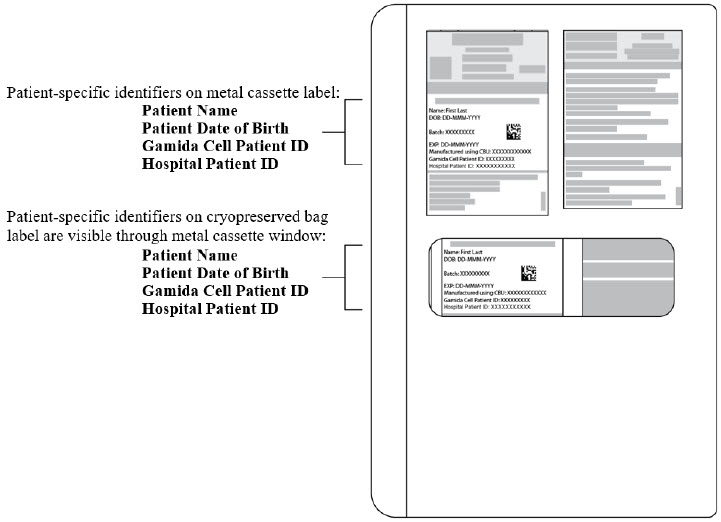
- Verify that the patient-specific identifiers on the labels on the outside of the CF and NF metal cassettes and on the CF and NF cryopreserved bags visible through the cassette window (see Figure 1) match the intended patient.
- Transfer the metal cassettes containing the CF and NF cryopreserved bags and the Chimerism Testing Sample(s) to onsite vapor phase of liquid nitrogen storage at ≤ -150℃.
Figure 1. CF or NF Cryopreserved Bag inside closed Metal Cassette.
Patient-specific identifiers are visible on the cryopreserved bag through the cassette window. Do NOT open the cassettes.
he refrigerated shipping container contains 2 IS bags, the IS for CF and the IS for NF, each with tubing and an attached spike adaptor. Each IS bag is packed inside a sterile bag.
- Ensure that both bags are intact and verify that the Infusion Solutions are within their expiry date by checking the expiration date on the labels located on the IS bags.
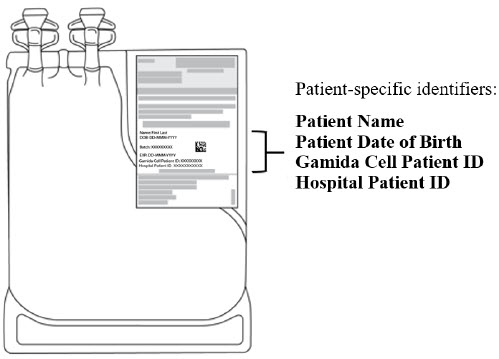
- Verify that the patient-specific identifiers on the IS bag labels match the intended patient (see Figure 2).
- Transfer both IS bags to refrigerated storage at 2-8°C.
Figure 2. Infusion Solution for CF Bag with Patient-Specific Label.
The IS bag has tubing with an attached spike adaptor and is packed inside a sterile bag.
Planning prior to OMISIRGE preparation:
- OMISIRGE must not be prepared until after receipt of the RFI Certificate for this patient-specific batch of OMISIRGE. CoAs for the CF, NF and IS batches are attached to the RFI Certificate. The RFI certificate will be issued via Gamida Cell Assist Hospital Portal up to 72 hours after completion of manufacturing.
- Confirm receipt of the RFI Certificate. Confirm patient-specific identifiers on the RFI Certificate and CoAs match the patient's identity.
- The CF bag must be administered FIRST.
- Confirm the infusion time in advance and adjust the start time of CF cryopreserved bag thaw so that it will be available for infusion when the patient is ready.
- Once the CF cryopreserved bag is removed from the metal cassette, thawing and dilution must be carried to completion and the cells administered within 2 hours post-dilution.
- Do not thaw the NF cryopreserved bag until you have determined that the CF has been safely administered.
- Once the NF cryopreserved bag is removed from the metal cassette, thawing and dilution must be carried to completion and the cells administered within 1 hour post-dilution.
- The infusion of the NF bag should begin within 1 hour after completion of the CF infusion.
Preparation of OMISIRGE for Infusion:
- Follow universal precautions and local biosafety guidelines for handling and disposal of human cells to avoid potential transmission of infectious diseases.
- Use aseptic technique for all processing steps, including spiking of all transfusion infusion bag ports. No samples should be drawn from OMISIRGE.
The Cultured Fraction:
Preparation of the Infusion Solution for CF
- Remove the IS for CF bag from the 2-8°C storage location. Remove only the IS for CF bag at this time.
- Confirm patient-specific identifiers on the label of the IS for CF match the intended patient.
- Wipe the IS for CF sterile bag with 70% alcohol. Place it in the Biological Safety Cabinet (BSC) (if available), for at least 20 minutes with a maximum of 24 hours at room temperature.
- Prior to dilution, remove the IS for CF bag from its sterile bag. Check that the pinch clamp is closed.
Thawing and diluting the CF
- Remove the CF metal cassette from the liquid nitrogen storage.
- Prior to opening the CF metal cassette, verify that the patient-specific identifiers on the label on the outside of the cassette and on the CF cryopreserved bag (visible through the cassette window) match the intended patient (see Figure 1).
- Once patient identity has been verified, open the CF metal cassette to remove the CF cryopreserved bag from the cassette. Leave the CF cryopreserved bag in the overwrap bag during thawing and dilution.
- Visually inspect the CF cryopreserved bag for damage. If the bag is damaged, contact Gamida Cell at (844) 477-7478. The cryopreserved CF should be white in color.
- Once the CF cryopreserved bag is removed from the metal cassette, the thaw and dilution must be carried to completion and the cells administered within 2 hours post-dilution.
- Incubate the CF cryopreserved bag for 5 minutes at room temperature.
- Place the CF cryopreserved bag in an approximately 37°C water bath until the product reaches a liquid consistency. This generally takes about 3-8 minutes.
Do not massage, knead or apply pressure on the product bag. Keep the bag fully submerged until thawed – do not remove before thawing completion.
- Remove the thawed bag from the water bath as soon as the cells have completely thawed. Do not remove the overwrap bag.
- Wipe the overwrap with 70% alcohol. Put the bag into the BSC (if available).
- Open the overwrap as follows:
- Wipe a pair of clean scissors with 70% alcohol.
- Cut the sealed area at the top of the overwrap.
Be careful not to damage the CF bag or the CF bag's ports/tubing.
- Insert the spike adapter attached to the IS for CF bag into one of the ports of the CF bag, while it remains in the overwrap bag.
- Open the pinch clamp on the IS tubing and double the volume of the CF by adding IS for CF (approximately 20 mL) to the CF bag. Gently swirl the bag until mixed well.
- Add the remaining IS for CF (approximately 60 mL) to the CF bag. Close the valve and swirl gently.
- Remove the overwrap of the CF bag and check the integrity of the CF bag.
- Check the appearance of the contents of the CF bag. The thawed and diluted CF should appear as a yellowish suspension, essentially free of visible white clumps and foreign particulates.
- Inspect the contents of the thawed and diluted CF bag for any visible cell clumps. If visible cell clumps remain, gently invert and/or massage the bag with fingertips. Small clumps of cellular material should disperse with gentle manual mixing. Do not infuse the CF if clumps are not dispersed, the bag is damaged or leaking, or otherwise appears to be compromised. If this occurs, call Gamida Cell at (844) 477-7478.
- Heat seal and detach the emptied Infusion Solution for CF bag.
- Connect the Transfusion Infusion Set to the free port on the CF bag. Alternatively, the infusion set may be connected in accordance with internal procedures.
- Place the CF bag containing the thawed and diluted CF in a new sterile bag.
Note: Do not wash, spin down, and/or resuspend CF in new media prior to infusion.
- Transport the product to the patient at room temperature. Unless prepared at the patient's bedside, transport the product to the bedside in a closed box/bag to protect the product during transport. The CF bag should be completely infused within 2 hours post-dilution.
- See the 'Administration' section on how to infuse the CF.
The Non-cultured Fraction:
Preparation of the Infusion Solution for NF
- Remove the IS for NF bag from the 2-8°C storage location.
- Repeat steps 2-4 from the CF process, for the IS for NF.
Thawing and diluting the NF
- Repeat steps 5-8 from the CF process, for the NF. The cryopreserved NF should be red in color.
- Once the NF cryopreserved bag is removed from the metal cassette, the thaw and dilution must be carried to completion and the cells administered within 1 hour post-dilution.
- Repeat steps 10-14 from the CF process, for the NF.
- Insert the spike adapter attached to the IS for NF bag into one of the ports of the NF bag, while it remains in the overwrap bag.
- Open the pinch clamp on the IS tubing and double the volume of the NF by adding Infusion Solution for NF (approximately 10 mL) to the NF bag. Gently swirl the bag until mixed well.
- Add the remaining IS for NF (approximately 30 mL) to the NF bag. Close the valve and swirl gently.
- Repeat steps 18-21 from the CF process, for the NF. The thawed and diluted NF should appear as a reddish suspension essentially free of visible clumps and foreign particulates.
- Repeat steps 22-25 from the CF process, for the NF. The NF should be completely infused within 1 hour post-dilution.
Administration
Do NOT use a leukodepleting filter
- Central venous access is recommended for the infusion of OMISIRGE.
- Confirm that the patient's identity matches the patient-specific identifiers on the CF and NF bags.
- Administer OMISIRGE by gravity infusion.
- Prior to spiking both the CF and NF bags, prime the infusion set tubing with normal saline.
- Infuse the entire contents of the CF and NF bags.
- The rate of infusion should not exceed a maximum of 10 mL per kg per hour.
Administration:
- The thawed and diluted CF bag must be infused FIRST. The infusion time should not exceed 2 hours from the end of dilution to the end of CF infusion. Should an infusion reaction occur, appropriately manage the reaction before thawing the NF.
- The thawed and diluted NF should be infused within 1 hour of safely administering the CF infusion. The infusion time should not exceed 1 hour from the end of dilution to the end of infusion.
- In the event of any deviation from the dosing schedule, contact Gamida Cell at (844) 477-7478.
- After the entire contents of the CF and NF bags are each infused, wash the tubing with normal saline at the same infusion rate to ensure as many cells as possible are delivered to the patient.
Follow universal precautions and local biosafety guidelines for handling and disposal of human cells to avoid potential transmission of infectious diseases.
Monitoring:
- Monitor the patient for hypersensitivity or other infusion-related reactions during the infusion and post-infusion, per institutional guidelines.
- Reduce the infusion rate if the fluid load is not tolerated. Pause the infusion in the event of a hypersensitivity reaction or if the patient develops a moderate to severe infusion reaction. Administer appropriate medical therapy as needed. [See Warnings and Precautions (5.2)]
- Conduct frequent clinical and laboratory assessments and vital signs and monitor for graft failure, GvHD, infections and other post-transplant complications according to institutional guidelines.
16.2. Storage and Handling
The Refrigerated Infusion Solutions
The Infusion Solutions (IS) used to dilute OMISIRGE CF and NF are provided in two IS bags labeled for the specific patient and for diluting the specific fraction. The IS for diluting the CF contains approximately 80 mL and the IS for diluting the NF contains approximately 40 mL of IS consisting of 6.8% Dextran 40 and 8% HSA. The Infusion Solutions are shipped in a refrigerated shipping container with the PI.
- Match the identity of the patient with the patient-specific identifiers on the IS bag labels upon receipt.
- Store the IS bags in a 2-8°C refrigerated storage until the time of thaw of the OMISIRGE CF and NF.
The Cryopreserved Cell Fractions
OMISIRGE is comprised of two cryopreserved cell fractions, a Cultured Fraction (CF) and a Non-cultured Fraction (NF) each in a separate cryopreserved bag labeled for the specific patient. Each cryopreserved bag is protected by a corresponding transparent overwrap bag and each cryopreserved bag enclosed in its overwrap bag is individually packed in a metal cassette. The cassettes are NOT to be opened upon receipt. Both cryopreserved OMISIRGE cell fractions are shipped together in the vapor phase of liquid nitrogen in a liquid nitrogen dry vapor shipper with the Prescribing Information (PI) and a Chimerism Testing Sample(s).
At the time of cryopreservation, the CF contains a minimum of 8.0 × 10⁸ total viable cells with a minimum of 8.7% CD34+ cells and a minimum of 9.2 × 10⁷ CD34+ cells suspended in 20 mL of a cryopreservation solution containing 10% DMSO.
See the CoA for the CF for actual cell counts. CoAs are attached to the RFI Certificate available via the Gamida Cell Assist Hospital Portal.
Upon cryopreservation, the CF appears white and is frozen at the bottom of the cryopreserved bag. The cassette may not be opened until the time of thaw for the specific fraction.
At the time of cryopreservation, the NF contains a minimum of 4.0 × 10⁸ total viable cells with a minimum of 2.4 × 10⁷ CD3+ cells suspended in 10 mL cryopreservation solution containing 10% DMSO.
See the CoA for the NF for actual cell counts.
Upon cryopreservation, the NF appears red and is frozen at the bottom of the cryopreserved bag. The cassette may not be opened until the time of thaw for the specific fraction.
- Do NOT open the metal cassettes until the time of thaw.
- Match the identity of the patient with the patient-specific identifiers on the cassettes and cryopreserved bag labels (visible through the cassette window) upon receipt.
- Store OMISIRGE frozen in the vapor phase of liquid nitrogen (≤ -150°C) in a temperature-controlled system.
- Thaw immediately prior to use [see Dosage and Administration (2.2)]
- Use closed containers when transporting the bags within the facility.
© All content on this website, including data entry, data processing, decision support tools, "RxReasoner" logo and graphics, is the intellectual property of RxReasoner and is protected by copyright laws. Unauthorized reproduction or distribution of any part of this content without explicit written permission from RxReasoner is strictly prohibited. Any third-party content used on this site is acknowledged and utilized under fair use principles.