OPZELURA Cream Ref.[115069] Active ingredients: Ruxolitinib
Source: European Medicines Agency (EU) Revision Year: 2026 Publisher: Incyte Biosciences Distribution B.V., Paasheuvelweg 25, 1105 BP Amsterdam, Netherlands
5.1. Pharmacodynamic properties
Pharmacotherapeutic group: Other dermatological preparations, agents for dermatitis, excluding corticosteroids
ATC code: D11AH09
Mechanism of action
Ruxolitinib is a Janus Kinase (JAK) inhibitor with selectivity for the JAK1 and JAK2 isoforms. Intracellular JAK signalling involves recruitment of STATs (signal transducers and activators of transcription) to cytokine receptors, and subsequent modulation of gene expression. Autoimmune IFNγ producing cytotoxic T lymphocytes are thought to be directly responsible for melanocyte destruction in human vitiligo. Recruitment of cytotoxic lymphocytes to lesional skin is mediated via IFNγ dependent chemokines, such as CXCL10. Downstream signalling of IFNγ is JAK1/2 dependent and treatment with ruxolitinib reduces CXCL10 levels in vitiligo patients.
Multiple inflammatory and pruritic cytokines involved in the pathogenesis of atopic dermatitis, such as IL-4, IL-5, IL-13, IL-22, IL-31, and thymic stromal lymphopoietin (TSLP), require JAK/STAT pathway activation for downstream biological activity.
Clinical efficacy and safety in vitiligo
Efficacy
Two double-blind, randomised, vehicle-controlled studies of identical design (TRuE-V1 and TRuE-V2) enrolled a total of 674 patients who have vitiligo on the face and total body vitiligo area (facial and nonfacial) not exceeding 10% BSA, with disease extent at initiation ranging from 3.2% to 10.1% of BSA, aged 12 years and older (10.7% of patients were 12 to 17 years of age and 6.7% were 65 years or older). Females constituted 53.1% of patients, 81.9% of patients were White, 4.7% were Black, and 4.2% were Asian. The majority of patients had Fitzpatrick skin types III, IV, V, or VI (67.5%).
In both studies, patients were randomised 2:1 to treatment with ruxolitinib cream or vehicle twice daily for 24 weeks with affected BSA not exceeding 10%, followed by an additional 28 weeks of treatment with ruxolitinib cream BID for all patients. The primary efficacy endpoint was the proportion of patients achieving a 75% repigmentation in the facial Vitiligo Area Scoring Index (F-VASI75) at week 24. Key secondary endpoints included the proportions of patients achieving a 90% repigmentation in F-VASI (F-VASI90), 50% improvement in total body Vitiligo Area Scoring Index (T-VASI50), and a Vitiligo Noticeability Scale (VNS) score of 4 or 5 (vitiligo "a lot less noticeable" or "no longer noticeable").
Repigmentation of treated vitiligo lesions and superiority of ruxolitinib cream over vehicle cream were observed for both studies, as demonstrated by statistically significant differences in response rates for F-VASI75/90, T-VASI50, and VNS score of 4 or 5 at week 24 (Table 2).
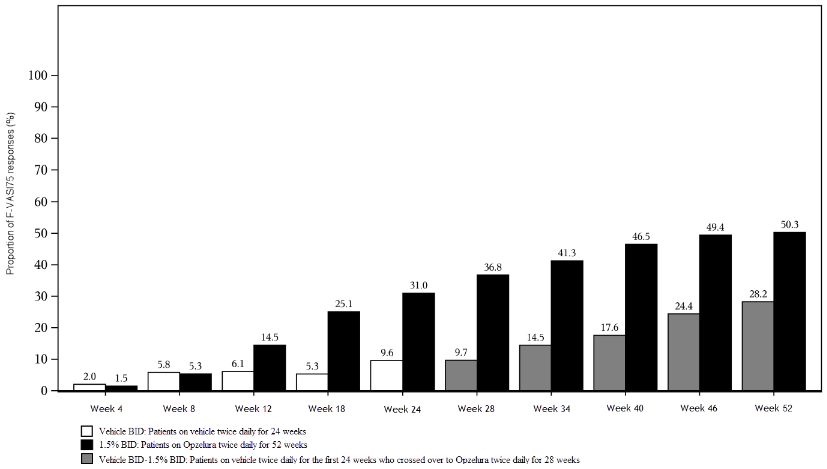
The treatment effect difference from vehicle emerges numerically as early as week 12. Continued repigmentation as assessed by VASI and VNS scores was observed through week 52 for patients who had continuously applied ruxolitinib cream twice daily from baseline. The proportion of patients who achieved F-VASI75 over the 52-week treatment period in pooled data from study TRuE-V1 and TRuE-V2 are shown in Figure 1.
Similar treatment responses at week 52 are seen for those who crossed over from vehicle to ruxolitinib (Figure 1).
Table 2. Percent of patients with vitiligo achieving the primary and key secondary endpoints at week 24 (intent-to-treat)a:
| TRuE-V1 | TRuE-V2 | |||
| Opzelura | Vehicle | Opzelura | Vehicle | |
| (N=221) | (N=109) | (N=222) | (N=109) | |
| F-VASI75 (%) | 29.8 | 7.4 | 30.9 | 11.4 |
| Response rate difference (95% CI) | 22.3b (14.214, 30.471) | - | 19.5c (10.537, 28.420) | - |
| F-VASI90 (%) | 15.3 | 2.2 | 16.3 | 1.3 |
| Response rate difference (95% CI) | 13.2d (7.497, 18.839) | - | 15.0e (9.250, 20.702) | - |
| T-VASI50 (%) | 20.6 | 5.1 | 23.9 | 6.8 |
| Response rate difference (95% CI) | 15.5d (8.339, 22.592) | - | 17.1c (9.538, 24.721) | - |
| VNS 4 or 5 (%) | 24.5 | 3.3 | 20.5 | 4.9 |
| Response rate difference (95% CI) | 21.2c (14.271, 28.143) | - | 15.5d (8.515, 22.561) | - |
a Primary and key secondary outcomes were corrected using multiple imputation method.
b p-value <0.0001
c p-value <0.001
d p-value <0.005
e p-value <0.01
Figure 1. Proportion of patients achieving F-VASI75 during the 52 week treatment period (Intent-to-treat) – pooled data from study TRuE-V1 and TRuE-V2:
At week 52, the observed response rate for F-VASI90, T-VASI50 and VNS was 30.3%, 51.1%, and 36.3% respectively for the ITT pooled population.
Durability of response
A Phase 3, double-blind, vehicle-controlled, randomised, withdrawal and treatment-extension study of ruxolitinib cream twice daily enrolled 458 eligible patients with vitiligo who had completed either of the parent studies using ruxolitinib (TRuE-V1 and TRuE-V2; week 52); patients were assigned to either cohort A or B with a follow-up up to 104 weeks.
Cohort A comprised 116 patients who reached ≥ F-VASI90 at week 52 of the parent study. These patients were re-randomised to either ruxolitinib or vehicle (i.e. withdrawal) to study relapse (< F-VASI75). A relapse occurred in 15% of patients in the ruxolitinib group, and in 29% of patients in the vehicle group. In the latter group, the majority of relapses (9/16) occurred during the first 4 months after stopping ruxolitinib cream. Among the 16 patients in the vehicle group who relapsed and were retreated, re-treatment resulted in a regained F-VASI75 in 12 (75%) patients in a median of 12 weeks and F-VASI90 was regained by 11 (69%) patients in a median of 15 weeks. Cohort B comprised 342 patients who reached < F-VASI90 at week 52 of the parent study. These patients continued with open-label ruxolitinib treatment; at week 104, among patients originally randomised to ruxolitinib cream twice daily, 66% reached F-VASI75, and 34% reached F-VASI90.
Safety
Safety in the long-term extension study up to 104 weeks cumulatively was consistent with the profile reported in the parent studies up to 52 weeks.
Clinical efficacy in atopic dermatitis
The efficacy and safety of ruxolitinib cream was evaluated in a pivotal double-blind, randomised, vehicle-controlled study (TRuE-AD4) in adult patients with moderate atopic dermatitis who had inadequate response to, were intolerant to, or were contraindicated to topical corticosteroids and topical calcineurin inhibitors.
The pivotal, double-blind, randomised, vehicle-controlled study (TRuE-AD4), enrolled a total of 241 patients, 18 years of age and older with moderate atopic dermatitis, defined by an Eczema Area and Severity Index (EASI) score >7, an Investigator's Global Assessment (IGA) score of 3, 10-20% Body Surface Area (BSA) involvement (excluding scalp), an Itch Numeric Rating Scale (Itch NRS) score of ≥4, and a Dermatology Life Quality Index (DLQI) score >10. Enrolled patients had a documented inadequate response to, were intolerant to, or were contraindicated to topical corticosteroids and topical calcineurin inhibitors. Patients were randomised 2:1 to treatment with ruxolitinib 1.5% cream twice daily (BID) or vehicle cream BID for 8 weeks, followed by a 16-week, vehicle-controlled extension, double-blind period for patients with an adequate response (at least EASI50 from baseline) and an open-label escape arm. During the double-blind, vehicle-controlled extension period, patients applied study drug to active lesions only.
Endpoints
In study TRuE-AD4, the co-primary efficacy endpoints were the proportion of patients reaching EASI75 (defined as ≥75% improvement in EASI score from baseline) and the proportion of patients achieving IGA Treatment Success (IGA-TS; defined as an IGA score of 0 [clear] or 1 [almost clear] and a ≥2-grade improvement from baseline) at week 8. Key secondary endpoints included the proportion of patients reaching ITCH4 (defined as ≥4-point improvement in Itch NRS score from baseline) at week 8, day 7, day 3, and day 2. Additional clinically relevant secondary endpoints included the proportion of patients achieving IGA-TS, EASI75, ITCH4, as well as change from baseline in DLQI, Patient-Oriented Eczema Measure (POEM), Patient-Reported Outcomes Measurement Information System (PROMIS) Short Form Sleep-Related Impairment (8a) and PROMIS Short Form Sleep Disturbance (8b), at each postbaseline visit.
Baseline characteristics
In study TRuE-AD4, the mean age was 39 years and 7.9% of patients were 65 years of age or older. Females constituted 54% of patients, 81% of patients were White, 5.8% were Black, and 10% were Asian. Patients had long-standing atopic dermatitis of 20 years (mean) before study entry. Recent (within the last 12 months) prior treatments for atopic dermatitis included topical corticosteroids (96%) and topical calcineurin inhibitors (81%), as well as systemic therapies (30%) and phototherapy (8.7%). The mean EASI score was 13, the mean Itch NRS score was 7.4, and the mean total % BSA affected was 15%. The mean DLQI score was 19, the mean POEM score was 20 (with no patients having a POEM score of 0-2), and the mean PROMIS 8a and PROMIS 8b scores were 22 and 24, respectively. Baseline characteristics were generally similar across the treatment groups.
Clinical response
In study TRuE-AD4, ruxolitinib cream was statistically significantly superior to vehicle cream at week 8 with respect to the co-primary endpoints, EASI75 (Table 3 and Figure 2) and IGA-TS (Table 3), and all of the key secondary endpoints, ITCH4 at week 8 (Table 3 and Figure 3), and ITCH4 at day 7, 3 and 2, with separation between the ruxolitinib cream and vehicle cream treatment groups at Day 1 (Figure 3).
The proportion of patients reaching IGA-TS increased from baseline during the double-blind, vehicle-controlled period (Table 3), with separation between the ruxolitinib cream and vehicle cream treatment groups at week 2 (29% and 2.5%, respectively) and week 4 (49% and 9.9%, respectively).
Table 3. Efficacy results of ruxolitinib cream, co-primary and selected key secondary endpoints at week 8:
| TRuE-AD4br>(intent-to-treat) | ||
| Ruxolitinib cream | Vehicle | |
| (N=160) | (N=81) | |
| EASI75 (%) | 70.0 | 18.5 |
| Response rate difference (95% CI) | 51.4 (40.48, 62.24)a | - |
| IGA-TS (%) | 61.3 | 13.6 |
| Response rate difference (95% CI) | 47.6 (36.98, 58.20)a | - |
| ITCH4 (%) | 62.5 | 19.8 |
| Response rate difference (95% CI) | 42.8 (31.44, 54.21)a | - |
a p-value<0.0001
Figure 2. Proportion of patients achieving EASI75 at each visit during the vehicle-controlled period in study TRuE-AD4 (intent-to-treat):

Figure 3. Line Plot of ITCH4 Response Rate from day 1 to day 7 – TRuE-AD4 (intent-to-treat Population):

p-value<0.0001 on D7 and D3; p-value=0.0072 on D2.
Nominal p-value = 0.0374 on D1, Nominal p-value < 0.0001 on D4, D5 and D6.
Durability of response
During the double-blind, vehicle-controlled extension period of week 8 to week 24, when patients applied study drug to active lesions only, the proportion of patients in the ruxolitinib cream group who reached EASI75, IGA-TS, and ITCH4 remained higher than the level at week 8.
Quality of life/patient-reported outcomes
In study TRuE-AD4, patients treated with ruxolitinib cream had clinically meaningful improvements in patient-reported symptoms and the impact of atopic dermatitis on health-related quality of life as measured by DLQI, and POEM and on sleep as measured by PROMIS Sleep-Related Impairment (8a) and Sleep Disturbance (8b), at week 8.
At week 8, DLQI scores had decreased (mean [STD]) from baseline by 15 (6.4) and 8.4 (7.7) for the ruxolitinib 1.5% cream and vehicle cream BID treatment groups, respectively. The proportion of patients achieving a 4-point reduction in DLQI was 97% and 78% for the ruxolitinib 1.5% cream and vehicle cream treatment groups, respectively.
At week 8, POEM scores had decreased (mean [STD]) from baseline by 15 (8.1) and 6.4 (7.5) for the ruxolitinib 1.5% cream and vehicle cream treatment groups, respectively. The proportion of patients achieving POEM 0 to 2 increased to 40% and 8.6% for the ruxolitinib 1.5% cream and vehicle cream treatment groups, respectively.
At week 8, the PROMIS (8a) Sleep-Related Impairment scores and the PROMIS (8b) Sleep Disturbance scores showed numerically larger improvements in the ruxolitinib 1.5% cream group, as compared to the vehicle cream treatment group.
Paediatric population
Vitiligo
A total of 72 adolescents (12 to <18 years; n=55 ruxolitinib cream, n=17 vehicle) were included in the pivotal studies. Adolescents showed equal response rates in primary and key secondary endpoints at 24 weeks when treated with ruxolitinib, as compared to adults from 18-65 years of age.
Atopic dermatitis
A total of 130 adolescents (12 to <18 years; n=87 ruxolitinib 1.5% cream; n=43 vehicle) with mild-to-moderate atopic dermatitis were included in a pooled analysis of two Phase 3 studies (TRuE-AD1 and TRuE-AD2). Ruxolitinib 1.5% cream had a higher response rate than vehicle at week 8 for the primary endpoint, EASI75 (61% versus 35%), and the key secondary endpoints, IGA-TS (51% versus 14%) and ITCH4 (52% versus 17%) (see section 4.2).
The safety of ruxolitinib 1.5% cream in 2 Phase 1 paediatric studies (INCB 18424-102 [39 patients aged 2 to <18 years with mild to severe atopic dermatitis] and INCB 18424-103 [21 patients aged 12 to <18 years with mild to severe atopic dermatitis]) was consistent with the profile reported in the Phase 3 study TRuE-AD4 in adults with moderate atopic dermatitis.
The European Medicines Agency has deferred the obligation to submit the results of studies with Opzelura in one or more subsets of the paediatric population for the treatment of vitiligo and atopic dermatitis (see section 4.2 for information on paediatric use).
5.2. Pharmacokinetic properties
Absorption
Vitiligo
The pharmacokinetics of ruxolitinib cream were investigated in 429 patients with vitiligo aged 12 years and older (12.6% were 12-17 years of age) with a mean ± STD BSA involvement of 7.31 ± 2.02% (range 3.2% to 10.0%). Patients applied approximately 1.58 mg/cm² of ruxolitinib cream (dose range was approximately 0.18 grams to 8.4 grams of ruxolitinib cream per application) to the same skin areas twice daily for 24 weeks.
The mean ± STD (median; geometric mean) steady state trough plasma concentration was 56.9 ± 62.6 nM (35.8 nM; 27.4 nM) with a projected AUC0-12h at 683 ± 751 h*nM, which is approximately 25% of the observed mean AUC0-12h at steady state (2716 h*nM) following 15 mg twice daily oral administration in healthy participants. The mean (geometric mean) topical bioavailability for ruxolitinib cream in vitiligo patients in the pooled data of the two Phase 3 studies was 9.72% (5.78%).
Atopic dermatitis
The pharmacokinetics of ruxolitinib cream were investigated in 114 patients with moderate atopic dermatitis aged 18 years and older with a mean ± STD BSA involvement of 15.2 ± 2.99% (range 10.0% to 20%). Patients applied approximately 3.97 grams of ruxolitinib cream (dose range was approximately 0.12 grams to 8.5 grams of ruxolitinib cream per application) to the same skin areas twice daily for 8 weeks.
The mean ± STD (median; geometric mean) steady state trough plasma concentration was 82.3 ± 98.4 nM (49.6 nM; 42.7 nM) with a projected AUC0-12h at 987.6 ± 1181 h*nM, which is approximately 36% of the observed mean AUC0-12h at steady state (2716 h*nM) following 15 mg twice daily oral administration in healthy participants. The mean (geometric mean) topical bioavailability for ruxolitinib cream in atopic dermatitis patients in the Phase 3 study was 8.87% (4.97%).
Distribution
Based on an in vitro study, ruxolitinib is 97% bound to human plasma proteins, mostly to albumin.
Biotransformation
Ruxolitinib is metabolised by CYP3A4 and to a lesser extent by CYP2C9.
Elimination
The mean elimination half-life of orally administered ruxolitinib is approximately 3 hours. The mean ± STD (median; geometric mean) apparent terminal half-life of ruxolitinib following topical application of Opzelura was estimated in 9 adult and adolescent patients with ≥25% BSA involvement with atopic dermatitis and is approximately 116 ± 251 (16.4; 32.5) hours, reflecting the slow drug absorption rate rather than the drug elimination rate.
Special populations
Renal impairment
The estimated AUC which is adjusted for the pharmacological activity of ruxolitinib plus the metabolites increases approximately two-fold in case of end stage renal disease (ESRD). As a precautionary measure, Opzelura should not be used by patients with ESRD, due to lack of data regarding the safety.
Hepatic impairment
Although the AUC was increased following oral administration of ruxolitinib to patients with hepatic impairment, there was no clear relationship between the severity of hepatic impairment and the increase in AUC. A dosing advice for patients with hepatic impairment is not necessary.
Paediatric population
Pharmacokinetic data from 2 Phase 1 studies conducted in paediatric patients with atopic dermatitis aged 2 to <18 years (INCB 18424-102 and INCB 18424-103) were aligned with studies conducted in adults.
5.3. Preclinical safety data
Ruxolitinib has been evaluated in safety pharmacology, repeated dose toxicity, genotoxicity and reproductive toxicity, and carcinogenicity studies following oral administration. Additional studies were conducted following dermal administration in minipigs and mice. Target organs associated with the pharmacological action of ruxolitinib in repeated dose oral studies include bone marrow, peripheral blood and lymphoid tissues. Infections generally associated with immunosuppression were noted in dogs. Margins (based on unbound AUC) at non-adverse levels in chronic toxicity studies were approximately 6- and 200-fold in male and female rats, and 10-fold in dogs, relative to systemic exposure observed in patients with vitiligo and 3.5- and 136-fold in male and female rats, and 7-fold in dogs, relative to systemic exposure observed in patients with moderate atopic dermatitis, that applied 1.5% ruxolitinib cream twice daily. Adverse decreases in blood pressure along with increases in heart rate were noted in a dog telemetry study, and an adverse decrease in minute volume was noted in a respiratory study in rats. The margins (based on unbound Cmax) at the non-adverse level in the dog and rat studies were at least 546-fold, and 362-fold greater, respectively, than systemic exposure observed in patients with vitiligo or moderate atopic dermatitis that applied 1.5% ruxolitinib cream twice daily. No adverse effects were noted in an evaluation of the neuropharmacological effects of ruxolitinib in rats.
A 3-month dermal repeat dose study revealed decreased lymphocyte counts in mice. Margins (based on unbound AUC) at non-adverse levels were approximately 10-fold in male and 24-fold in female mice relative to systemic exposure observed in patients with vitiligo, and 5.7-fold in male and 15-fold in female mice relative to systemic exposure observed in patients with moderate atopic dermatitis that applied 1.5% ruxolitinib cream twice daily. Non-adverse decreased peripheral lymphocyte counts were also noted in minipigs in a 9-month dermal toxicity study. Margins (based on unbound AUC) at non-adverse levels in minipigs were approximately 3-fold relative to systemic exposure observed in patients with vitiligo and 2-fold relative to systemic exposure observed in patients with moderate atopic dermatitis that applied 1.5% ruxolitinib cream twice daily. This effect was not observed in a 3-month dermal toxicity study in minipigs. No evidence of systemic toxicity was observed in Gottingen minipigs following topical administration of 1.5% ruxolitinib cream formulation twice daily for up to 9 months.
In juvenile rat studies, oral administration of ruxolitinib resulted in effects on growth and bone measures. Reduced bone growth was observed at doses ≥5 mg/kg/day when treatment started on postnatal day 7 (comparable to human newborn) and at ≥15 mg/kg/day when treatment started on postnatal days 14 or 21 (comparable to human infant, 1–3 years). Fractures and early termination of rats were observed at doses ≥30 mg/kg/day when treatment was started on postnatal day 7. Based on unbound AUC, the exposure at the NOAEL (no observed adverse effect level) in juvenile rats treated as early as postnatal day 7 was approximately 20-fold that of adult patients with vitiligo, and 14-fold that of patients with moderate atopic dermatitis, while reduced bone growth and fractures occurred at exposures that were 22- and 150-fold that of adult patients with vitiligo, and 14- and 90-fold that of adult patients with moderate atopic dermatitis, respectively. The effects were generally more severe in males and when administration was initiated earlier in the postnatal period. Other than bone development, the effects of ruxolitinib in juvenile rats were similar to those in adult rats. Juvenile rats are more sensitive than adult rats to ruxolitinib toxicity.
In embryofoetal development studies, oral administration of ruxolitinib to rats and rabbits during gestation resulted in decreased foetal weight and increased post-implantation loss at doses associated with maternal toxicity. There was no evidence of a teratogenic effect in rats and rabbits. Margins (based on unbound AUC) at non-adverse levels for developmental toxicity in rats were approximately 25-fold the systemic exposure observed in patients with vitiligo, and 16-fold that in patients with moderate atopic dermatitis that applied 1.5% ruxolitinib cream twice daily. No effects of oral ruxolitinib were noted on fertility in male or female rats. In a pre- and postnatal development study, a slightly prolonged gestation period, reduced number of implantation sites, and reduced number of pups delivered were observed. In the pups, decreased mean initial body weights and short period of decreased mean body weight gain were observed. In lactating rats, ruxolitinib and/or its metabolites were excreted into the milk with a concentration that was 13-fold higher than the maternal plasma concentration. Ruxolitinib was not mutagenic or clastogenic. Ruxolinitib showed no carcinogenic potential following topical administration in mice or following oral administration in Sprague-Dawley rats and Tg.rasH2 mice.
© All content on this website, including data entry, data processing, decision support tools, "RxReasoner" logo and graphics, is the intellectual property of RxReasoner and is protected by copyright laws. Unauthorized reproduction or distribution of any part of this content without explicit written permission from RxReasoner is strictly prohibited. Any third-party content used on this site is acknowledged and utilized under fair use principles.