RHAPSIDO Film-coated tablet Ref.[116081] Active ingredients: Remibrutinib
Source: FDA, National Drug Code (US) Revision Year: 2025
12.1. Mechanism of Action
Remibrutinib is an oral, small molecule kinase inhibitor that inhibits Bruton's tyrosine kinase (BTK). BTK is an intracellular protein expressed in mast cells, basophils, B cells, macrophages, and thrombocytes. BTK is involved in intracellular signaling via Fc epsilon receptor-1 (FcεR1), Fc gamma receptors (FcγR), and the B cell antigen receptor (BCR). Remibrutinib also inhibits the BTK-related kinases tec protein tyrosine kinase (TEC) and BMX non-receptor tyrosine kinase (BMX).
Remibrutinib inhibits mast cell and basophil degranulation, including release of histamine and other proinflammatory mediators, mediated by pathogenic IgE or IgG directed against the FcεR1 or IgE.
12.2. Pharmacodynamics
Exposure-Response
Within the range from 0.2 to 4 times the daily recommended dose, a flat dose-response relationship was observed for the weekly urticaria activity score (UAS7) at Week 4.
Cardiac Electrophysiology
At concentrations approximately 9 times the mean steady state peak plasma concentrations provided by the recommended dose, clinically significant QTc prolongation was not observed.
Effects on Blood Pressure
The effect of remibrutinib treatment on blood pressure was assessed in CSU patients using a 24-hour blood pressure measurement by ambulatory blood pressure monitoring (ABPM) at steady state (Week 4) compared to baseline in a multi-center, open-label study (A2305). The study enrolled 144 patients with CSU inadequately controlled by H1 antihistamines, who were administered remibrutinib 25 mg twice daily. Remibrutinib 25 mg twice daily was not associated with clinically significant changes in blood pressure.
12.3. Pharmacokinetics
Following administration of remibrutinib 25 mg twice daily, the mean (standard deviation) Cmax is 57 (27) ng/mL and AUClast is 193 (136) ng*h/mL at steady state. Remibrutinib Cmax and AUC increase in a dose-proportional manner between 0.4 to 4 times the recommended dosage. Following administration of multiple doses of 25 mg twice daily, Cmax increases 1.6-fold and AUC0-4 increases 2.7-fold.
No clinically significant differences in remibrutinib pharmacokinetics were observed between healthy subjects and patients with CSU.
Absorption
Remibrutinib median (min, max) time to maximum plasma concentration (Tmax) is 1 hour (0, 4 hours) at steady state.
Effect of food
No clinically significant differences in remibrutinib pharmacokinetics were observed following administration of a high-fat meal (1000 calories, 50% fat).
Distribution
Remibrutinib blood-to-plasma ratio is 0.813 in vitro. Plasma protein binding is 95.4% and is not concentration-dependent in vitro. The estimated remibrutinib steady state apparent (oral) volume of distribution is 1238 L.
Elimination
Remibrutinib estimated elimination half-life is 1 to 2 hours with an apparent (oral) clearance of 160 L/hr.
Metabolism
Remibrutinib is primarily metabolized by CYP3A4.
Excretion
Following IV administration of 14C remibrutinib to healthy subjects, 70% of the total radioactivity was recovered in feces (0% as unchanged remibrutinib), and 30% was recovered in urine (2.9% as unchanged remibrutinib).
Specific Populations
No clinically significant differences in the pharmacokinetics of remibrutinib were observed based on age (range: 18 to 80 years), sex (63.5% females and 36.5% males), race/ethnicity (59.3% Non-Asian [White, Black, and Others], 8.8% Mainland Chinese, 12.2% Japanese, and 19.7% other Asian), body weight (range: 39 to 162 kg), and mild (eGFR 60-89 mL/min/1.73 m², estimated by Cockcroft-Gault), moderate (eGFR 30-59 mL/min/1.73 m²) or severe (eGFR 15-29 mL/min/1.73 m²) renal impairment.
Patients with Hepatic Impairment
The pharmacokinetics of remibrutinib were evaluated in subjects with mild (Child-Pugh Class A), moderate (Child-Pugh Class B), and severe (Child-Pugh Class C) hepatic impairment following administration of 25 mg twice daily. Relative to patients with normal hepatic function, remibrutinib AUC increased 2.33-fold and Cmax increased 1.85-fold in patients with mild hepatic impairment, AUC increased 2.3-fold and Cmax increased 1.65-fold in patients with moderate hepatic impairment, and AUC increased 3.49-fold and Cmax increased 1.99-fold in patients with severe hepatic impairment [see Use in Special Populations (8.6)].
Drug Interaction Studies
Clinical Studies and Model-Informed Approaches
Strong CYP3A4 Inhibitors: Remibrutinib Cmax increased by 3.3-fold and AUC increased by 4.3-fold following concomitant administration with ritonavir (a strong CYP3A4 inhibitor) 100 mg twice daily for 4 days [see Drug Interactions (7.1)].
Remibrutinib Cmax increased by 1.24-fold and AUC increased by 1.3-fold when co-administered with grapefruit juice.
Moderate CYP3A4 Inhibitors: Remibrutinib Cmax is predicted to increase by approximately 1.9-fold and AUC is predicted to increase by approximately 2.3-fold following concomitant administration with erythromycin (a moderate CYP3A4 inhibitor) 500 mg four times a day for 7 days [see Drug Interactions (7.1)].
Strong CYP3A4 Inducers: Remibrutinib Cmax decreased by 74% and AUC decreased by approximately 77% following concomitant administration with carbamazepine (a strong CYP3A4 inducer) 300 mg twice daily for 14 days [see Drug Interactions (7.1)].
Moderate CYP3A4 Inducers: Remibrutinib Cmax is predicted to decrease by approximately 60% and AUC is predicted to decrease by approximately 64% following concomitant administration with efavirenz (a moderate CYP3A4 inducer) 600 mg once daily for 14 days [see Drug Interactions (7.1)].
P-gp Substrates: Co-administration of remibrutinib at four times the recommended dosage with a single dose of 0.25 mg digoxin (a P-gp substrate) increased digoxin Cmax by 2.1-fold and AUC by 1.4-fold [see Drug Interactions (7.1)].
BCRP Substrates: Co-administration of remibrutinib at four times the recommended dosage with a single dose of 10 mg rosuvastatin (a BCRP and OATP1B substrate) increased rosuvastatin Cmax by 1.6-fold and AUC by 1.7-fold.
Other Drugs: No clinically significant differences in the pharmacokinetics of the following drugs were observed when used concomitantly with remibrutinib: oral midazolam (CYP3A4 substrate), oral contraceptives containing ethinyl estradiol and levonorgestrel (CYP3A4 substrate), tolbutamide (CYP2C9 substrate), caffeine (CYP1A2 substrate), and coproporphyrin I (an endogenous OATP1B substrate).
In Vitro Studies
CYP450 Enzymes: Remibrutinib is a CYP3A4 substrate. Remibrutinib inhibits CYP1A2, CYP2B6, CYP2C8, CYP2C9, CYP2C19, CYP2D6 and CYP3A4/5. Remibrutinib induces CYP1A2, CYP2B6, CYP2C9 and CYP3A4/5.
Transporter Systems: In vitro, remibrutinib is a P-gp substrate. Remibrutinib inhibits P-gp, BCRP, BSEP, OATP1B1, OATP1B3, OAT1, OAT3, OCT1, OCT2 and MATE1.
13.1. Carcinogenesis, Mutagenesis, Impairment of Fertility
Remibrutinib did not show evidence of carcinogenic potential in a 6-month rasH2 mouse study at oral doses up to 1500 mg/kg/day and a 2-year rat carcinogenicity study at oral doses up to 300 mg/kg/day (approximately 8 times and 98 times than MRHD of 25 mg twice daily based on AUC for males and females, respectively).
Remibrutinib was not mutagenic in a bacterial mutagenicity (Ames) assay and was not clastogenic in an in vitro micronucleus assay in human peripheral lymphocytes or in an in vivo blood reticulocyte micronucleus assay in rats.
In a fertility study in rats, remibrutinib did not impact fertility in female or male rats up to the maximum achievable exposures of 79 and 15 times higher than MRHD of 25 mg twice daily based on AUC.
14. Clinical Studies
The efficacy of RHAPSIDO for chronic spontaneous urticaria (CSU) in adult patients who remain symptomatic despite H1 antihistamine treatment was evaluated in two identical, 52-week, multi-center, randomized, double-blind, placebo-controlled clinical trials (REMIX-1 [NCT05030311] and REMIX-2 [NCT05032157]).
REMIX-1 and REMIX-2 enrolled a total of 925 adult patients, diagnosed with CSU inadequately controlled despite treatment with H1 antihistamines, as defined by the presence of itch and hives for ≥6 consecutive weeks. All patients were required to have a weekly urticaria activity score (UAS7) ≥16 (range 0-42), a weekly itch severity score (ISS7) ≥6 (range 0-21) and a weekly hives severity score (HSS7) ≥6 (range 0-21) for 7 days prior to randomization. Patients were randomized in a 2:1 ratio to receive either RHAPSIDO 25 mg or placebo, respectively, orally twice daily for 24 weeks during the double-blind treatment period and subsequently continued in a 28-week open-label treatment period, during which all patients received RHAPSIDO 25 mg twice daily. While REMIX-1 and REMIX-2 clinical trials included an open-label period, efficacy is based on results from 912 patients treated during the controlled period of 24 weeks.
Demographics and baseline characteristics in REMIX-1 and REMIX-2 are provided in Table 2.
Table 2. Baseline Demographic and Disease Characteristics of Adult Patients with CSU in REMIX-1 and REMIX-2:
| REMIX-1 (N=462) | REMIX-2 (N=450) | |
| Age | ||
| 18-65 years, n (%) | 419 (91) | 416 (92) |
| >65 years, n (%) | 43 (9) | 34 (8) |
| Mean age, years | 45 | 42 |
| Sex, n (%) | ||
| Female | 313 (68) | 294 (65) |
| Race, n (%) | ||
| White or Caucasian | 270 (58) | 234 (52) |
| Black or African American | 15 (3) | 10 (2) |
| Asian | 139 (30) | 201 (45) |
| Ethnicity, n (%) | ||
| Hispanic/Latino | 116 (25) | 21 (5) |
| Disease characteristics | ||
| UAS7 ≥28, n (%) | 298 (65) | 269 (60) |
| Mean HSS7 score | 16 | 16 |
| Mean ISS7 score | 15 | 14 |
| Previous experience of Angioedema, n (%) | 240 (52) | 208 (46) |
| Previous exposure to anti-IgE biologics, n (%) | 147 (32) | 138 (31) |
CSU: chronic spontaneous urticaria, UAS7: weekly urticaria activity score, HSS7: weekly hive severity score, ISS7 score: weekly itch severity score
The reported mean duration of CSU at enrollment across treatment groups was 6.6 and 5.2 years in REMIX-1 and REMIX-2, respectively, with 39% and 29% of the patients having a duration of CSU >5 years.
The co-primary endpoints were absolute change from baseline in ISS7 and HSS7 at Week 12. The ISS7 (range 0 to 21) was defined as the sum of the daily itch severity scores (range 0 to 3) recorded over a 7-day period. The HSS7 (range 0 to 21) was defined as the sum of the daily hive severity scores (range 0 to 3) recorded over a 7-day period. The key secondary endpoint was absolute change from baseline in UAS7 at Week 12. The UAS7 (range 0 to 42) was a composite of the ISS7 and HSS7.
Secondary endpoints included proportion of patients who achieved UAS7 ≤6 at Weeks 2 and 12, and the proportion of patients who achieved complete absence of itch and hives (UAS7 = 0) at Week 12. In both REMIX-1 and REMIX-2 studies, the co-primary and all secondary endpoints showed statistically significant improvement in itch and hives symptoms in patients treated with RHAPSIDO compared to patients treated with placebo. Results are presented in Table 3.
Table 3. Efficacy Results of Adult Patients with CSU in REMIX-1 and REMIX-2 at Week 12a:
| REMIX-1 | REMIX-2 | |||
| RHAPSIDO (N=309) | Placebo (N=153) | RHAPSIDO (N=297) | Placebo (N=153) | |
| Change from Baseline in ISS7 at Week 12 | ||||
| LS mean (SE) CFB | -9.52 (0.34) | -6.89 (0.47) | -8.95 (0.34) | -5.72 (0.45) |
| Difference in LS mean (SE) vs placebo | -2.63 (0.54) | -3.23 (0.55) | ||
| 95% CI for difference | -3.70, -1.56 | -4.29, -2.16 | ||
| Change from Baseline in HSS7 at Week 12 | ||||
| LS mean (SE) CFB | -10.47 (0.40) | -6.86 (0.55) | -10.47 (0.39) | -6.00 (0.53) |
| Difference in LS mean (SE) vs placebo | -3.61 (0.64) | -4.47 (0.64) | ||
| 95% CI for difference | -4.85, -2.36 | -5.71, -3.23 | ||
| Change from Baseline in UAS7 at Week 12 | ||||
| LS mean (SE) CFB | -20.02 (0.72) | -13.79 (0.98) | -19.41 (0.70) | -11.73 (0.95) |
| Difference in LS mean (SE) vs placebo | -6.22 (1.14) | -7.68 (1.14) | ||
| 95% CI for difference | -8.45, -4.00 | -9.91, -5.46 | ||
| Proportion of Patients with UAS7 ≤6 at Week 2 | ||||
| n (%) | 104 (33.7) | 5 (3.3) | 89 (30.0) | 9 (5.9) |
| Treatment difference | 30.20 | 24.55 | ||
| (95% CI) | 24.30, 36.10 | 18.31, 30.80 | ||
| Proportion of Patients with UAS7 ≤6 at Week 12 | ||||
| n (%) | 154 (49.8) | 38 (24.8) | 139 (46.8) | 30 (19.6) |
| Treatment difference | 25.44 | 27.61 | ||
| (95% CI) | 16.48, 34.39 | 19.14, 36.08 | ||
| Proportion of Patients with UAS7 = 0 at Week 12 | ||||
| n (%) | 96 (31.1) | 16 (10.5) | 83 (27.9) | 10 (6.5) |
| Treatment difference | 20.55 | 21.60 | ||
| (95% CI) | 13.35, 27.75 | 15.10, 28.10 | ||
LS Mean: Least squares mean, SE: standard error, CFB: change from baseline, CI: confidence interval
a Multiple imputation techniques were implemented for missing data
Figure 1 shows the effect of RHAPSIDO over time up to Week 24 in REMIX-2 patients treated with RHAPSIDO. The results were similar in REMIX-1.
Figure 1 Mean Change from Baseline in Weekly Itch Severity Score (ISS7) and Hive Severity Score (HSS7) up to Week 24 in REMIX-2 (Observed Data)
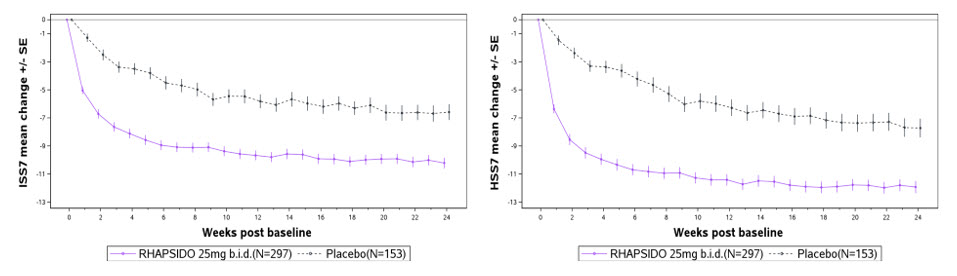
Improvements in ISS7 and HSS7 at Week 12 were consistent regardless of patients' baseline total IgE level.
© All content on this website, including data entry, data processing, decision support tools, "RxReasoner" logo and graphics, is the intellectual property of RxReasoner and is protected by copyright laws. Unauthorized reproduction or distribution of any part of this content without explicit written permission from RxReasoner is strictly prohibited. Any third-party content used on this site is acknowledged and utilized under fair use principles.