RISPIDE Oral solution Ref.[115328] Active ingredients: Risperidone
Source: Health Products Regulatory Authority (ZA) Publisher: Abex Pharmaceutica (Pty) Ltd, Suite C, Rubenstein Ridge, 617 Rubenstein Drive, Moreleta Park, 0181
Therapeutic indications
RISPIDE is indicated for the treatment of:
- Acute and chronic schizophrenic psychoses and related psychosis in which positive symptoms (such as hallucinations, delusions, thought disturbances, hostility, suspiciousness) and/or the negative symptoms (such as blunted affect, emotional and social withdrawal, poverty of speech) are prominent. RISPIDE also alleviates affective symptoms (such as depression, guilt feelings, anxiety) associated with schizophrenia. In patients who have shown an initial treatment response, RISPIDE is also effective in maintaining the clinical improvement.
- Mania in bipolar disorder. These episodes are characterised by symptoms such as elevated, expansive, or irritable mood, inflated self-esteem, decreased need for sleep, pressured speech, racing thoughts, distractibility, or poor judgment, including disruptive or aggressive behaviours.
- Conduct and other disruptive behaviour disorders in children (aged 5 to 12 years), with subaverage intellectual functioning or mental retardation in whom destructive behaviours (e.g. aggression, impulsivity and self-injurious behaviours) are prominent.
Posology and method of administration
Posology
Schizophrenia
Switching from other antipsychotics to RISPIDE
When medically appropriate, gradual discontinuation of the previous treatment, while RISPIDE therapy is initiated, is recommended. Also, if medically appropriate, when switching patients from depot antipsychotics, initiate RISPIDE therapy in place of the next scheduled injection. The need for continuing existing anti-Parkinson medications should be re-evaluated periodically.
Adults
RISPIDE may be given once or twice daily.
Patients should start with 2 mg/day RISPIDE. The dosage may be increased on the second day to 4 mg/day. From then on, the dosage can be maintained unchanged, or further individualised, if needed. Most patients will benefit from daily doses of between 4 mg/day and 8 mg/day. Doses above 6 mg/day (when administered twice daily) were associated with more extrapyramidal symptoms and other adverse effects and are not generally recommended. In some patients, particularly with first episode acute psychosis, a slower titration phase and a lower starting and maintenance dose may be appropriate.
Doses above 10 mg/day have not been shown to be superior in efficacy to lower doses and may cause an increased incidence of side effects such as extrapyramidal symptoms. Dosages above 10 mg/day should only be considered if the benefits outweigh the risk. The maximum total daily dose is 16 mg/day.
A benzodiazepine may be added to RISPIDE if additional sedation is required.
Elderly patients and patients with renal and hepatic impairment
A starting dose of 0,5 mg twice daily is recommended. This dosage can be individually adjusted with 0,5 mg twice daily increments to 1 to 2 mg twice daily.
Children
Not for children under 15 years as efficacy and safety in children under the age of 15 years have not been demonstrated in schizophrenia.
Mania in bipolar disorders
RISPIDE should be administered on a once daily schedule, starting with 2 or 3 mg. Dosage adjustments, if indicated, should occur at intervals of not less than 24 hours and in dosage increments of 1 mg per day. Efficacy was demonstrated in flexible doses over a range of 1 to 6 mg per day.
The continued use of RISPIDE must be evaluated and justified on an ongoing basis. Experience is lacking in bipolar mania in children and adolescents less than 18 years of age.
Conduct and other disruptive behaviour disorders (DBD) in children 5 to 12 years of age
Subjects <50 kg
A starting dose of 0,01 mg/kg once daily is recommended. This dosage can be individually adjusted by increments of 0,01 mg/kg once daily not more frequently than every other day, if needed. The recommended maintenance dose is 0,02 to 0,04 mg/kg once daily. The mean dose is 0,03 mg/kg once daily.
The continued use of RISPIDE must be evaluated and justified on an ongoing basis.
Experience is lacking in children aged less than 5 years.
Renal and liver impairment
Patients with renal impairment have less ability to eliminate the active antipsychotic fraction than normal adults. Patients with impaired hepatic function have increases in plasma concentration of the free fraction of risperidone.
Irrespective of the indication, starting and consecutive dosing should be halved, and dose titration should be slower for patients with renal or hepatic impairment. RISPIDE should be used with caution in these groups of patients.
Method of administration
RISPIDE is for oral use.
Directions for opening the bottle and using the pipette
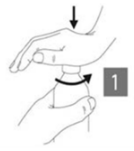
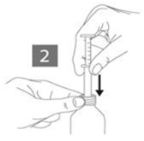
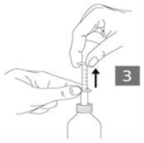
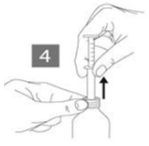
The solution comes with a pipette (syringe). This should be used to help you to measure the exact amount of medicine you need. To open the bottle and use the pipette:
1. The bottle comes with a child resistant cap and should be opened as follows: push the plastic screw cap down while turning it counterclockwise (Figure 1). Remove the unscrewed cap.
2. Insert the pipette into the bottle (Figure 2).
3. While holding the bottom ring, pull the top ring up to the mark that corresponds to the number of millilitres or milligram you need to give/take (Figure 3).
4. Holding the bottom ring, remove the entire pipette from the bottle (Figure 4).
5. Empty the pipette into any non-alcoholic drink, except for tea, by sliding the upper ring down.
6. Close the bottle.
7. Rinse the pipette with some water.
Overdose
Symptoms
Reported signs and symptoms have been those resulting from an exaggeration of the medicine's known pharmacological effects. Symptoms of acute overdosage include drowsiness, sedation, hypotension, tachycardia, and extrapyramidal symptoms. In overdose, QT-prolongation and convulsions have been reported. Torsade de pointes has been reported in association with combined overdose of oral risperidone as in RISPIDE and paroxetine. In the case of acute overdosage, the possibility of multiple medicine involvement should be considered.
Treatment
Establish and maintain a clear airway and ensure adequate oxygenation and ventilation. Administration of activated charcoal together with a laxative should be considered. Cardiovascular monitoring should commence immediately and should include continuous electrocardiographic monitoring to detect possible dysrhythmias.
Since there is no known antidote if accidental poisoning or overdosage is suspected, appropriate supportive measures should be instituted. Hypotension and circulatory collapse should be treated with appropriate measures such as intravenous fluids and/or sympathomimetic medicines. In case of severe extrapyramidal symptoms, anticholinergic medicine should be administered. Close medical supervision and monitoring should continue until the patient recovers.
Shelf life
RISPIDE oral solution: 3 years.
Shelf life after first opening: 4 months.
Special precautions for storage
Store at or below 25°C. Store in the original package until required for use. Do not freeze.
Nature and contents of container
Type III amber glass bottle with a plastic (polypropylene/LDPE) child resistant and tamper-evident cap. RISPIDE oral solution is presented in bottle sizes of 30 ml, 60 ml, 100 ml and 120 ml.
Additionally, a dosing pipette (syringe) is supplied in each pack consisting of a polystyrene plunger and a LDPE-barrel and piston.
Not all pack sizes may be marketed.
Special precautions for disposal and other handling
No special requirements for disposal.
Any unused medicine or waste material should be disposed of in accordance with local requirements.
© All content on this website, including data entry, data processing, decision support tools, "RxReasoner" logo and graphics, is the intellectual property of RxReasoner and is protected by copyright laws. Unauthorized reproduction or distribution of any part of this content without explicit written permission from RxReasoner is strictly prohibited. Any third-party content used on this site is acknowledged and utilized under fair use principles.