SIMTRIYO Extended-release capsule Ref.[116784] Active ingredients: Centanafadine
Source: FDA, National Drug Code (US) Revision Year: 2026
12.1. Mechanism of Action
Centanafadine has inhibitory activity at norepinephrine (NE), dopamine (DA), and serotonin (5-HT) reuptake transporters and is a central nervous system stimulant. The mechanism of action of centanafadine in the treatment of ADHD is unclear; however, its efficacy could be mediated through its activity as a norepinephrine-dopamine-serotonin reuptake inhibitor.
12.2. Pharmacodynamics
Centanafadine binds to the norepinephrine transporter, dopamine transporter, and serotonin transporter, and inhibits the reuptake of these neurotransmitters.
Cardiac Electrophysiology
At 2 times the maximum recommended dose of centanafadine, clinically significant QTc interval prolongation was not observed.
12.3. Pharmacokinetics
Following multiple doses of SIMTRIYO, peak plasma concentration (Cmax) and area under the plasma concentration-time curve (AUC) increased slightly greater than dose proportionally across the dose range of 140 to 280 mg following once-daily dosing. Steady state concentrations were achieved on Day 2 with minimal drug accumulation (1.2- to 1.3-fold).
Absorption
Time to reach Cmax (Tmax) of once daily SIMTRIYO extended-release capsules was 5 hours.
Effect of Food
Administration of SIMTRIYO with a high-fat meal (1000 calories, 50% fat) resulted in 29% increase in Cmax, 1.5 hours delay in Tmax and no change in AUCinf of SIMTRIYO capsule compared to the fasted state. The differences in pharmacokinetic parameters are not considered clinically meaningful [see Dosage and Administration (2.3)].
Sprinkling the contents of a SIMTRIYO capsule on applesauce or yogurt, or in orange juice, had comparable pharmacokinetics (Cmax and AUC) to those observed after administration of the intact capsule of SIMTRIYO [see Dosage and Administration (2.3)].
Distribution
Centanafadine is highly plasma protein bound. The fraction unbound of centanafadine in the plasma of healthy adults is <0.01 and is independent of centanafadine concentrations. The apparent volume of distribution of SIMTRIYO is approximately 167 L.
Elimination
The mean half-life of SIMTRIYO is 5.2 hours. The mean apparent clearance is 410 mL/min.
Metabolism
Centanafadine is primarily metabolized by monoamine oxidase A. The lactam metabolite was the most abundant metabolite and was not pharmacologically active.
Excretion
Following administration of a 14C centanafadine dose, 88% of the administered radioactivity was excreted in the urine as metabolites, and 7% was recovered in the feces.
Specific Populations
Pediatric Patients (6 to 12 years of age)
The pharmacokinetics of centanafadine (Cmax and AUC) in pediatric patients was similar to adults following single and multiple centanafadine doses when the dosage was adjusted for weight. Similar to adults, minor accumulation was observed following multiple centanafadine doses to pediatric patients.
Patients with Renal Impairment
In adults with severe renal impairment (eGFR <30 mL/min, and not undergoing dialysis), centanafadine exposures were lower (Cmax reduced by 25% and AUCinf reduced by 20%) compared to healthy matched adults.
Patients with Hepatic Impairment
In adults with moderate hepatic impairment (Child Pugh B), centanafadine exposures were lower (Cmax reduced by 30% and AUCinf reduced by 25%) compared to healthy matched adults. The effect of severe hepatic impairment (Child Pugh C) or mild hepatic impairment (Child-Pugh Class A) on centanafadine pharmacokinetics has not been studied [see Use in Specific Populations (8.6)].
Drug Interaction Studies
No clinically meaningful change in pharmacokinetics of centanafadine was observed with concomitant use of ciprofloxacin (a CYP1A2 inhibitor), quinidine (a CYP2D6 inhibitor), or smoking (a CYP1A2 inducer).
Following the concomitant use of multiple oral doses of another centanafadine formulation with a caffeine citrate solution (200 mg), a CYP1A2 substrate, there was no appreciable change in the mean Cmax of caffeine; however, there was a 2-fold increase in the AUCinf of caffeine compared to a single dose administration of caffeine citrate solution (200 mg) alone [see Drug Interactions (7)].
Effect of Alcohol
An in vitro dissolution study was conducted to evaluate the effects of alcohol on the release characteristics of centanafadine from SIMTRIYO. The study showed that 20% and 40% alcohol can cause approximately 85% and 100% of centanafadine release, respectively, within 1.5 hours compared to 23% of centanafadine release in the control (0% alcohol). At 5% alcohol, the centanafadine release was comparable to the control through 1.5 hours; however, the release was accelerated beyond that time point (i.e., after 2 hours) [see Drug Interactions (7)].
13.1. Carcinogenesis, Mutagenesis, Impairment of Fertility
Carcinogenesis
Centanafadine did not increase the incidence of tumors in rats treated for up to 91 weeks at any of the oral doses tested, up to 20 mg/kg/day in males and 30 mg/kg/day in females, which are less than the human exposure at the maximum recommended human dose (MRHD) of 280 mg based on AUC. Centanafadine did not increase the incidence of tumors in rasH2 mice treated for 26 weeks at oral doses of up to 10 mg/kg/day.
Mutagenesis
Centanafadine was not genotoxic in a battery of genotoxicity tests. Centanafadine was not mutagenic in the in vitro bacterial reverse mutation (Ames) assay, or clastogenic in the in vitro mammalian chromosomal aberration assay or in vivo in the rat bone marrow micronucleus test.
Impairment of Fertility
Centanafadine did not impact rat fertility or reproduction at doses of 3, 10, or 30 mg/kg/day, with the highest dose tested being lower than the human exposure at the MRHD of 280 mg based on AUC.
14. Clinical Studies
Pediatric Patients with ADHD
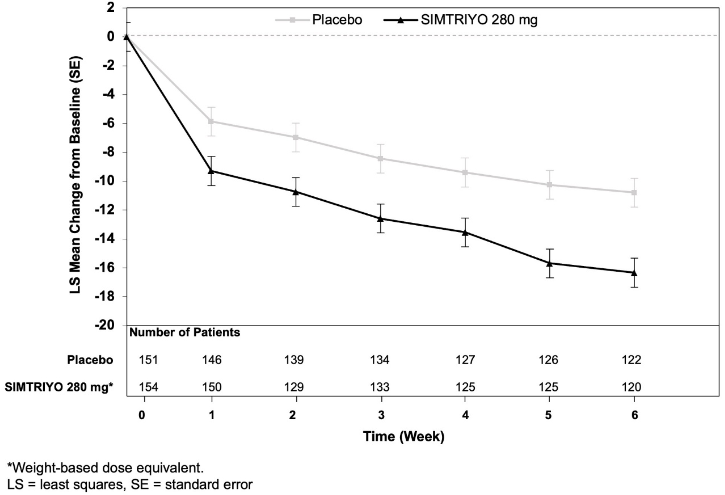
The efficacy of SIMTRIYO for the treatment of ADHD in pediatric patients 6 years of age and older weighing at least 20 kg was evaluated in two short-term, randomized, placebo-controlled studies (Studies 1 and 2).
Study 1
Study 1 (NCT05428033) was a randomized, double-blind, multicenter, placebo-controlled study in patients 4 to 12 years of age with ADHD. SIMTRIYO is not approved for use in patients less than 6 years of age or weighing less than 20 kg [see Indications and Usage (1)]; efficacy results are presented only for pediatric patients 6 years of age and older.
Patients in Cohort 1 (6 to 12 years of age) were randomized 1:1:1 at baseline to receive weight-based dose equivalent to 280 mg SIMTRIYO, weight-based dose equivalent to 140 mg SIMTRIYO, or placebo once daily for 6 weeks. Patients had a mean age of 9 years (range: 6 to 12 years), 58% were male, 27% Black/African American and 65% White, and 31% were of Hispanic or Latino ethnicity.
The primary endpoint was the change from baseline at Week 6 (Day 42) in the symptoms total raw score on the ADHD Rating Scale Version 5 (ADHD-RS-5). Higher ADHD-RS-5 scores reflect more severe symptoms.
A total of 480 patients 6 to 12 years of age were randomized, 367 completed the study and 90 were discontinued. Patients treated with a weight-based dose equivalent to 280 mg SIMTRIYO once daily showed a statistically significant difference in the ADHD-RS-5 symptoms total raw score at Week 6 (Day 42) compared to patients treated with placebo (see Table 6 and Figure 1).
Only the weight-based dose equivalent to 280 mg SIMTRIYO once daily is approved for pediatric patients 6 to 12 years of age [see Dosage and Administration (2.2)]. The weight-based dose equivalent to 140 mg SIMTRIYO once daily did not demonstrate a significantly greater difference in the ADHD-RS-5 symptoms total raw score at Day 42 compared to patients treated with placebo and is not an approved dosage regimen.
Table 6. Primary Efficacy Results for Change from Baseline in ADHD-RS-5 Total Score in Pediatric Patients 6 to 12 Years of Age with ADHD (Study 1):
| Primary Efficacy Measure: ADHD-RS-5 Total Score | ||||
| Treatment Group | N | Mean Baseline Score (SD) | LS Mean Change from Baseline (SE) | Placebo-subtracted Difference* (95% CI) |
| Placebo | 151 | 43.0 (6.69) | -10.8 (1.19) | -- |
| SIMTRIYO 280 mg once daily† | 154 | 43.0 (6.65) | -16.3 (1.19) | -5.6 (-8.78, -2.33) |
SD: standard deviation; SE: standard error; LS Mean: least-squares mean; CI: confidence interval.
* Difference (drug minus placebo) in least-squares mean change from baseline.
† Weight-based dose equivalent
Figure 1. LS Mean Change from Baseline in ADHD-RS-5 Total Score in Pediatric Patients 6 to 12 Years of Age with ADHD (Study 1):
Study 2
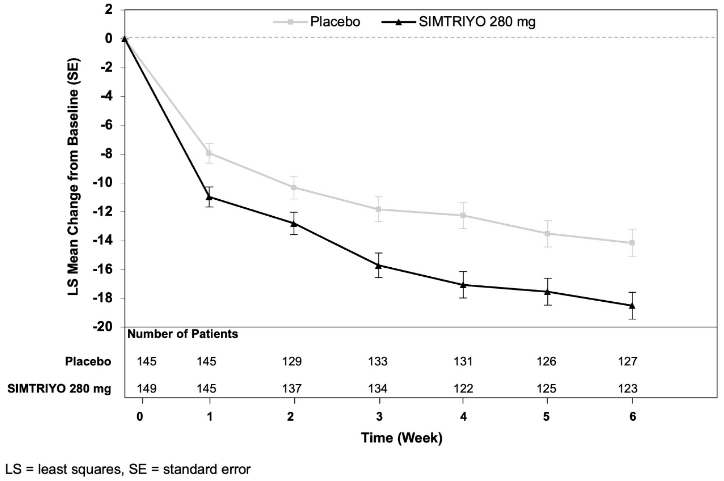
Study 2 (NCT05257265) was a randomized, double-blind, multicenter, placebo-controlled study in patients 13 to 17 years of age with ADHD. Patients were randomized 1:1:1 to receive 140 mg SIMTRIYO, 280 mg SIMTRIYO, or placebo once daily for 6 weeks. Patients had a mean age of 15 years (range: 13 to 17 years), 59% were male; 25% Black/African American, 70% White, and 28% were of Hispanic or Latino ethnicity.
The primary endpoint was the change from baseline at Week 6 (Day 42) in the symptoms total raw score on the ADHD Rating Scale Version 5 (ADHD-RS-5), an 18-question scale that assesses hyperactivity, impulsivity, and inattentive symptoms. Higher ADHD-RS-5 scores reflect more severe symptoms.
A total of 459 patients were randomized, 371 completed the study, and 88 were discontinued. Patients treated with 280 mg SIMTRIYO once daily showed a statistically significant difference in the ADHD-RS-5 symptoms total raw score at Week 6 (Day 42) compared to patients treated with placebo (see Table 7 and Figure 2).
Only SIMTRIYO 280 mg once daily is approved for pediatric patients 13 to 17 years of age [see Dosage and Administration (2.2)]. Patients treated with 140 mg SIMTRIYO once daily did not demonstrate a significantly greater difference in the ADHD-RS-5 symptoms total raw score at Day 42 compared to patients treated with placebo and is not an approved dosage regimen.
Table 7. Primary Efficacy Results for Change from Baseline in ADHD-RS-5 Total Score in Pediatric Patients 13 to 17 Years of Age with ADHD (Study 2):
| Treatment Group | N | Primary Efficacy Measure: ADHD-RS-5 Total Score | ||
| Mean Baseline Score (SD) | LS Mean Change from Baseline (SE) | Placebo-subtracted Difference* (95% CI) | ||
| Placebo | 145 | 37.0 (5.73) | -14.2 (0.93) | -- |
| SIMTRIYO 280 mg once daily | 149 | 37.9 (6.46) | -18.5 (0.93) | -4.4 (-6.83, -1.87) |
SD: standard deviation; SE: standard error; LS Mean: least-squares; CI: confidence interval.
* Difference (drug minus placebo) in least-squares mean change from baseline.
Figure 2. LS Mean Change from Baseline in ADHD-RS-5 Total Score in Pediatric Patients 13 to 17 Years of Age with ADHD (Study 2):
Adult Patients with ADHD
The efficacy of SIMTRIYO for the treatment of ADHD in adults is based on two short-term, randomized, double-blind, multicenter, placebo-controlled studies with another formulation of centanafadine (Studies 3 and 4). There are no expected differences in effectiveness of the low and high doses of the other centanafadine formulation compared to SIMTRIYO 210 mg and 280 mg once daily, respectively, for the treatment of ADHD.
In Study 3 (NCT03605680) and Study 4 (NCT03605836), patients 18 to 55 years of age were randomized (1:1:1) to receive low or high doses of another formulation of centanafadine or placebo for 6 weeks. Patients began double-blind treatment on Day 1 and continued through Day 42. Patients randomized to receive the low dose-initiated treatment on Day 1 and remained at that dose for the duration of the study. Patients randomized to receive the high dose-initiated treatment at the low dose on Day 1 through Day 7, then received the high dose on Day 8 through the duration of the study.
Study 3 included 466 patients with a mean age of 36 years (range: 18 to 55 years old); 51% were male; 14% Black/African American, 81% White, and 22% were of Hispanic or Latino ethnicity. Study 4 included 440 patients with a mean age of 35 years (range: 18 to 55 years old); 53% were male; 13% Black/African American, 79% White, and 18% were of Hispanic or Latino ethnicity.
The primary endpoint in both studies was the change from baseline at Day 42 in the ADHD Investigator Symptom Rating Scale (AISRS) total score, an 18-item scale corresponding to 18 symptoms of ADHD. Higher AISRS scores reflect more severe symptoms. The change from baseline in the Clinical Global Impression-Severity of Illness (CGI-S) score at Day 42 was the key secondary endpoint. Higher CGI-S scores reflect more severe symptoms.
In Studies 3 and 4, a total of 906 patients were randomized; 684 completed the study, and 222 were discontinued. In both studies, the change from baseline (reduction) in the AISRS total score at Day 42 was statistically significantly greater in adults treated with another formulation of centanafadine compared to adults treated with placebo (see Table 8 and Figures 3 and 4). In addition, the change from baseline (reduction) in the CGI-S score, demonstrating reduction in the severity of symptoms of ADHD, was statistically significantly greater in adults treated with another formulation of centanafadine compared to adults treated with placebo.
Table 8. Primary Efficacy Results for Change from Baseline in AISRS Total Score in Adults with ADHD (Studies 3 and 4):
| Study Number | Treatment Group | N | Primary Efficacy Measure: AISRS Total Score in Adults | ||
| Mean Baseline Score (SD) | LS Mean Change from Baseline (SE) | Placebo-subtracted Difference* (95% CI) | |||
| Study 3 | Placebo | 144 | 39.5 (7.20) | -7.0 (0.98) | -- |
| Another centanafadine formulation (low dose†) | 147 | 39.6 (6.69) | -10.1 (0.99) | -3.2 (-5.79, -0.51) | |
| Another centanafadine formulation (high dose†) | 147 | 39.6 (6.82) | -9.7 (0.98) | -2.7 (-5.35, -0.14) | |
| Study 4 | Placebo | 141 | 37.7 (6.35) | -8.1 (0.94) | -- |
| Another centanafadine formulation (low dose†) | 140 | 37.6 (6.75) | -12.1 (0.96) | -4.0 (-6.55, -1.46) | |
| Another centanafadine formulation (high dose†) | 140 | 38.8 (6.96) | -12.5 (0.99) | -4.4 (-7.02, -1.82) | |
SD: standard deviation; SE: standard error; LS Mean: least-squares mean; CI: confidence interval.
* Difference (drug minus placebo) in least-squares mean change from baseline.
† There are no expected differences in effectiveness of SIMTRIYO 210 mg and 280 mg once daily compared to the low and high doses of the other centanafadine formulation, respectively, for the treatment of ADHD in adults.
Figure 3. LS Mean Change from Baseline in AISRS Total Score in Adults with ADHD (Study 3):
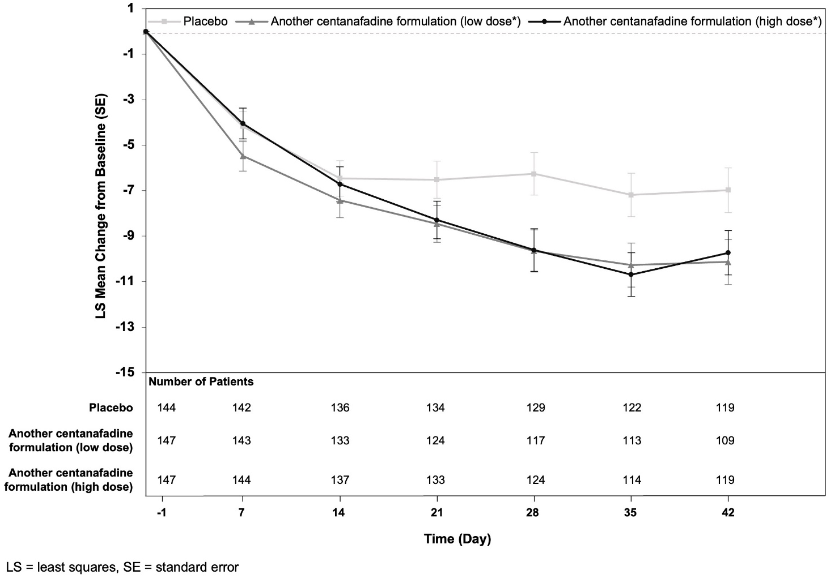
* There are no expected differences in effectiveness of SIMTRIYO 210 mg and 280 mg once daily compared to the low and high doses of the other centanafadine formulation, respectively, for the treatment of ADHD in adults.
Figure 4. LS Mean Change from Baseline in AISRS Total Score in Adults with ADHD (Study 4):
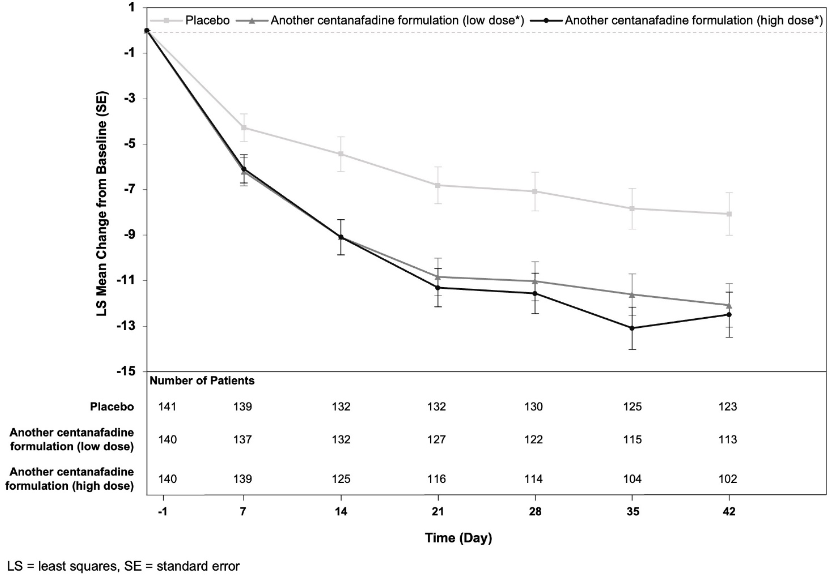
* There are no expected differences in effectiveness of SIMTRIYO 210 mg and 280 mg once daily compared to the low and high doses of the other centanafadine formulation, respectively, for the treatment of ADHD in adults.
© All content on this website, including data entry, data processing, decision support tools, "RxReasoner" logo and graphics, is the intellectual property of RxReasoner and is protected by copyright laws. Unauthorized reproduction or distribution of any part of this content without explicit written permission from RxReasoner is strictly prohibited. Any third-party content used on this site is acknowledged and utilized under fair use principles.