TUDRIQEV Suspension for injection Ref.[116925] Active ingredients: Vusolimogene oderparepvec
Source: FDA, National Drug Code (US) Revision Year: 2026
1. Indications and Usage
TUDRIQEV is indicated in combination with nivolumab for the treatment of adult patients with unresectable advanced cutaneous melanoma who experienced disease progression with a programmed death receptor-1 (PD-1)-blocking antibody-based regimen.
This indication is approved under accelerated approval based on objective response rate (ORR) and duration of response [see Clinical Studies (14)]. Continued approval for this indication may be contingent upon verification of clinical benefit in a confirmatory trial(s).
2. Dosage and Administration
2.1 Recommended Dosage
For intratumor injection only. DO NOT administer intravenously.
- The recommended dosage of TUDRIQEV is 1 mL/cm of the largest dimension of the tumor for a maximum of 10 mL across all lesions treated with each dose.
- Administer intratumor injections of TUDRIQEV every two weeks for 8 consecutive doses starting at a concentration of 106plaque-forming units (PFU) per mL at Week 1 followed by 107PFU per mL for subsequent weeks.
- Assess the size of each injectable lesion on each treatment day to determine the required TUDRIQEV volume.
- If multiple tumors are present, prioritize the most rapidly growing and largest new or existing lesions suitable for injection.
Patients with no confirmed disease progression could be retreated with TUDRIQEV at a concentration of 107PFU/mL every two weeks.
Administer nivolumab as intravenous injection starting at Week 3. Refer to the nivolumab prescribing information for the dosage and administration information including dose modifications, preparation, and administration [see Clinical Studies (14)].
2.2 Preparation and Handling
- Avoid accidental exposure to TUDRIQEV by wearing appropriate personal protective equipment (PPE). Observe standard precautions when preparing and administering TUDRIQEV [see Warnings and Precautions (5.1)].
- Clean surfaces that may have come in contact with TUDRIQEV (including spills) with broad spectrum virucidal agent such as 70% isopropanol alcohol or 1% sodium hypochlorite.
- Dispose of the used vials and all materials that may have come in contact with TUDRIQEV as biohazardous waste.
TUDRIQEV should be prepared by a healthcare professional experienced in the use of anticancer therapy.
1. Determine the volume required for injection [see Dosage and Administration (2.1)].
2. Thaw TUDRIQEV vials inside the original carton at room temperature [15°C to 25°C (59°F to 77°F)] or during refrigeration [2°C to 8°C (36° to 46°F)]. DO NOT refreeze TUDRIQEV after thawing [see How Supplied/Storage and Handling (16.2)].
3. Swirl gently, inspect vial. Particles may be visible [see Description (11)]. If settlement occurs, re-suspend by gently swirling. DO NOT shake.
4. Using aseptic technique, withdraw the required TUDRIQEV dosage volume from the vial(s) into the syringe(s) to be used for administration.
5. Select needles gauged between 17G and 27G based on the location and characteristics of the tumors to be injected. A higher needle gauge will allow for a smaller puncture in tissue and will reduce leakage of TUDRIQEV along the needle tract. A lower needle gauge is needed for fibrotic or deeper lesions.
6. Administer TUDRIQEV within 2 hours of syringe preparation [see How Supplied/Storage and Handling (16.2)].
2.3 Administration
DO NOT administer TUDRIQEV into brain or spinal cord tumors or scalp tumors with moderate to extensive bone erosion. Avoid tumors that encase, invade, or occlude major blood vessels, major nerve structures, or airways. Avoid direct injection into blood vessels.
Pre-Injection:
1. Clean the skin areas where the needle will be inserted with an alcohol swab and let dry.
2. Treat the injection site with a topical or local anesthetic agent, if necessary. DO NOT inject anesthetic agent directly into the lesion. Inject anesthetic agent around the periphery of the lesion.
Intratumor Injection into Nonulcerated Superficial Tumors:
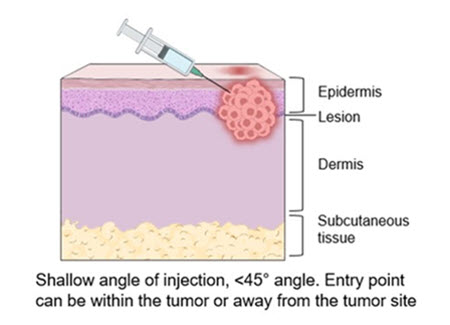
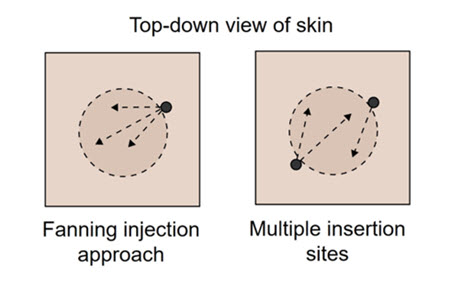
Administer TUDRIQEV via direct intratumor injection into superficial tumors using visualization and palpation for guidance. Injection techniques are shown in Figure 1 and Figure 2.
1. Insert the needle from the periphery at a shallow angle (less than 45-degree) to the base of the tumor. Avoid areas of necrosis and target viable tumor tissue.
2. Using a single insertion point, partially inject TUDRIQEV slowly.
3. While keeping the needle inserted at a single insertion point, partially withdraw, and move the needle to different viable areas of the tumor as shown in Figure 1 and disperse TUDRIQEV as uniformly as possible throughout the tumor. Continue until the full dose is dispensed.
4. Multiple insertion sites may be needed, depending on the size of the tumor.
5. When removing the needle, withdraw from the tumor slowly to avoid leakage of TUDRIQEV at the insertion point.
Figure 1. Injection Administration for Nonulcerated Superficial Tumors:
Intratumor Injection into Ulcerated Superficial Tumors:
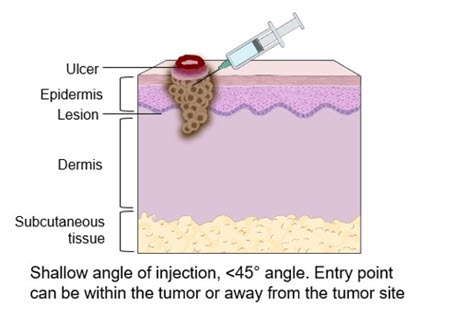
1. DO NOT inject TUDRIQEV through areas of ulceration and/or necrosis.
2. Insert the needle from the periphery at a shallow angle (less than 45-degree) to the base of the tumor.
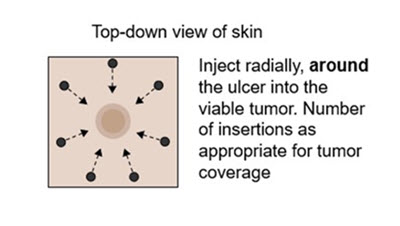
3. Using multiple insertion points (radial insertion) as shown in Figure 2, partially inject TUDRIQEV slowly. Disperse TUDRIQEV as uniformly as possible throughout the tumor. Continue until the full volume is dispensed.
4. Withdraw from the tumor slowly to avoid leakage of TUDRIQEV at the insertion point.
Figure 2. Injection Administration for Ulcerated Cutaneous Tumors:
Intratumor Injection into Deep or Visceral Lesions
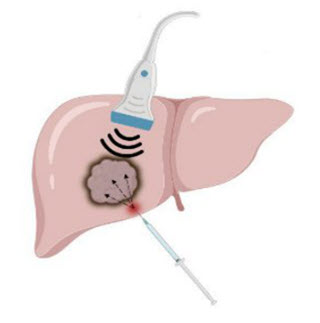
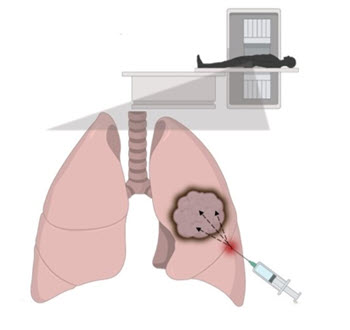
Administer TUDRIQEV via direct intratumor injection into deep or visceral tumors guided by imaging technology. Consider the safest needle placement when selecting tumors for injection to avoid major vessels.
- Select hepatic tumors that are at a safe distance from the main portal vein and common bile duct.
- Select lung tumors that are at a safe distance from any lobar or segmental pulmonary arteries or veins or lobar or segmental bronchi. DO NOT inject tumors in both the right and left lung lobes on the same day.
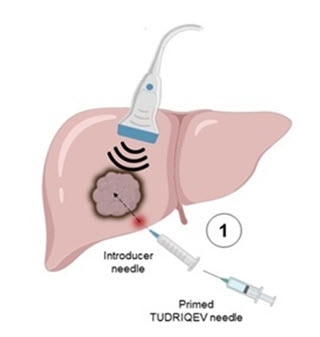
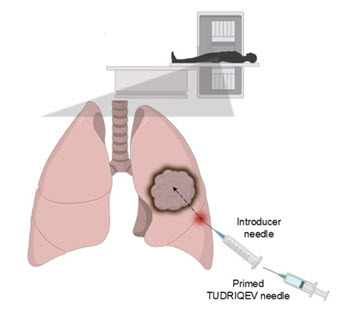
Injection administration techniques in deep or visceral tumors are shown in Figure 3 (radial injection) and Figure 4 (coaxial injection).
1. Insert the needle into the tumor through a single insertion point to the distal end of the tumor. Multi-prong or multi-orifice needles may be used.
2. Partially inject TUDRIQEV slowly while withdrawing the needle from the tumor.
3. Redirect the needle as shown in Figure 3 and repeat steps until the full TUDRIQEV dose is dispensed.
4. When removing the needle, withdraw from the tumor slowly to avoid leakage of TUDRIQEV at the injection point.
Figure 3. Radial Injection Administration in Deep or Visceral Tumor:
Note: Visceral organs may also include the lung, kidney or other organs.
If necessary for injection, insert an introducer needle into the visceral organ where the tumor is to be treated as shown in Figure 4.
1. Pass the primed higher gauge TUDRIQEV needle through the introducer needle into the target tumor and inject TUDRIQEV slowly.
2. Redirect the needles and repeat until the full TUDRIQEV dose is dispensed.
3. When removing the needle, withdraw from the tumor slowly to avoid leakage of TUDRIQEV at the injection point.
Figure 4. Coaxial Injection Administration in Visceral Tumor with Image Guidance
Note: Visceral organs may also include the lung, kidney or other organs.
Post-Injection
1. Swab the injection site(s) and surrounding area with alcohol.
2. Change gloves and apply a sterile occlusive dressing at each injection site. Instruct patients to keep the injection site(s) covered for at least 48 hours.
3. Clean surfaces that may have come in contact with TUDRIQEV (including spills) with broad spectrum virucidal agent such as 70% isopropanol or 1% sodium hypochlorite.
4. Dispose of all materials (e.g. syringe, gloves, cleaning materials) that may have come in contact with TUDRIQEV as biohazardous waste.
5. Monitor patients post injection for procedure related reactions and for at least 2 to 4 hours in patients undergoing injections for liver, lung, or kidney tumors.
16.2. Storage and Handling
- Protect TUDRIQEV from light. Store in the original carton until use.
- Store TUDRIQEV at -70°C to -90°C (-94°F to -130°F). If a freezer is not available, refer to Table 4 for refrigeration guidelines.
- Thaw TUDRIQEV immediately prior to administration [see Dosage and Administration (2.2)]. DO NOT refreeze.
Table 4. Storage of Thawed TUDRIQEV in Vial and Syringe:
| Storage Condition | Thawed Vial | Prepared Syringe |
| Refrigeration: 2°C to 8°C (36°F to 46°F) | 106 PFU/mL vial up to 2 days 107 PFU/mL vial up to 10 days | Use within 2 hours of preparation |
| Room temperature: 15°C to 25°C (59°F to 77°F) | Up to 24 hours | Use within 2 hours of preparation |
© All content on this website, including data entry, data processing, decision support tools, "RxReasoner" logo and graphics, is the intellectual property of RxReasoner and is protected by copyright laws. Unauthorized reproduction or distribution of any part of this content without explicit written permission from RxReasoner is strictly prohibited. Any third-party content used on this site is acknowledged and utilized under fair use principles.