ZANVASTRO Solution for injection Ref.[116918] Active ingredients: Zilganersen
Source: FDA, National Drug Code (US) Revision Year: 2026
12.1. Mechanism of Action
ZANVASTRO is an antisense oligonucleotide that causes degradation of glial fibrillary acidic protein (GFAP) pre-mRNA through binding to GFAP pre-mRNA, which results in a reduction of GFAP protein synthesis.
12.2. Pharmacodynamics
Effect of Zilganersen on Plasma GFAP
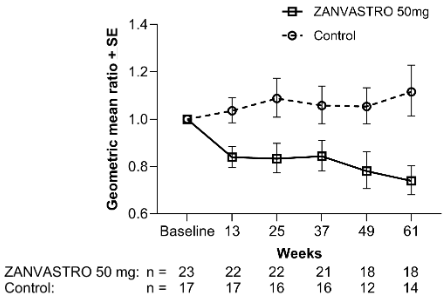
Plasma GFAP, an indirect measure of target engagement, was evaluated longitudinally in patients with Alexander disease [see Clinical Studies (14)]. At week 61 (after 5 doses), the geometric mean ratio to baseline in plasma GFAP was 33.6% lower in patients on ZANVASTRO compared to controls (see Figure 2).
Figure 2. Mean Change from Baseline in Plasma GFAP (Geometric Mean Ratio ± SE) in Patients Treated with ZANVASTRO 50 mg or Control (Study 1; Main Study):
Cardiac Electrophysiology
Based on the chemical properties of zilganersen and the absence of cardiac electrophysiology findings in nonclinical studies, zilganersen is not expected to affect the QTc interval.
12.3. Pharmacokinetics
Absorption
The pharmacokinetic properties of zilganersen were evaluated following intrathecal administration of multiple doses given as a 50mg bolus every 12 weeks in pediatric (≥2 years old) and adult patients with Alexander disease. Following 50 mg dosing in patients ≥2 years old, zilganersen was quantifiable in CSF 84 days after injection (trough). The steady state pharmacokinetics are presented as geometric mean (%CV). The steady-state CSF trough (Ctrough, CSF, ss) concentration was 1.21 ng/mL (40.8%). The steady-state maximum plasma concentration (Cmax,ss) was 908 ng/mL (74.3%), with a median time to maximum plasma concentration (Tmax,ss) of 4.03 hours (range: 1.00–23.7 hours). The steady-state trough plasma concentration (C~trough,plasma,ss~) was 0.252 ng/mL (147%), and the area under the plasma concentration-time curve from 0 to 24 hours (AUC0-24h) was 7,716 ng·h/mL (97.4%).
No evidence of time-dependent plasma pharmacokinetics was observed between the first and sixth administration of ZANVASTRO in patients >2 years of age.
Distribution
In vitro, greater than 98% of zilganersen binds to human plasma proteins. Following intrathecal administration of ZANVASTRO into the CSF, zilganersen distributes into the systemic circulation and tissues with the central compartment volume of 7.95 L and the peripheral compartment volume of 315 L.
Elimination
The terminal elimination half-life in plasma is approximately 1 month.
Metabolism
Zilganersen undergoes endonuclease and exonuclease-mediated cleavage to shorter oligonucleotide metabolites; it is not a CYP substrate, and CYP450-mediated metabolism is not expected.
Excretion
The primary route of elimination is likely by urinary excretion for zilganersen and its chain-shortened metabolites. The urinary excretion of unchanged zilganersen has not been characterized.
Specific Populations
No clinically meaningful differences in the pharmacokinetics of zilganersen were observed based on age, body weight, sex, race, ethnicity, mild renal impairment (eGFR ≥60 to <90 mL/min/1.73 m²), or mild hepatic impairment (defined using NCI-ODWG Criteria: total bilirubin ≤1 × ULN and AST >1 × ULN, or total bilirubin >1 to 1.5 × ULN and any AST).
ZANVASTRO has not been studied in patients aged ≥65 years, patients with moderate or severe renal impairment, end-stage renal disease, or moderate or severe hepatic impairment.
Drug Interaction Studies
No clinical drug–drug interaction studies have been performed with ZANVASTRO. In vitro, studies show that zilganersen is not a substrate or inhibitor of major drug transporters, does not interact with highly plasma protein bound medicines, and is not an inhibitor or inducer of cytochrome P450 (CYP) enzymes.
13.1. Carcinogenesis, Mutagenesis, Impairment of Fertility
Carcinogenesis
Long-term studies to assess the carcinogenic potential of zilganersen have not been conducted.
Mutagenesis
Zilganersen was negative in in vitro (bacterial reverse mutation and mammalian cell chromosomal aberration) and in vivo (mouse micronucleus) assays.
Impairment of Fertility
No adverse effects on male or female fertility were observed when zilganersen (0, 10, 30, or 60 mg/kg) was administered by subcutaneous injection to mice every 2 weeks prior to and during mating and continuing in females every other day throughout organogenesis. The NOAEL (60 mg/kg) provides a safety margin of 6 compared to the maximum recommended human dose (MRHD of 50 mg) when normalized to a per-dose BSA basis.
14. Clinical Studies
The efficacy of ZANVASTRO was evaluated in a multicenter study in pediatric and adult patients with Alexander disease (Study 1; NCT04849741). Study 1 comprised two parts: a double-blind, randomized, controlled Main Study that enrolled 49 patients aged 2 to 65 years, and an open-label substudy that enrolled 4 patients less than 2 years of age. All patients had Alexander disease confirmed by clinical phenotype, brain MRI, and a pathogenic variant in the GFAP gene.
The Main Study duration was up to 274 weeks, including a 6-week screening period; a 60-week double-blind period (i.e., ended at Week 61) followed by a 60-week open-label period; a 120-week long-term extension; and a 28-week post-treatment follow-up. During the double-blind period, patients 2 years and older were enrolled into two ascending-dose cohorts (25 mg; n=8 or 50 mg; n=24) and randomized in each cohort 2:1 to ZANVASTRO every 12 weeks, or control (n=17).
Randomization in the Main Study was stratified as follows: Stratum 1: (i) patients ≥5 years, (ii) if ≥18 years, had onset of Alexander disease motor symptoms/signs within 5 years, and (iii) demonstrated an abnormality in gross motor skills; Stratum 2: all other enrolled patients. The primary endpoint was evaluated in Stratum 1 and secondary endpoints were assessed in all randomized patients in the Main Study population (both Stratum 1 and Stratum 2). In patients 2-4 years of age enrolled in Stratum 2, efficacy was evaluated using an alternate endpoint, as described below.
Baseline characteristics for the Main Study randomized population (n=49) were similar between the ZANVASTRO and control groups with a median age of 11 years and mean gait speed, as measured by the 10- meter walk test, of 1.2 m/sec. Sixty-five percent were female, 86% White, 8% other/multiple races, 6% Asian, and 10% Hispanic or Latino ethnicity. Twelve (12) patients (Stratum 1 = 9 [75%]) enrolled in the 25 mg dose cohort (half the recommended dosage) and 37 patients (Stratum 1 = 27 [73%]) enrolled in the 50 mg dose cohort.
The primary efficacy analysis for Stratum 1 of the Main Study was the difference in the mean percent change in gait speed from baseline to Week 61, as assessed by the 10-meter walk test (10MWT), comparing ZANVASTRO 50 mg with control. Treatment with ZANVASTRO 50 mg demonstrated a statistically significant difference in gait speed compared to control (-2.1% with ZANVASTRO 50 mg vs. -35.4% with control; adjusted least squares mean difference: 33.3% [95% CI: 1.44, 65.25], p = 0.041) (see Figure 3).
Figure 3. Mean Percent Change in Gait Speed from Baseline in Stratum 1 Patients Treated with ZANVASTRO 50 mg or Control:
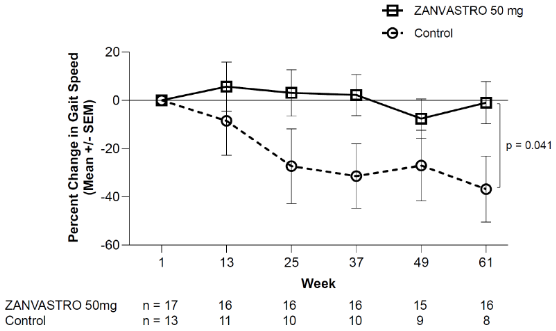
n = number of patients with observed data at each timepoint.
The p-value was estimated from an ANCOVA model with treatment group and Baseline value as covariates. The ANCOVA model used prespecified imputation methods that utilized all patients in the primary analysis (n=17 ZANVASTRO 50 mg, n =13 Control).
In the subgroup of patients 2-4 years of age, motor function was assessed as the difference in the mean change from baseline to Week 61 in the Gross Motor Function Measure-88 (GMFM-88) subscales for standing (Dimension D) and for walking, running, and jumping (Dimension E). Patients in this subgroup treated with ZANVASTRO (n=4) had an observed improvement on the GMFM-88 Dimension D and Dimension E combined score while patients in the control arm (n=3) had an observed decline (least squares mean difference: 22.9, standard error: 5.2).
© All content on this website, including data entry, data processing, decision support tools, "RxReasoner" logo and graphics, is the intellectual property of RxReasoner and is protected by copyright laws. Unauthorized reproduction or distribution of any part of this content without explicit written permission from RxReasoner is strictly prohibited. Any third-party content used on this site is acknowledged and utilized under fair use principles.