Oveporexton
Chemical formula: C₂₃H₂₅F₅N₂O₄S Molecular mass: 520.146 g/mol PubChem compound: 154617563
Mechanism of action
The mechanism of action of oveporexton in the treatment of narcolepsy type 1 (NT1) is through agonism of the orexin receptor 2 (OX2R). NT1 is associated with the loss of orexin neuropeptide signaling.
Pharmacodynamic properties
Cardiac Electrophysiology
Based on a comprehensive concentration-QTc analysis, there was no clinically relevant effect of oveporexton (i.e., >10 ms) on the QTc interval up to 11 times the mean steady state Cmax at the maximum recommended dose.
Pharmacokinetic properties
Oveporexton showed dose proportional increase in exposures (Cmax and AUC0-t) at steady state over the dosage range of 1 mg twice daily to 2 mg twice daily. With two times daily administration, steady state was reached within 5 days, with an accumulation ratio of approximately 1.6 after a oveporexton dosage of 1 mg twice daily to 2 mg twice daily.
Absorption
Oveporexton median (min, max) time to maximum plasma concentration (Tmax) is 1.5 hours (1 to 4 hours) at steady state.
Effect of Food: No clinically significant differences in the pharmacokinetics of oveporexton were observed following administration with a high-fat high-calorie meal.
Distribution
The apparent steady state volume of distribution of oveporexton is approximately 325 L. Protein binding is high (>96%) and concentration-independent in human plasma. The whole blood to plasma concentration ratio ranged from 0.61 to 0.90.
Elimination
The mean terminal elimination half-life of oveporexton is approximately 23.2 hours.
Metabolism: Oveporexton is primarily eliminated by hepatic metabolism. CYP3A4 is the predominant CYP enzyme involved in oveporexton metabolism with no major metabolites identified in circulation.
Excretion: After a single 25 mg radiolabeled oral dose of oveporexton, 80.5% of the total dose was recovered in feces and 11.0% was recovered in urine. Renal elimination of unchanged drug accounts for <1% of the total clearance of oveporexton.
Specific Populations
Patients with Hepatic Impairment
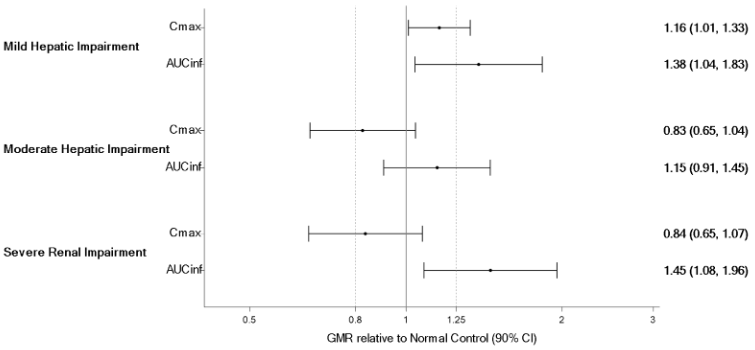
Exposure of oveporexton in patients with mild hepatic impairment (HI) (Child-Pugh A) or moderate HI (Child-Pugh B) compared to patients with normal hepatic function is summarized in Figure 1. Changes in oveporexton exposures (AUCinf) due to HI did not exceed 2-fold compared to patients with normal hepatic function.
Patients with severe HI (Child-Pugh C) were not evaluated in clinical trials.
Patients with Renal Impairment
Exposures of oveporexton in patients with severe renal impairment (RI) (eGFR<15 mL/min; not on dialysis) compared to patients with normal renal function is summarized in Figure 1. Changes in oveporexton exposures (AUCinf) due to RI did not exceed 2-fold compared to patients with normal renal function.
Patients with ESRD (eGFR <15 mL/minute or dialysis patients) were not evaluated in clinical trials.
Figure 1. Effects of Hepatic and Renal Impairment on Oveporexton Pharmacokinetics:
Other Specific Populations
Based on population pharmacokinetic analysis, age, sex, race/ethnicity, and body weight did not have clinically meaningful effects on the pharmacokinetics of oveporexton.
Drug Interaction Studies
Clinical Studies and Model-Informed Approaches
Effects of Other Drugs on Oveporexton:
- Strong and Moderate CYP3A Inhibitors: Concomitant use of oveporexton with itraconazole (a strong CYP3A inhibitor) resulted in increases in oveporexton AUCinf (7.4-fold increase) and Cmax (1.7-fold increase), compared to the use of oveporexton alone. The half-life of oveporexton was approximately 5-fold longer in the presence of itraconazole. Concomitant use of oveporexton with fluconazole (a moderate CYP3A inhibitor) resulted in increases in oveporexton AUCinf (2.9-fold increase) and Cmax (1.5-fold increase), compared to the use of oveporexton alone. The half-life of oveporexton was approximately 2-fold longer in the presence of fluconazole.
- Weak CYP3A Inhibitors: Based on physiologically-based pharmacokinetic (PBPK) modeling, no clinically meaningful interaction is expected during concomitant use of oveporexton with weak CYP3A inhibitors.
- Strong and Moderate CYP3A Inducers: Concomitant use of oveporexton with phenytoin (a strong CYP3A inducer) resulted in decreases in oveporexton AUCinf and Cmax by 81% and 56%, respectively, compared to use of oveporexton alone. Based on PBPK modeling, concomitant use of oveporexton with a moderate CYP3A inducer is predicted to decrease AUCinf and Cmax by 73% and 55%, respectively, compared to use of oveporexton alone.
- Weak CYP3A Inducers: Based on PBPK modeling, no clinically meaningful interaction is expected during concomitant use of oveporexton with weak CYP3A inducers.
Effects of Oveporexton on Other Drugs:
Based on a clinical evaluation of the effect of oveporexton on CYP3A activity assessed by 4β-hydroxycholesterol to cholesterol ratios and PBPK modeling, oveporexton is not expected to affect CYP3A activity or alter systemic exposure of CYP3A substrates at the maximum recommended oveporexton dose.
Based on a clinical evaluation of the effects of oveporexton on OATP1B1/B3 activity assessed by Coproporphyrin I (CPI) and Coproporphyrin III (CPIII), there was no apparent risk of inhibition of these transporters at the maximum recommended oveporexton dose.
In Vitro Studies
Cytochrome P450 (CYP) Enzymes:
In vitro, oveporexton exposures at the maximum recommended oveporexton dose is not expected to directly inhibit or induce CYP enzymes (CYP3A4, CYP1A2, CYP2B6, CYP2C8, CYP2C9, CYP2C19, and CYP2D6).
Drug Transporter Systems
- Transporter Inhibition: In vitro, oveporexton did not inhibit P-gp, BCRP, OAT1, OAT3, OCT1, OCT2, OATP1B1, OATP1B3, MATE1, MATE2K, or MRP2.
- In vitro, oveporexton was an inhibitor of efflux transporters BSEP, MRP3, MRP4, and MDR3. However, inhibition of these transporters by oveporexton is not expected at the maximum recommended oveporexton dose.
- Transporter Substrate: In vitro, oveporexton was not a substrate of P-gp, BCRP, OATP1B1, or OATP1B3.
Related medicines
© All content on this website, including data entry, data processing, decision support tools, "RxReasoner" logo and graphics, is the intellectual property of RxReasoner and is protected by copyright laws. Unauthorized reproduction or distribution of any part of this content without explicit written permission from RxReasoner is strictly prohibited. Any third-party content used on this site is acknowledged and utilized under fair use principles.