ABILIFY MAINTENA 720 mg / 960 mg Prolonged-release suspension for injection Ref.[116141] Active ingredients: Aripiprazole
Source: European Medicines Agency (EU) Revision Year: 2025 Publisher: Otsuka Pharmaceutical Netherlands B.V., Herikerbergweg 292, 1101 CT, Amsterdam, Netherlands
5.1. Pharmacodynamic properties
Pharmacotherapeutic group: Psycholeptics, other antipsychotics
ATC code: N05AX12
Mechanism of action
It has been proposed that aripiprazole's efficacy in schizophrenia is mediated through a combination of partial agonism at dopamine D2 and serotonin 5-HT1A receptors and antagonism at serotonin 5-HT2A receptors. Aripiprazole exhibited antagonist properties in animal models of dopaminergic hyperactivity and agonist properties of dopaminergic hypoactivity. Aripiprazole exhibits high binding affinity in vitro for dopamine D2 and D3, serotonin 5-HT1A and 5-HT2A receptors and has moderate affinity for dopamine D4, serotonin 5-HT2C and 5-HT7, alpha-1 adrenergic, and histamine H1 receptors. Aripiprazole also exhibited moderate binding affinity for the serotonin reuptake site and no appreciable affinity for cholinergic muscarinic receptors. Interaction with receptors other than dopamine and serotonin subtypes may explain some of the other clinical effects of aripiprazole.
Aripiprazole oral doses ranging from 0.5 mg to 30 mg administered once a day to healthy subjects for 2 weeks produced a dose-dependent reduction in the binding of 11C-raclopride, a D2/D3 receptor ligand, to the caudate and putamen detected by positron emission tomography.
Clinical efficacy and safety
Maintenance treatment of schizophrenia in adults
The efficacy of Abilify Maintena 960 mg, administered once every two months, was established in part, on the basis of pharmacokinetic bridging through an open-label, multiple-dose, randomized, parallel-arm multi-centre study. The study demonstrated that Abilify Maintena 960 mg provides similar aripiprazole concentrations, and thus similar effectiveness, to Abilify Maintena 400 mg over the dosing interval (see section 5.2). The similarity of aripiprazole plasma concentrations of Abilify Maintena 960 mg to Abilify Maintena 400 mg is presented in table 1.
Table 2. Geometric mean ratio and confidence interval (CI) following the fourth administration of Abilify Maintena 960 mg or the seventh and eighth Abilify Maintena 400 mg in the open-label study:
The effectiveness of Abilify Maintena 960 mg/720 mg in the treatment of schizophrenia is further supported by the established effectiveness of Abilify Maintena 400 mg/300 mg, as summarised below:
Efficacy of Abilify Maintena 400 mg/300 mg
The efficacy of Abilify Maintena 400 mg/300 mg in the maintenance treatment of patients with schizophrenia was established in two randomised, double-blind, long-term trials.
The pivotal trial was a 38 week, randomised, double-blind, active-controlled trial designed to establish the efficacy, safety, and tolerability of this medicinal product administered as monthly injections compared to once daily oral aripiprazole tablets 10 mg to 30 mg as maintenance treatment in adult patients with schizophrenia. This trial consisted of a screening phase and 3 treatment phases: Conversion phase, oral stabilisation phase, and double-blind, active-controlled phase.
Six-hundred and sixty-two patients eligible for the 38-week double-blind, active-controlled phase were randomly assigned in a 2:2:1 ratio to double-blind treatment to one of 3 treatment groups: 1) Abilify Maintena 2) the stabilisation dose of oral aripiprazole 10 mg to 30 mg, or 3) aripiprazole long-acting injectable 50 mg/25 mg. The aripiprazole long-acting injectable 50 mg/25 mg dose was included as a low dose aripiprazole to test assay sensitivity for the non-inferiority design.
The results of analysis of the primary efficacy endpoint, the estimated proportion of patients experiencing impending relapse by end of week 26 of the double-blind, active-controlled phase, showed that Abilify Maintena 400 mg/300 mg is non-inferior to aripiprazole oral tablets 10 mg to 30 mg.
The estimated relapse rate by end of week 26 was 7.12 % for Abilify Maintena 400 mg/300 mg, and 7.76 % for oral aripiprazole tablets 10 mg to 30 mg, a difference of −0.64 %.
The 95 % CI (−5.26, 3.99) for the difference in the estimated proportion of patients experiencing impending relapse by end of week 26 excluded the predefined non-inferiority margin, 11.5 %.
Therefore, Abilify Maintena 400 mg/300 mg is non-inferior to aripiprazole oral tablets 10 mg to 30 mg.
The estimated proportion of patients experiencing impending relapse by end of week 26 for Abilify Maintena 400 mg/300 mg was 7.12 %, which was statistically significantly lower than in aripiprazole long-acting injectable 50 mg/25 mg (21.80 %; p = 0.0006). Thus, superiority of Abilify Maintena 400 mg/300 mg over the aripiprazole long-acting injectable 50 mg/25 mg was established, and the validity of the trial design was confirmed.
The Kaplan-Meier curves of the time from randomisation to impending relapse during the 38-week, double-blind, active-controlled phase for Abilify Maintena 400 mg/300 mg, oral aripiprazole 10 mg to 30 mg, and aripiprazole long-acting injectable 50 mg/25 mg are shown in figure 1.
Figure 1. Kaplan-Meier product limit plot for time to exacerbation of psychotic symptoms/impending relapse:
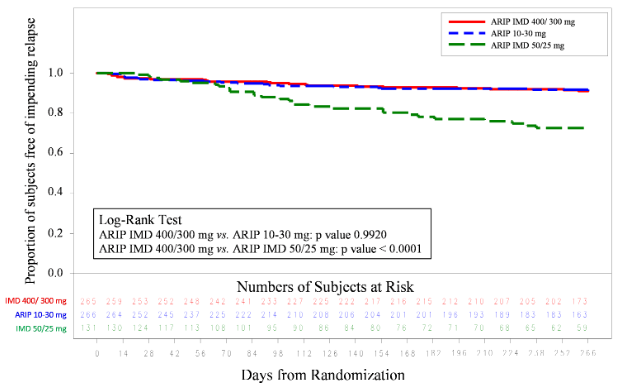
NOTE: ARIP IMD 400/300 mg = Abilify Maintena; ARIP 10 mg to 30 mg = oral aripiprazole; ARIP IMD 50/25 mg = Aripiprazole long-acting injectable
Further, the non-inferiority of Abilify Maintena compared to oral aripiprazole 10 mg to 30 mg is supported by the results of the analysis of the positive and negative syndrome scale score (PANSS).
Table 3. PANSS total score – change from baseline to week 38-Last Observation Carried Forward (LOCF): randomised efficacy samplea,b:
| PANSS total score – change from baseline to week 38-LOCF: randomised efficacy samplea,b | |||
| Abilify Maintena 400 mg/300 mg (n=263) | Oral aripiprazole 10-30 mg/day (n=266) | Aripiprazole long-acting injectable 50 mg/25 mg (n=131) | |
| Mean baseline (SD) | 57.9 (12.94) | 56.6 (12.65) | 56.1 (12.59) |
| Mean change (SD) | −1.8 (10.49) | 0.7 (11.60) | 3.2 (14.45) |
| P-value | NA | 0.0272 | 0.0002 |
a Negative change in score indicates improvement.
b Only patients having both baseline and at least one post baseline were included. P-values were derived from comparison for change from baseline within analysis of covariance model with treatment as term and baseline as covariate.
The second trial was a 52-week, randomised, withdrawal, double-blind, trial conducted in US adult patients with a current diagnosis of schizophrenia. This trial consisted of a screening phase and 4 treatment phases: Conversion, oral stabilisation, IM stabilisation, and double-blind placebo-controlled. Patients fulfilling the oral stabilisation requirement in the oral stabilisation phase were assigned to receive, in a single-blind fashion, Abilify Maintena 400 mg/300 mg and began an IM phase for a minimum of 12 weeks and a maximum of 36 weeks. Patients eligible for the double-blind, placebo-controlled phase were randomly assigned in a 2:1 ratio to double-blind treatment with Abilify Maintena 400 mg/300 mg or placebo, respectively.
The final efficacy analysis included 403 randomised patients and 80 exacerbations of psychotic symptoms/impending relapse events. In the placebo group 39.6% of the patients had progressed to impending relapse, whilst in the Abilify Maintena 400 mg/300 mg group impending relapse occurred in 10% of the patients; thus, patients in the placebo group had a 5.03-fold greater risk of experiencing impending relapse.
Prolactin
In the double-blind, active-controlled phase of the 38-week trial, from baseline to last visit there was a mean decrease in prolactin levels in Abilify Maintena 400 mg/300 mg (−0.33 ng/mL) compared with a mean increase in oral aripiprazole tablets 10 mg to 30 mg (0.79 ng/mL; p<0.01). The incidence of Abilify Maintena 400 mg/300 mg patients with prolactin levels >1 time the upper limit of normal range (ULN) at any assessment was 5.4% compared with 3.5% of the patients on oral aripiprazole tablets 10 mg to 30 mg.
Male patients generally had a higher incidence than female patients in each treatment group.
In the double-blind placebo-controlled phase of the 52-week trial, from baseline to last visit there was a mean decrease in prolactin levels in Abilify Maintena 400 mg/300 mg (−0.38 ng/mL) compared with a mean increase in placebo (1.67 ng/mL). The incidences of Abilify Maintena 400 mg/300 mg patients with prolactin levels >1 time the ULN was 1.9% compared to 7.1% for placebo patients.
Acute treatment of schizophrenia in adults
The efficacy of Abilify Maintena 400 mg/300 mg in acutely relapsed adult patients with schizophrenia was established in a short-term (12-week), randomised, double-blind, placebo-controlled trial (n=339). The primary endpoint (change in PANSS total score from baseline to week 10) showed superiority of Abilify Maintena 400 mg/300 mg (n=167) over placebo (n=172). Similar to the PANSS total score, both the PANSS positive and negative subscale scores also showed an improvement (decrease) from baseline over time.
Table 4. PANSS total score – change from baseline to week 10: randomised efficacy sample:
| PANSS total score – change from baseline to week 10: randomised efficacy samplea | ||
| Abilify Maintena 400 mg/300 mg | Placebo | |
| Mean baseline (SD) | 102.4 (11.4) n=162 | 103.4 (11.1) n=167 |
| LS mean change (SE) | −26.8 (1.6) n=99 | −11.7 (1.6) n=81 |
| P-value | <0.0001 | |
| Treatment differenceb (95% CI) | −15.1 (−19.4, −10.8) | |
a Data were analysed using a mixed model repeated measures (MMRM) approach. The analysis included only subjects who were randomly assigned to treatment, given at least one injection, had baseline and at least one post-baseline efficacy assessment.
b Difference (Abilify Maintena minus placebo) in least squares mean change from baseline.
Abilify Maintena 400 mg/300 mg also showed statistically significant improvement in symptoms represented by Clinical Global Impressions Severity, CGI-S (CGI-S) score change from baseline to week 10.
Personal and social functioning were evaluated using the Personal and Social Performance (PSP) scale. The PSP is a validated clinician-rated scale that measures personal and social functioning in four domains: socially useful activities (e.g. work and study), personal and social relationships, self-care, and disturbing and aggressive behaviours. There was a statistically significant treatment difference in favour of Abilify Maintena 400 mg/300 mg compared to placebo at week 10 (+7.1, p<0.0001, 95% CI: 4.1, 10.1 using an ANCOVA model (LOCF)).
The safety profile was consistent with that known to Abilify Maintena 400 mg/300 mg. Nevertheless, there were differences from what has been observed with maintenance use in the treatment of schizophrenia. In a short-term (12-week), randomised, double-blind, placebo-controlled trial with Abilify Maintena 400 mg/300 mg treated subjects the symptoms which had at least twice the incidence of placebo were increased weight and akathisia. The incidence of weight gain of ≥7% from baseline to last visit (week 12) was 21.5% for Abilify Maintena 400 mg/300 mg compared with the placebo group 8.5%. Akathisia was the most frequently observed EPS symptom (Abilify Maintena 400 mg/300 mg 11.4% and placebo group 3.5%).
Paediatric population
The European Medicines Agency has waived the obligation to submit the results of studies with Abilify Maintena in all subsets of the paediatric population in schizophrenia (see section 4.2 for information on paediatric use).
5.2. Pharmacokinetic properties
The pharmacokinetics of aripiprazole after administration of Abilify Maintena, presented below, are based on gluteal administration.
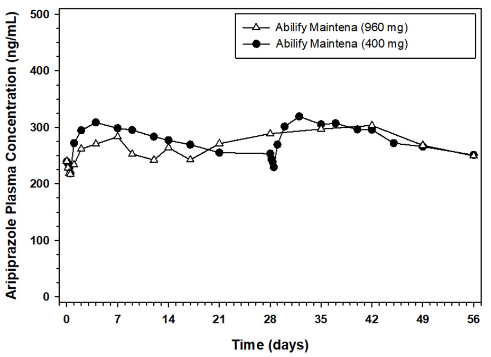
Abilify Maintena 960 mg/720 mg delivers aripiprazole over a 2-month period, compared to Abilify Maintena 400 mg/300 mg. Abilify Maintena doses of 960 mg and 720 mg, administered in the gluteal muscle, result in aripiprazole total exposure ranges that are encompassed within the exposure range corresponding to 300 mg and 400 mg doses of Abilify Maintena (dosed once a month), respectively. Additionally, mean observed maximum plasma concentrations (Cmax) and plasma concentrations of aripiprazole at the end of the dosing interval were similar for Abilify Maintena 960 mg/720 mg as compared to corresponding doses of Abilify Maintena 400 mg/300 mg (see section 5.1).
The mean aripiprazole plasma concentration compared to the time profiles following the fourth administration of Abilify Maintena 960 mg (n=102) or the seventh and eighth administration of Abilify Maintena 400 mg (n=93) in the gluteal muscle of patients with schizophrenia (and bipolar I disorder) are shown in figure 2.
Figure 2. Mean Aripiprazole plasma concentration vs. time profile following the fourth administration of Abilify Maintena 960 mg or the seventh and eighth administration of Abilify Maintena 400 mg:
Absorption/Distribution
Aripiprazole absorption into the systemic circulation is slow and prolonged following gluteal injection due to low solubility of aripiprazole particles. The release profile of aripiprazole from Abilify Maintena 960 mg/720 mg results in sustained plasma concentrations over 2 months following gluteal injection(s). The release of the active substance after a single 780 mg dose of 2-monthly aripiprazole ready-to-use long-acting-injectable starts Day 1 and lasts for as long as 34 weeks.
Biotransformation
Aripiprazole is extensively metabolised by the liver primarily by three biotransformation pathways: dehydrogenation, hydroxylation, and N-dealkylation. Based on in vitro studies, CYP3A4 and CYP2D6 enzymes are responsible for dehydrogenation and hydroxylation of aripiprazole, and N-dealkylation is catalysed by CYP3A4. Aripiprazole is the predominant medicinal product moiety in systemic circulation. Following administration of multiple doses of Abilify Maintena 960 mg/720 mg, dehydro-aripiprazole, the active metabolite, represents approximately 30% of aripiprazole AUC in plasma.
Elimination
Following a single oral dose of [14C]-labelled aripiprazole, approximately 25% and 55% of the administered radioactivity was recovered in the urine faeces, respectively. Less than 1% of unchanged aripiprazole was excreted in the urine and approximately 18% was recovered unchanged in the faeces.
Pharmacokinetics in special patient groups
No specific studies have been performed with Abilify Maintena in special patient groups.
CYP2D6 poor metabolisers
Based on population pharmacokinetic analysis, the plasma concentrations of aripiprazole is around 2-fold higher in poor metabolisers of CYP2D6 compared with normal CYP2D6 metabolisers. (see section 4.2).
Elderly
After oral administration of aripiprazole, there are no differences in the pharmacokinetics of aripiprazole between healthy elderly and younger adult subjects. Similarly, there was no detectable effect of age in a population pharmacokinetic analysis of aripiprazole in schizophrenia patients.
Gender
After oral administration of aripiprazole, there are no differences in the pharmacokinetics of aripiprazole between healthy male and female subjects. Similarly, there was no clinically relevant effect of gender in a population pharmacokinetic analysis of aripiprazole in clinical trials in patients with schizophrenia.
Smoking
Population pharmacokinetic evaluation of oral aripiprazole has revealed no evidence of clinically relevant effects from smoking on the pharmacokinetics of aripiprazole.
Race
Population pharmacokinetic evaluation showed no evidence of race-related differences on the pharmacokinetics of aripiprazole.
Renal impairment
In a single-dose study with oral administration of aripiprazole, the pharmacokinetic characteristics of aripiprazole and dehydro-aripiprazole were found to be similar in patients with severe renal disease compared to that in young healthy subjects.
Hepatic impairment
A single-dose study with oral administration of aripiprazole to subjects with varying degrees of liver cirrhosis (Child-Pugh Classes A, B, and C) did not reveal a significant effect of hepatic impairment on the pharmacokinetics of aripiprazole and dehydro-aripiprazole, but the study included only 3 patients with Class C liver cirrhosis, which is insufficient to draw conclusions on their metabolic capacity.
5.3. Preclinical safety data
The toxicological profile for aripiprazole administered to experimental animals by intramuscular injection is generally similar to that seen following oral administration at comparable plasma levels. With intramuscular injection, however an inflammatory response was seen at the injection site, and consisted of granulomatous inflammation, foci (deposited active substance), cellular infiltrates, oedema (swelling) and, in monkeys, fibrosis. These effects gradually resolved with discontinuation of dosing.
Non-clinical safety data for orally administered aripiprazole reveal no special hazard for humans based on conventional studies of safety pharmacology, repeated dose toxicity, genotoxicity, carcinogenic potential, toxicity to reproduction and development.
Oral aripiprazole
For oral aripiprazole, toxicologically significant effects were observed only at doses or exposures that were sufficiently in excess of the maximum human dose or exposure, indicating that these effects were limited or of no relevance to clinical use. These included: dose-dependent adrenocortical toxicity in rats after 104 weeks of oral administration at approximately 3- to 10-times the mean steady-state AUC at the maximum recommended human dose and increased adrenocortical carcinomas and combined adrenocortical adenomas/carcinomas in female rats at approximately 10-times the mean steady-state AUC at the maximum recommended human dose. The highest non-tumorigenic exposure in female rats was approximately 7-times the human exposure at the recommended dose.
An additional finding was cholelithiasis as a consequence of precipitation of sulphate conjugates of hydroxy-metabolites of aripiprazole in the bile of monkeys after repeated oral dosing at 25 mg/kg/day to 125 mg/kg/day or approximately 16- to 81-times the maximum recommended human dose based on mg/m².
However, the concentrations of the sulphate conjugates of hydroxy-aripiprazole in human bile at the highest dose proposed, 30 mg per day, were no more than 6% of the bile concentrations found in the monkeys in the 39-week study and are well below (6%) their limits of in vitro solubility.
In repeated dose studies in juvenile rats and dogs, the toxicity profile of aripiprazole was comparable to that observed in adult animals, and there was no evidence of neurotoxicity or adverse events on development.
Based on results of a full range of standard genotoxicity tests, aripiprazole was considered non-genotoxic in humans. Aripiprazole did not impair fertility in reproductive toxicity studies.
Developmental toxicity, including dose-dependent delayed foetal ossification and possible teratogenic effects, were observed in rats at doses resulting in sub-therapeutic exposures (based on AUC) and in rabbits at doses resulting in exposures approximately 3- and 11-times the mean steady-state AUC at the maximum recommended clinical dose. Maternal toxicity occurred at doses similar to those eliciting developmental toxicity.
© All content on this website, including data entry, data processing, decision support tools, "RxReasoner" logo and graphics, is the intellectual property of RxReasoner and is protected by copyright laws. Unauthorized reproduction or distribution of any part of this content without explicit written permission from RxReasoner is strictly prohibited. Any third-party content used on this site is acknowledged and utilized under fair use principles.