LISRAYA Film-coated tablet Ref.[116910] Active ingredients: Brepocitinib
Source: FDA, National Drug Code (US) Revision Year: 2026
12.1. Mechanism of Action
Brepocitinib is a Janus kinase (JAK) and tyrosine kinase 2 (TYK2) inhibitor. In a cell-free isolated enzyme assay, brepocitinib had greater inhibitory potency at TYK2 and JAK1 than JAK2 (≥3.4-fold) and JAK3 (≥286-fold). The JAK family comprises cytoplasmic tyrosine kinases that mediate signal transduction of cytokine receptors to influence immune cell function. Within the signaling pathway, JAKs phosphorylate and activate signal transducers and activators of transcription (STATs) which modulate intracellular activity including gene expression.
JAKs mediate cytokine signaling through hetero- or homodimeric pairing. In human cellular assays, brepocitinib inhibited signaling of TYK2- and JAK1-mediated cytokine-induced STAT phosphorylation, including signaling of TYK2/JAK1, TYK2/JAK2, JAK1/JAK3, and TYK2/JAK1/JAK2. The relevance of inhibition of specific JAK combinations to therapeutic effectiveness is not known.
12.2. Pharmacodynamics
Inhibition of Type I IFN and IL-6 induced STAT1 and STAT3 phosphorylation
In peripheral blood mononuclear cells isolated from dermatomyositis patients, brepocitinib resulted in concentration-dependent inhibition of Type I IFN induced and IL-6 induced phosphorylation of STAT1 and STAT3.
Inhibition of IFNγ, IL-10, IL-12, IL-13, and IL-23 induced STAT phosphorylation
In whole blood from healthy donors, brepocitinib resulted in concentration-dependent inhibition of IFNγ, IL-10, IL-12, IL-13, and IL-23 induced STAT1, STAT3, STAT4, STAT6, and STAT3 phosphorylation, respectively.
Gene Expression
After administration of LISRAYA 30 mg once daily to patients with dermatomyositis, expression of genes associated with Type I signaling were reduced by Week 12 and sustained through Week 52 in whole blood. The clinical relevance is unclear.
Cardiac Electrophysiology
LISRAYA caused concentration-dependent QTc interval prolongation with a supratherapeutic dose of 200 mg (6.67 times the approved recommended dose). At the maximum recommended LISRAYA oral dose of 30 mg once daily, clinically significant QTc interval prolongation is not expected.
12.3. Pharmacokinetics
Absorption
Following oral administration of LISRAYA, the median Tmax of brepocitinib is 1 hour. The absolute oral bioavailability of LISRAYA is approximately 75%.
Effect of Food
Coadministration of LISRAYA with a high-fat meal (approximately 50% fat and 800-1000 calories) resulted in 18% decrease in AUC and 36% decrease in Cmax [see Dosage and Administration (2.2)].
Distribution
Brepocitinib is 39% bound to plasma proteins. The blood to plasma partition ratio is 0.84.
Elimination
Metabolism
Brepocitinib is primarily cleared by metabolism, which is mediated mainly by cytochrome P450 (CYP)1A1 and CYP1A2 with minor contribution from CYP3A4. The pharmacologic activity of brepocitinib is attributed to the parent molecule. In a human radiolabeled study, unchanged brepocitinib and the major inactive metabolite M1 accounted for 48% and 37% of the total circulating radioactivity in plasma, respectively.
Excretion
Following oral administration of radiolabeled brepocitinib in healthy subjects, 88% (7.7% as unchanged and 51% as M1) and 8.7% (0.8% as unchanged and 0.7% as M1) of the total radioactivity was recovered in urine and feces, respectively. Brepocitinib mean terminal half-life ranged from 5.4 to 12 hours.
Specific Populations
Body Weight, Sex, Age, and Race
Based on population PK analysis, body weight (39-204 kg), sex, age (18-77 years) and race (White, Black, Asian, Native American, Pacific Islander, Other Race) did not have a clinically meaningful effect on brepocitinib exposure in adult patient populations.
Patients with Renal Impairment
Following a single oral administration of LISRAYA 30 mg, brepocitinib AUC was 29% lower, 48% higher, and 12% higher in subjects with mild (eGFR: 60 to 89 mL/min, based on Modification of Diet in Renal Disease formula), moderate (eGFR: 30 to 59 mL/min), and severe (eGFR: 15 to 29 mL/min) renal impairment, respectively. Cmax was 5% lower, 24% higher, and 10% higher in subjects with mild, moderate, and severe renal impairment, respectively, compared to subjects with normal renal function. Brepocitinib metabolite M1 AUC was 45% higher, 129% higher, and 346% higher in subjects with mild, moderate, and severe renal impairment, respectively. Cmax was 33% higher, 22% higher, and 78% higher in subjects with mild, moderate, and severe renal impairment, respectively, compared to subjects with normal renal function [see Use in Specific Populations (8.6)].
Patients with Hepatic Impairment
Following a single oral administration of LISRAYA 30 mg, brepocitinib AUC and Cmax was 19% higher and 27% lower, respectively, in subjects with moderate hepatic impairment (Child-Pugh B) compared to subjects with normal hepatic function. Brepocitinib metabolite M1 AUC and Cmax was 19% higher and 19% lower, respectively, in subjects with moderate hepatic impairment compared to subjects with normal hepatic function. LISRAYA was not evaluated in patients with severe hepatic impairment (Child-Pugh C) [see Use in Specific Populations (8.7)].
Drug Interaction Studies
Effects of Other Drugs on Pharmacokinetics of Brepocitinib
Smoking causes induction of CYP1A1 and CYP1A2 levels. Following the administration of LISRAYA 30 mg once daily, brepocitinib AUC and Cmax at steady state was estimated to be 45% and 33% lower, respectively, in current smokers compared to non-current smokers.
There was no clinically significant effect on the pharmacokinetics of brepocitinib when co-administered with multiple doses of itraconazole 200 mg once daily (CYP3A/P-gp inhibitor).
Effects of Brepocitinib on Pharmacokinetics of Other Drugs
Multiple doses of LISRAYA 60 mg once daily (2 times the approved recommended dosage) did not have a clinically significant effect on the PK of a combined oral contraceptive containing ethinylestradiol and levonorgestrel.
In vitro studies indicate that brepocitinib does not inhibit the activity of enzymes CYP1A2, CYP2B6, CYP2C8, CYP2C9, CYP2C19, CYP2D6, and CYP3A4/5, or human sulfotransferase enzymes or uridine 5'-diphospho-glucuronosyltransferases at clinically relevant concentrations.
In vitro studies indicate that brepocitinib does not induce CYP3A4, CYP2B6 or CYP1A2 at clinically relevant concentrations.
In vitro studies indicate that brepocitinib does not inhibit the transporters OATP1B1, OATP1B3, OAT1, OAT3, or BSEP. Brepocitinib inhibits OCT1, OCT2, MATE1, MATE2K, P-gp, and BCRP. The observed serum creatinine increase in clinical studies with brepocitinib is likely due to inhibition of tubular secretion of creatinine via OCT2, MATE1, and MATE2-K. The effect of brepocitinib on P-gp and BCRP has not been studied.
13.1. Carcinogenesis, Mutagenesis, Impairment of Fertility
Carcinogenesis
The carcinogenic potential of brepocitinib was evaluated in Wistar Han rats and Tg.rasH2 mice. No evidence of tumorigenicity was observed in mice administered brepocitinib orally up to 150 mg/kg/day. In male rats that received brepocitinib for 104 weeks at oral doses of 30 mg/kg/day (approximately 33 times the MRHD), brepocitinib caused benign Leydig cell tumors. The relevance of this finding to humans is not known. No evidence of tumorigenicity was observed in male or female rats that received brepocitinib for 104 weeks at oral doses up to 10 mg/kg/day or 30 mg/kg/day, respectively (approximately 10 or 33 times the MRHD).
Mutagenesis
Brepocitinib was negative for mutagenesis in the in vitro microbial reverse mutation assay (Ames assay). Brepocitinib was negative for mutagenesis in the in vivo micronucleus assay within rat peripheral blood cells.
Impairment of Fertility
In male rats, brepocitinib had no effect on fertility at oral doses up to 55 mg/kg/day (approximately 54 times the MRHD).
In female rats, brepocitinib reduced fertility at an oral dose of 10 mg/kg/day (approximately 10 times the MRHD) based upon higher early resorptions, higher post-implantation loss and a lower number of live embryos compared to control females. Additionally, maintenance of pregnancy was adversely affected at 55 mg/kg/day (approximately 50 times the MRHD) based upon findings of significantly lower corpora lutea and implantation sites and all pregnant females having total litter loss due to higher pre- and post-implantation loss. Brepocitinib had no effect on female fertility at 3 mg/kg/day (approximately 2 times the MRHD).
14. Clinical Studies
The efficacy of LISRAYA in the treatment of dermatomyositis in adults was assessed in a Phase 3 randomized, double-blind, multicenter, placebo-controlled trial in 241 adult patients with dermatomyositis (Trial DM; NCT05437263). Patients were randomized 1:1:1 to receive oral LISRAYA 30 mg once daily, brepocitinib 15 mg once daily (unapproved dosage), or placebo once daily for a 52-week double-blind treatment period. Enrolled patients were permitted to receive standard background therapies for dermatomyositis.
Patient demographics and disease characteristics were generally balanced across treatment arms. The study population was primarily female (78%) and White (72%), with a mean age of 51 years. At baseline, 65% of patients had at least one cardiovascular risk factor or history of atherosclerotic cardiovascular disease and 20% had interstitial lung disease. The majority of patients had active skin disease at baseline, with other baseline disease activity including a mean Physician Global Assessment score of 5.4, a mean Patient Global Assessment score of 6.0, a mean Manual Muscle Test-8 score of 122.6, and most abnormal muscle enzymes being lactate dehydrogenase (40%) and creatine kinase (36%); additionally, baseline dermatomyositis therapies included oral corticosteroids (76%), non-steroid immunosuppressive therapy (72%), and anti-malarials (27%). Patients were permitted to continue these therapies at a stable dosage throughout Trial DM.
Primary Efficacy Endpoint
In Trial DM, the primary endpoint was the mean Total Improvement Score (TIS) at Week 52. The TIS is a composite myositis improvement index reflecting changes in six core set measures (CSMs): Physician Global Assessment (PhGA), Patient Global Assessment (PtGA), Manual Muscle Testing of 8 Muscles (MMT-8), Extramuscular Global Assessment (EMGA), Health Assessment Questionnaire - Disability Index (HAQ-DI), and muscle enzymes (including aldolase, creatine kinase, alanine aminotransferase, aspartate aminotransferase, and lactate dehydrogenase). TIS values range from 0 to 100 with higher scores representing greater improvement.
Clinical Response
The LISRAYA group achieved a higher mean TIS at Week 52 compared to the placebo group, as shown in Table 3. Treatment with LISRAYA resulted in a higher proportion of patients who achieved a Major Improvement (TIS ≥ 60) at Week 52 compared to treatment with placebo (Table 3).
Table 3. TIS and TIS Responder Rates (% of Patients) at Week 52 in Adult Patients with Dermatomyositis in Trial DM:
| Placebo N=79 | LISRAYA N=81 | Difference vs. Placebo (95% CI) | |
| LS Mean TIS (SE) (Primary Efficacy Endpoint) | 33.3 (3.7) | 47.5 (3.4) | 14.2 (5.5, 22.9) |
| TIS ≥ 20 | 63% | 82% | 19% (4.9, 33) |
| TIS ≥ 40 | 47% | 69% | 20% (5.1, 35) |
| TIS ≥ 60 | 26% | 48% | 22% (6.7, 37) |
Abbreviations: LS: least squares; SE: standard error; CI: confidence interval
LS mean TIS, difference and 95% CI based on an analysis of covariance model adjusted for stratification factors.
Response rate (risk) differences calculated using the Cochran-Mantel-Haenszel method adjusted for stratification factors.
The results for the Core Set Measures are presented in Table 4.
Table 4. Mean Change from Baseline in Core Set Measures (LS Means) at Week 52 in the Adult Patients with Dermatomyositis in Trial DM:
| Measure (score range) | Placebo N=79 | LISRAYA N=81 | Difference vs. Placebo (95% CI) |
| PhGA (0 to 10) | -0.9 | -2.6 | -1.6 (-2.8, -0.5) |
| PtGA (0 to 10) | -0.6 | -2.5 | -1.9 (-2.9, -0.9) |
| EMGA (0 to 10) | -0.2 | -1.8 | -1.6 (-2.8, -0.4) |
| MMT-8 (0 to 150) | 5.9 | 12.3 | 6.4 (0.5, 12.3) |
| HAQ-DI (0 to 3) | 0.3 | -0.3 | -0.6 (-0.9, -0.3) |
| Most abnormal muscle enzymea | 36.8% | 16.9% | -19.9% (-46.9%, 7.1%) |
Abbreviations: LS: least squares; CI: confidence interval (LS means, difference and 95% CI based on an analysis of covariance model adjusting for stratification factors); PhGA: Physician Global Assessment; PtGA: Patient Global Assessment; EMGA: Extramuscular Global Assessment; MMT-8: Manual Muscle Testing of 8 Muscles; HAQ-DI: Health Assessment Questionnaire - Disability Index.
a Percent change from baseline for the most abnormal muscle enzymes including aldolase, creatine kinase, alanine aminotransferase, aspartate aminotransferase, and lactate dehydrogenase.
For all the individual measures except MMT-8, lower values represent improvement. For MMT-8, lower values represent worsening.
Figure 1 shows the mean TIS score through the 52-week double-blind treatment period.
Figure 1. TIS by Visit Through Week 52 in Adult Patients with Dermatomyositis in Trial DM:
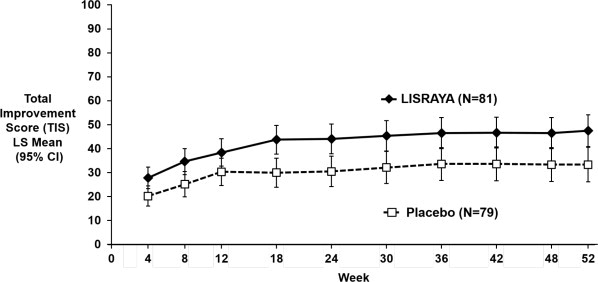
Abbreviations: LS: least squares; CI: confidence interval
Effect on Cutaneous Disease
In Trial DM, treatment with LISRAYA resulted in an improvement in skin disease activity, driven primarily by reductions in erythema.
Effect on Concomitant Corticosteroid Treatment
At baseline, 76% of patients received oral corticosteroids, with a mean dose of 11.4 mg/day of prednisone or equivalent in Trial DM. The proportion of patients who achieved TIS ≥40 with minimal-to-no corticosteroids (≤2.5 mg/day) at Week 52 in the LISRAYA and placebo groups was 55% and 30%, respectively, with a difference of 23.3% (95% CI: 8.3%, 38.2%).
Among patients who received ≥7.5 mg/day of corticosteroids at baseline, the proportion of patients who used a corticosteroid dose ≤2.5 mg/day at both Week 48 and Week 52 was 62% in the LISRAYA group and 38% in the placebo group, while the proportion of patients with no corticosteroid use (0 mg/day) at both Week 48 and Week 52 was 45% in the LISRAYA group and 29% in the placebo group.
Physical Function Response
In Trial DM, the LISRAYA group showed a higher observed improvement in physical function compared to the placebo group as assessed by HAQ-DI at Week 52.
© All content on this website, including data entry, data processing, decision support tools, "RxReasoner" logo and graphics, is the intellectual property of RxReasoner and is protected by copyright laws. Unauthorized reproduction or distribution of any part of this content without explicit written permission from RxReasoner is strictly prohibited. Any third-party content used on this site is acknowledged and utilized under fair use principles.