Levodopa and Carbidopa
Mechanism of action
Levodopa is a precursor of dopamine, and is given as replacement therapy in Parkinson's disease.
Carbidopa is a peripheral dopa decarboxylase inhibitor. It prevents metabolism of levodopa to dopamine in the peripheral circulation, ensuring that a higher proportion of the dose reaches the brain, where dopamine acts. A lower dose of levodopa can be used, reducing the incidence and severity of side-effects.
Pharmacodynamic properties
Levodopa/carbidopa combination is useful in relieving many of the symptoms of parkinsonism, particularly rigidity and bradykinesia. It is frequently helpful in the management of tremor, dysphagia, sialorrhoea, and postural instability associated with Parkinson's disease and syndrome.
When response to levodopa alone is irregular, and signs and symptoms of Parkinson's disease are not controlled evenly throughout the day, substitution of levodopa/carbidopa usually reduces fluctuations in response. By reducing some of the adverse reactions produced by levodopa alone, levodopa/carbidopa permits more patients to obtain adequate relief from the symptoms of Parkinson's disease.
Levodopa/carbidopa subcutaneous and continuous intestinal administration were shown to have comparable levodopa Cmax, AUC, and degree of fluctuation, which supports a comparable efficacy profile. By achieving same concentrations of levodopa as intestinal gel, solution for infusion reduces the motor fluctuations and increases the "On"-time in levodopa-responsive patients with advanced Parkinson's disease. The motor fluctuations and hyperkinesia or dyskinesia are reduced because the plasma concentrations of levodopa are being kept at a steady level within the individual therapeutic window. Therapeutic effect on motor symptoms ("On" state) is achieved on the first treatment day.
Pharmacokinetic properties
Oral administration
Following oral dosing levodopa, in the absence of decarboxylase inhibitor, is rapidly but variably absorbed from the gastrointestinal tract. It has a plasma half-life of about 1 hour and is mainly converted by decarboxylation to dopamine, a proportion of which is converted to noradrenaline. Up to 30% is converted to 3-O-methyldopa which has a half-life of 9 to 22 hours. About 80% of levodopa is excreted in the urine within 24 hours mainly as homovanillic acid and dihydroxyphenylactic acid. Less than 1% is excreted unchanged.
Once in the circulation it competes with other neutral amino acids for transport across the blood brain barrier. Once it has entered the striatal neurones it is decarboxylated to dopamine, stored and released from presynaptic neurones. Because levodopa is so rapidly decarboxylated in the gastrointestinal tract and the liver, very little unchanged drug is available for transport into the brain. The peripheral decarboxylation reduces the therapeutic effectiveness of levodopa but is responsible for many of its side effects. For this reason levodopa is usually administered together with a peripheral decarboxylase inhibitor such as carbidopa, so that lower doses may be given to achieve the same therapeutic effect.
Carbidopa in the absence of levodopa, is rapidly but incompletely absorbed from the gastrointestinal tract following oral dosing. Following an oral dose approximately 50% is recorded in the urine with about 3% of this as unchanged drug. It does not cross the blood brain barrier but crosses the placenta and is excreted in breast milk. Turnover of the drug is rapid and virtually all unchanged drug appears in the urine within 7 hours.
Carbidopa inhibits the peripheral decarboxylation of levodopa to dopamine but as it does not cross the blood brain barrier, effective brain levels of dopamine get produced with lower levels of levodopa therapy reducing the peripheral side effects noticeably nausea and vomiting and cardiac arrhythmias.
Subcutaneous administration
Absorption
Levodopa/carbidopa solution for infusion is administered directly into the subcutaneous space and is quickly absorbed and converted to levodopa and carbidopa. In a phase 1 study in healthy volunteers, levodopa and carbidopa were detectable in plasma within 30 minutes at the first pharmacokinetic collection point. In most subjects the steady state was achieved within 2 hours when levodopa/carbidopa solution for infusion dosing was delivered as loading dose followed by continuous infusion.
In order to determine absorption of levodopa/carbidopa solution for infusion at different subcutaneous sites, healthy volunteers were administered levodopa/carbidopa solution for infusion to the abdomen, arm and thigh using a 3-way crossover design. Pharmacokinetic analysis from this study showed that the 3 sites have nearly identical levodopa and carbidopa exposure suggesting levodopa/carbidopa solution for infusion absorption is similar at the different subcutaneous sites. Levodopa/carbidopa solution for infusion bypasses the gut, so food does not change absorption or exposure of levodopa/carbidopa.
Distribution
The volume of distribution of levodopa is moderately small. The partitioning ratio for levodopa between erythrocytes and plasma is approximately 1. Levodopa has negligible binding to plasma proteins (< 10%). Levodopa is transported into the brain by the carrier mechanism for large neutral amino acids.
Carbidopa is approximately 36% bound to plasma protein. Carbidopa does not cross the blood-brain barrier.
Both foslevodopa and foscarbidopa have low binding to plasma proteins (24%-26%).
Biotransformation and elimination
Foslevodopa and foscarbidopa prodrugs are rapidly converted by alkaline phosphatases into levodopa and carbidopa. Levodopa is mainly metabolised by the aromatic amino acid decarboxylase (AAAD) and the COMT enzymes. Other routes of metabolism are transamination and oxidation. The decarboxylation of levodopa to dopamine by AAAD is the major enzymatic pathway when no enzyme inhibitor is co-administered. O-methylation of levodopa by COMT forms 3-O-methyldopa. When administered with carbidopa, the elimination half-life of levodopa is approximately 1.5 hours.
Carbidopa is metabolised to two main metabolites (α-methyl-3-methoxy-4-hydroxyphenylpropionic acid and α-methyl-3,4-dihydroxyphenylpropionic acid). These 2 metabolites are primarily eliminated in the urine unchanged or as glucuronide conjugates. Unchanged carbidopa accounts for 30% of the total urinary excretion. The elimination half-life of carbidopa is approximately 2 hours.
Special Populations
Levodopa/carbidopa solution for infusion is intended for use in Parkinson's disease patients who are already on a stable dose of oral levodopa and subcutaneous dose is optimised once patients begin therapy.
Elderly
The impact of age on the levodopa pharmacokinetics following levodopa/carbidopa infusion was not specifically evaluated. Studies with levodopa suggest a modest reduction of levodopa clearance with increasing age.
Renal or hepatic impairment
The pharmacokinetics of levodopa/carbidopa solution for infusion in subjects with renal and/or hepatic impairment has not been established.
The anticipated daily phosphorus load from the highest proposed clinical dose of foslevodopa/foscarbidopa (6000/300 mg/day of foslevodopa/foscarbidopa) is approximately 700 mg, which is considerably less than the United States National Academy of Sciences dietary reference intake upper limit of 3000 mg/day; however, there are no pharmacokinetic or safety data with levodopa/carbidopa solution for infusion in patients with End Stage Renal Disease requiring dialysis. Therefore, caution should be exercised in patients with End Stage Renal Disease on dialysis requiring treatment with levodopa/carbidopa solution for infusion because of diminished ability of the kidneys to eliminate phosphate.
Body weight
The impact of body weight on the levodopa pharmacokinetics following levodopa/carbidopa infusion was not specifically evaluated. Previous studies of levodopa have shown that weight increases volume of distribution and can lower levodopa exposure.
Gender or race
Following levodopa/carbidopa subcutaneous administration, carbidopa and levodopa exposures in both Japanese subjects and Han Chinese subjects were comparable to those in Caucasian subjects.
The impact of gender on the pharmacokinetics following levodopa/carbidopa infusion was not specifically evaluated. The effect of gender on the pharmacokinetics of levodopa has been evaluated and studies suggested there is no clinically meaningful gender related difference in levodopa exposure. Following levodopa/carbidopa infusion dosing, levodopa exposure was higher in females once weight was considered by approximately 18% based on AUC.
Continuous intestinal administration
Absorption
Levodopa/carbidopa intestinal gel is administered via an inserted tube directly into the duodenum or jejunum. Levodopa is absorbed quickly and effectively from the intestine through a high capacity transport system for amino acids. The absolute bioavailability of levodopa from oral levodopa/carbidopa immediate release tablets is reported to be 84-99%. A cross-study population pharmacokinetic analysis suggested that levodopa/carbidopa intestinal gel has comparable levodopa bioavailability to the oral levodopa/carbidopa (100/25 mg) tablets.
In a Phase 1 study, intrajejunal administration of levodopa/carbidopa intestinal gel rapidly achieved therapeutic plasma levels of levodopa and maintained consistent levodopa levels over the course of infusion. Following termination of infusion, levodopa levels declined rapidly (Figure 1). The intra-subject variability in levodopa plasma concentrations starting from hour 2 to hour 16 following initiation of infusion was low (13%).
Figure 1. Plasma Concentrations (mean ± standard deviation) versus Time Profile of Levodopa with Levodopa/carbidopa Intestinal Gel 16-Hour Infusion:
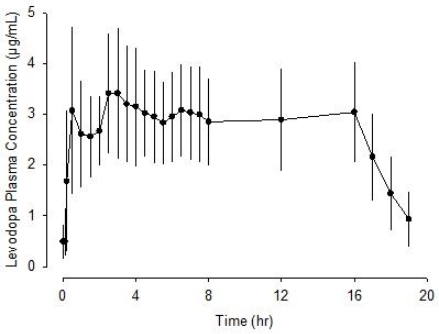
In a levodopa/carbidopa double-blind, active-controlled, Phase 3 Study, the intra-subject variability in levodopa plasma concentrations was lower for patients treated with levodopa/carbidopa intestinal gel (21%) than in patients treated with oral levodopa/carbidopa 100/25 mg over-encapsulated tablets (67%).
Distribution
Levodopa is co-administered with carbidopa, a decarboxylase inhibitor, which increases the bioavailability and decreases clearance for levodopa. Clearance and volume of distribution for levodopa is 0.3 l/hour/kg and 0.9-1.6 l/kg, respectively, when given together with a decarboxylase inhibitor. The partitioning ratio for levodopa between erythrocytes and plasma is approximately 1. The protein binding of levodopa in plasma is negligible (about 10%-30%). Levodopa is transported into the brain by the carrier mechanism for large neutral amino acids.
Carbidopa is approximately 36% bound to plasma protein. Carbidopa does not cross the blood-brain barrier.
Biotransformation and elimination
When administered with carbidopa, the elimination half-life for levodopa is approximately 1.5 hours. Levodopa is eliminated completely through metabolism and the metabolites formed are excreted mainly in the urine. Four metabolic pathways are known, but levodopa is mainly eliminated via metabolism by the aromatic amino acid decarboxylase (AAAD) and the catechol-O-methyl-transferase (COMT) enzymes. Other routes of metabolism are transamination and oxidation. The decarboxylation of levodopa to dopamine by AAAD is the major enzymatic pathway when no enzyme inhibitor is co-administered. When levodopa is co-administered with carbidopa, the decarboxylase enzyme is inhibited, so that metabolism via catechol-O-methyl-transferase (COMT) becomes the dominant metabolic pathway. O-methylation of levodopa by COMT forms 3-O-methyldopa.
Carbidopa is metabolized to two main metabolites (α-methyl-3-methoxy-4-hydroxyphenylpropionic acid and α-methyl-3,4-dihydroxyphenylpropionic acid). These 2 metabolites are primarily eliminated in the urine unchanged or as glucuronide conjugates. Unchanged carbidopa accounts for 30% of the total urinary excretion. The elimination half-life of carbidopa is approximately 2 hours.
Pharmacokinetic-pharmacodynamic relationship
The reduced fluctuations in the plasma concentration of levodopa reduce fluctuations in the treatment response. The levodopa dose needed varies considerably in advanced Parkinson's disease and it is important that the dose is individually adjusted based on the clinical response. Development of tolerance over time has not been observed with levodopa/carbidopa intestinal gel.
Preclinical safety data
Levodopa/carbidopa combination is well established in medical use. Preclinical data is broadly consistent with clinical experience.
Non-clinical data reveal no special hazard for humans based on conventional studies of safety pharmacology, repeated dose toxicity, genotoxicity, and carcinogenic potential. In reproductive toxicity studies, both levodopa and the combination of levodopa/carbidopa have caused visceral and skeletal malformations in rabbits.
Hydrazine is a degradation product of foscarbidopa. In animal studies, hydrazine showed notable systemic toxicity, particularly by inhalation exposure. These studies reported that hydrazine is hepatotoxic, has CNS toxicities (although not described after oral treatment), and is genotoxic as well as carcinogenic.
Related medicines
© All content on this website, including data entry, data processing, decision support tools, "RxReasoner" logo and graphics, is the intellectual property of RxReasoner and is protected by copyright laws. Unauthorized reproduction or distribution of any part of this content without explicit written permission from RxReasoner is strictly prohibited. Any third-party content used on this site is acknowledged and utilized under fair use principles.